


Search for a red light panel and you will find the phrase “FDA approved” on listings, in ad copy, and in reviews. For this category of device, that phrase is almost always wrong, and the difference between it and what is actually true matters.
This guide explains the regulatory terms, what a cleared device is really cleared for, and how to check a claim yourself in about two minutes.
This article is informational and is neither medical nor legal advice. Please read our Medical Disclaimer before acting on anything here.
Clearance and approval are different pathways
The FDA regulates medical devices in classes according to risk, and different classes reach the market by different routes.
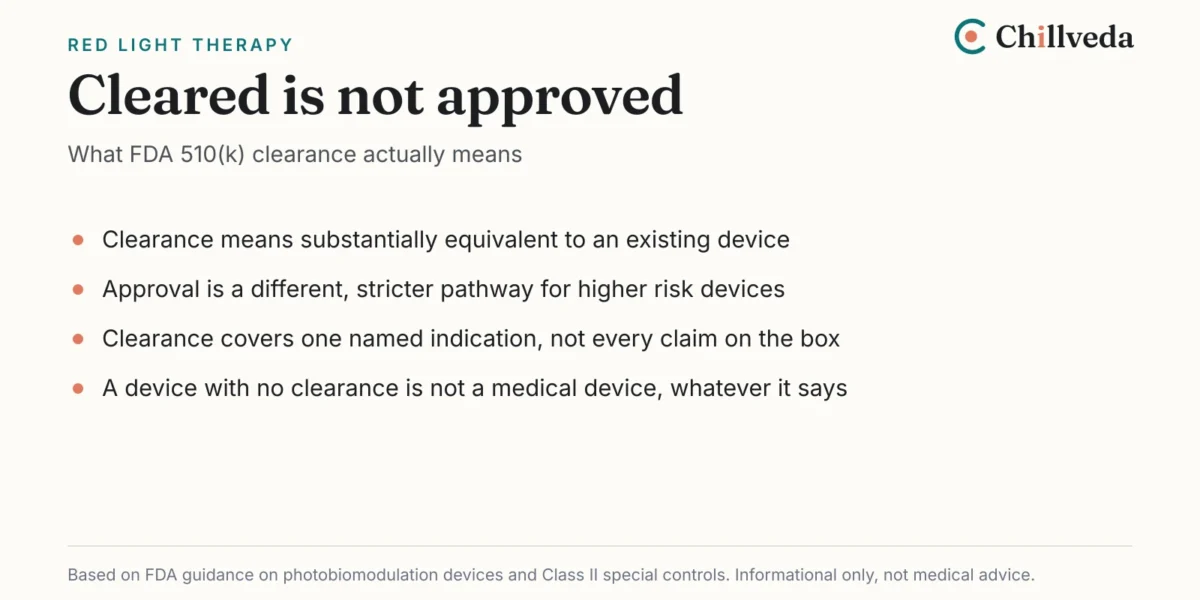
510(k) clearance is the premarket notification route. A manufacturer demonstrates that its device is substantially equivalent to a device already legally on the market, known as a predicate. The agency reviews that comparison and, if satisfied, clears the device. Low level light therapy and photobiomodulation devices generally sit in Class II and take this route.
Premarket approval is the stricter pathway, used for higher risk devices, and it requires the manufacturer to demonstrate safety and effectiveness rather than equivalence to something else.
So when a consumer red light device has been through the process at all, it has almost certainly been cleared, not approved. Writing “FDA approved” on that device is not a small wording slip. It describes a different, more demanding process the product did not go through.
Cleared for what, exactly
This is the part that gets skipped even by brands that use the right word.
A clearance is granted for a specific, named indication. A device cleared for the temporary relief of minor muscle and joint pain has been cleared for that. It has not been cleared for anything else the marketing mentions, and clearance for one indication says nothing about any other claim on the box.
So the question to ask is never simply “is it FDA cleared”. It is “cleared for what indication, and is that the thing I am buying it for”.
What a device with no clearance is
Plenty of red light panels on the market have no clearance at all. They are sold as general wellness products rather than medical devices, which is a legitimate category with a lower regulatory bar, provided the seller does not make medical claims.
A panel with no clearance that is advertised as treating a condition is a product whose marketing has outrun its regulatory status. That is a warning sign about the company, not just about the paperwork.
How to check a claim yourself
The FDA publishes a searchable database of 510(k) clearances. Look up the manufacturer or the device name, find the clearance letter, and read the indications for use. It is a public record and it takes a couple of minutes.
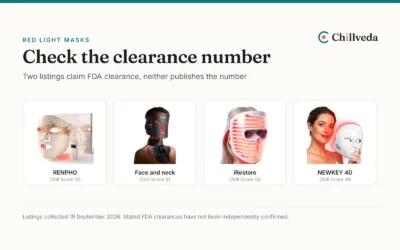
If a brand claims clearance, it should be able to give you the clearance number without hesitation. Ask for it. A company that cannot produce one has told you the answer.
Be aware that a clearance held by a company for one of its products does not extend to every product it sells. Check that the number corresponds to the device you are actually buying.
Why this matters beyond pedantry
For you, it is the difference between a device reviewed for a specific medical use and one that has been through no review at all. Those are not the same purchase.
For a brand, misusing these terms is a compliance problem, and the Federal Trade Commission has a long record of acting against health claims that outrun the evidence. A seller willing to be loose about its regulatory status is a seller you should read carefully on everything else.
What Chillveda does with this
We never write that a device is FDA approved. Where a device holds clearance, we say so and we name the indication it was cleared for. Where it does not, we do not imply otherwise, and we do not treat the absence of clearance as proof a product is useless, only as the fact that it is.
Our full approach to regulated devices and health claims is in the Editorial Policy, and How We Review sets out what our process includes and what it does not.
Before you buy
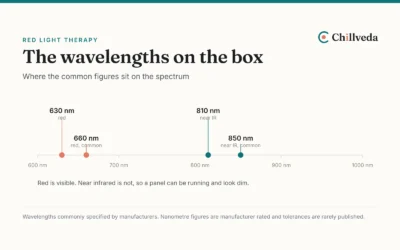
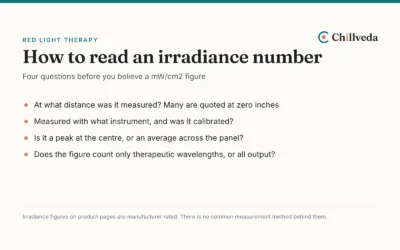
Decide what you want the device for. If that purpose is medical, look for a device cleared for that specific indication, and verify the number. If your purpose is general wellness, then clearance is not the deciding factor, and you should weigh the things covered in our guides to reading an irradiance figure and the wavelengths on the box instead.
Either way, speak to a clinician before using any device to address a health condition, particularly if you are pregnant, take photosensitizing medication, or have an eye condition.
Sources: FDA guidance on photobiomodulation devices and premarket notification, and FDA Class II special controls guidance for low level laser systems.
Write Your Review
No reviews yet. Be the first to share your experience!