


An outdoor sauna is the most expensive thing most people will ever buy for their backyard that is not a vehicle. It is also, on a marketplace, one of the hardest categories to buy safely, because the listings that ask the most money are frequently the ones with the least behind them.
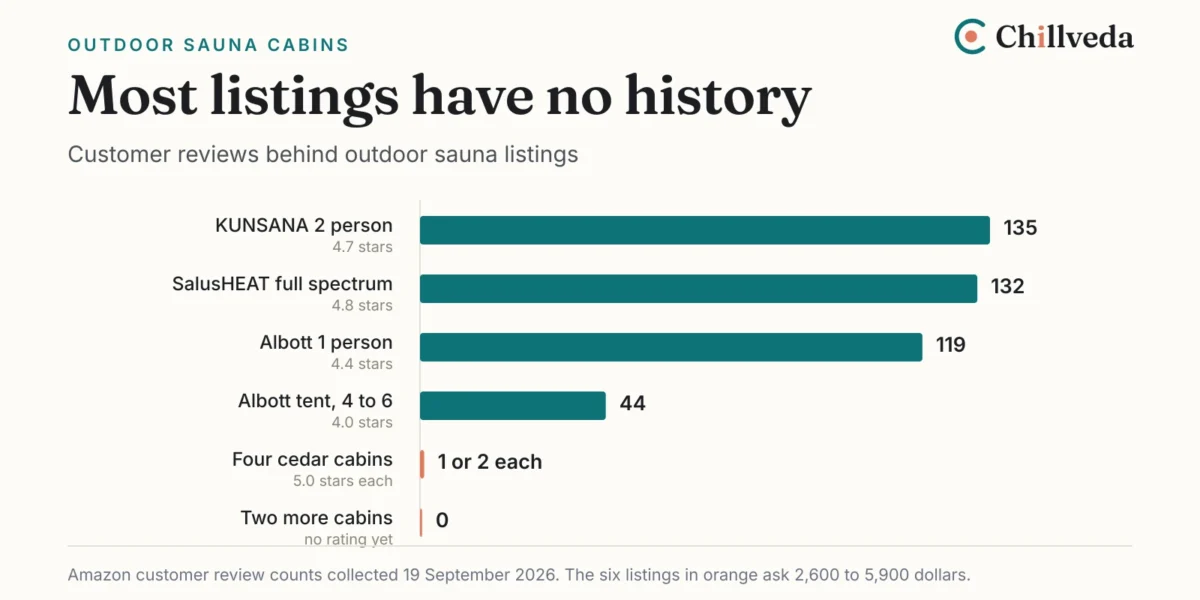
That is the finding of this roundup, and the chart above is the short version of it.
This article is informational and is not medical advice. Heat exposure places real stress on the cardiovascular system. Please read our Medical Disclaimer and speak to a clinician first if you have a heart condition, are pregnant, or take medication affecting blood pressure or thermoregulation.
Our picks


What we left out, and why
We looked at twelve outdoor sauna listings. Six of them have between zero and two customer reviews. Those six ask between roughly two and a half and six thousand dollars, and four of them are described as customizable builds in red cedar or hemlock.
We did not include them. Not because they are necessarily bad, but because there is no evidence either way, and a cabin at that price is not a product you buy on no evidence. If one of them fails to arrive, arrives damaged, or arrives different from the listing, you are several thousand dollars into a dispute with a seller nobody has dealt with yet.
A five star average from one review is not a five star product. It is one review.
Why the scores are low
The Chill Score weighs performance 30, build quality 20, value including running cost 20, safety certifications 15, and warranty and support 15.
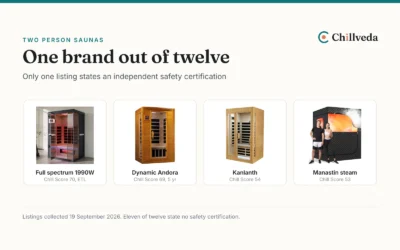
Not one outdoor sauna we reviewed states a UL, ETL or CSA listing. These are structures containing heaters drawing thousands of watts, frequently installed outdoors in the weather, and the category does not mention independent electrical safety assessment at all. Every product loses fifteen points on that alone.
Only the SalusHEAT refers to a warranty, and it does so without stating a term, which earns partial credit rather than full. The other three publish nothing.
That is why the top score here is 59. These are not damning verdicts on the products. They are an accurate picture of how little this category commits to in writing, on purchases running into thousands of dollars.
The four things that decide this purchase
1. Electrical service
This is the question to answer before you look at a single photograph. An infrared cabin of the size in our picks generally runs on a standard supply, but traditional heaters from about 4.5 kW upward need 240V, hard wiring, and a licensed electrician, and outdoor installations need ground fault protection.
For many buyers the electrician’s quote changes the decision entirely. Get it before you order, not after the crate arrives. Our guide to what a 240V cabin actually needs walks through how to check your panel.
2. Delivery, and how it reaches your yard
Cabins ship by freight, not parcel. Ask whether liftgate service is included and where exactly the carrier will leave the crate. The default answer is frequently the kerb or the end of the driveway, and a crated sauna is not something two people move sixty feet on a whim.
Budget for this in time and in help, and confirm it in writing before you buy.
3. Materials and weather
The KUNSANA listing states khaya mahogany construction rated for outdoor use between minus five and 120 degrees Fahrenheit. The Albott one person cabin states an asphalt shingle roof with ridge cover and an integrated waterproof layer. Those are the kind of specifics worth looking for, because a cabin that is not built for your winter will not survive it.
All of these figures are manufacturer rated. None of these listings publish an independent durability assessment.
4. What the marketing is claiming
The SalusHEAT listing pairs its full spectrum heat with 660nm and 850nm red light and describes effects on circulation, collagen and detoxification. We do not repeat those claims. If red light is part of why you are considering it, read our guides to reading an irradiance figure and what FDA clearance actually means first, because a red light feature inside a sauna is advertised with even less specification than a standalone panel.
Cabins, tents, and the gap between them
Two of our picks are not cabins. The Albott four to six person unit is a sauna tent, listed at 8.2 by 8.2 by 6.7 feet in three layer thermal fabric with a wood burning stove.
A tent is a genuinely different proposition: a fraction of the price, no foundation, no electrician, and it packs away. It is also fabric, it will not last like timber, and a wood burning stove brings its own requirements around clearance, ventilation, and carbon monoxide.
We include it because for a lot of people weighing a five thousand dollar cabin, a tent is the honest first step, and finding out whether you will actually use an outdoor sauna is worth doing cheaply.
What it costs to run
An infrared cabin in the one to two person range costs roughly five dollars a month at four sessions a week, using the June 2026 US residential average of 18.34 cents per kWh. A traditional 6 kW heater indoors runs closer to fifteen, and an 8 kW outdoor unit in winter closer to twenty five.
Outdoor units fight the weather, so budget for the winter figure rather than the average. The full arithmetic is in what it costs to run a home sauna.
Who should not buy an outdoor sauna
If you rent, this is not your purchase. A cabin is a permanent structure and it is not coming with you.
If your electrical panel cannot take a new circuit and a service upgrade is not in the budget, size down to something that runs on what you have rather than buying now and hoping to solve the electrics later.
If you have never used a sauna regularly somewhere else, start with a gym membership or a blanket for a season. A surprising number of expensive cabins become garden storage by the second winter.
And if the listing you like has one review and a five thousand dollar price, please buy something else. That is the clearest recommendation in this article.
Safety
Have electrical work done by a licensed electrician and insist on ground fault protection for anything outdoors. Look for a UL, ETL or CSA listing. Wood burning units need correct clearances, a proper flue, and a carbon monoxide alarm.
Beyond the equipment: drink water, keep sessions moderate, never use a sauna after alcohol, leave immediately if you feel unwell, and do not leave children unattended near one.
Common questions
Is an infrared or a traditional outdoor sauna better?
Infrared is usually simpler to power and quicker to warm up. Traditional gives you steam and higher air temperature. The full comparison is in infrared or traditional.
Do I need a foundation?
Most cabins need a level, load bearing base. Gravel, pavers, or a concrete pad are the usual answers, and it is another cost the listing will not mention.
Do I need a permit?
It depends on your locality, the size of the structure, and the electrical work involved. Ask your local authority before you order. An uninspected high current circuit feeding a wet structure is exactly what an insurer asks about after a fire.
How long do these last?
Nobody in this set publishes a figure worth quoting, and the warranty terms are largely unstated. That absence is itself information, and it is why we are not scoring these yet.
Sources: Product specifications and customer review counts are as published on the retailer listings and were collected on 19 September 2026. Dimensions, temperature ratings and material claims are manufacturer rated. Electricity figures use the US Energy Information Administration residential average for June 2026, 18.34 cents per kWh.

Write Your Review
No reviews yet. Be the first to share your experience!