


Full body red light panels are sold on one number: irradiance in milliwatts per square centimetre. It is the least standardised figure in home recovery equipment, and comparing two panels on it is close to meaningless unless both brands state the same measurement conditions, which they almost never do.
So this roundup ranks on the things that can actually be checked: coverage area, wavelengths, mounting, warranty, and whether the brand publishes anything independent at all.
This article is informational and is not medical advice. Please read our Medical Disclaimer, use the eye protection supplied with any device, and speak to a clinician first if you have a photosensitive condition or take medication that increases light sensitivity.
Our picks


Read the irradiance number, then set it aside
Every panel here publishes an irradiance figure. None of them publishes it with a stated measurement distance, instrument and calibration in a form you could reproduce.
Light spreads as it travels, so a reading taken with a sensor pressed against the panel face will be several times higher than one taken at the six or twelve inches where a person actually stands. A number without a distance is not a specification. Our guide to reading an irradiance figure sets out the four questions worth asking a brand.
We label every one of these figures as manufacturer rated, and we do not rank on them.
What we ranked on instead
Coverage
A full body panel that does not cover the part of you that you bought it for is the wrong panel. LED counts here run from 200 upward, and physical panel dimensions matter more than the count, because a dense cluster of diodes in a small area does not cover a torso.
Check the stated panel dimensions against the area you want to treat, and remember you will be standing back from it.
Wavelengths
Most of these combine red around 660nm with near infrared around 850nm, which is what the bulk of the published research used and what the supply chain makes cheaply. Some add 630nm and 810nm, and a couple advertise four or more bands.
More bands is not automatically better. A panel splitting its diodes across six wavelengths may deliver less in the two you care about than a simpler panel that commits. Our guide to the wavelengths on the box explains how to read that.
Warranty
Four of the twelve panels we reviewed publish a warranty term. That is a better rate than most categories on this site, and it separates the picks here. The Hooga HG1000 and the EXESAS both state one, and both score accordingly.
Mounting and noise
These panels are heavy and most ship with a door hook or a stand. Check which, because a panel you cannot position at the right height is a panel you stop using. Larger panels have cooling fans, and fan noise in a small room is a real consideration that no spec sheet quantifies honestly.
On regulatory claims
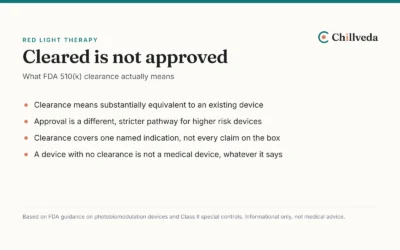
None of our picks states FDA clearance, and none should be assumed to have it. Clearance applies to a specific named indication and is not the same as approval. If a panel you are considering claims either, ask for the clearance number and check it. We explain the difference and how to verify it in cleared is not approved.
You will also see claims about collagen, circulation, inflammation and recovery. We do not repeat them. Research on photobiomodulation exists and is genuinely interesting, and it is also smaller and more limited than the marketing implies. A finding in a study is not a promise about a consumer panel.
Safety, and why it matters more here
Near infrared is invisible, so the blink reflex that normally protects your eyes does not trigger. Do not look into an illuminated array, use the eye protection supplied, and be more careful than instinct suggests precisely because the panel does not look bright.
None of these panels states a UL, ETL or CSA listing, which costs every one of them fifteen points under our scoring. These are mains powered devices with substantial LED arrays and cooling fans, so that absence is worth noticing.
Who should not buy a full body panel
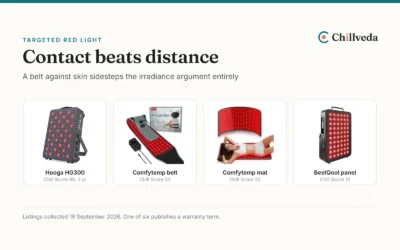
If you want to treat one knee or one shoulder, a full body panel is the wrong purchase and an expensive one. Buy a targeted device instead.
If you have no wall space or door you can dedicate to it, be realistic. These are large objects and the ones that get used are the ones that stay up.
And if you are buying primarily because a product page promised a clinical outcome, read our How We Review page first. We are not going to tell you a panel will do that, and we would rather you spent the money knowing what you are buying.
Common questions
How long is a session?
Manufacturer guidance across these devices generally falls in the ten to twenty minute range per area. Start at the short end.
How far should I stand?
Follow the manual for the specific panel, because the recommended distance is tied to the output the maker assumes. Standing closer is not automatically better and it narrows your coverage.
Why do scores here top out in the sixties?
No panel in this category states a safety certification, so all lose fifteen points, and most publish no warranty. Our How We Review page explains why we score non-disclosure as zero.
Sources: Specifications, warranty statements and customer review counts are as published on the retailer listings and were collected on 19 September 2026. Irradiance, wavelength and LED count figures are manufacturer rated.



Write Your Review
No reviews yet. Be the first to share your experience!