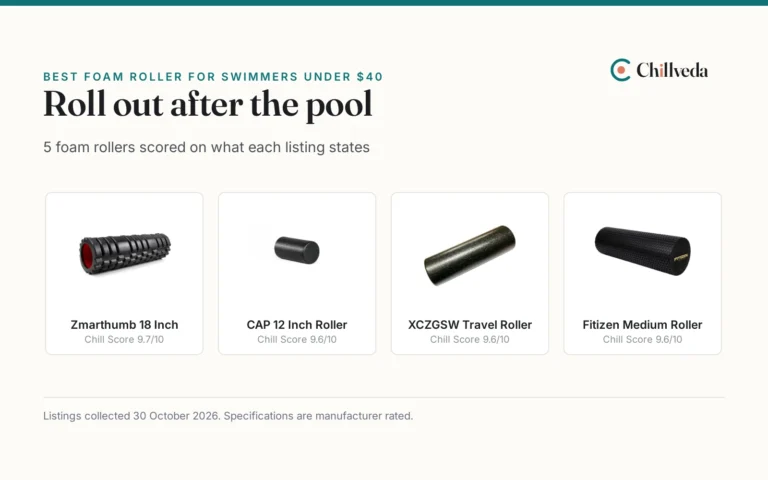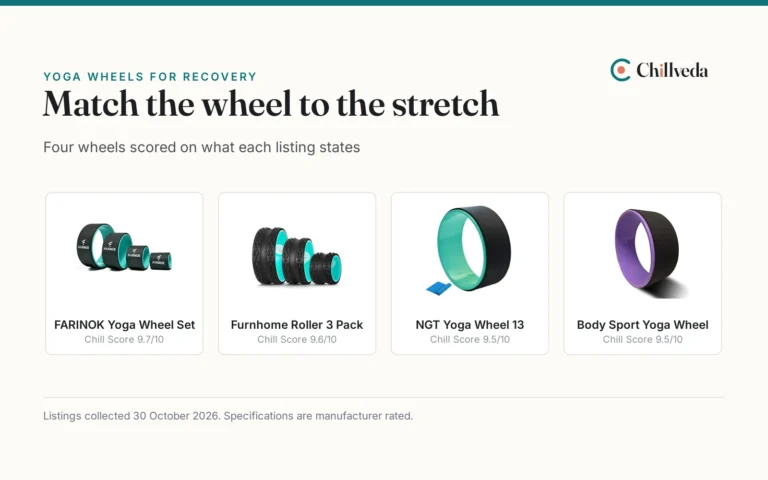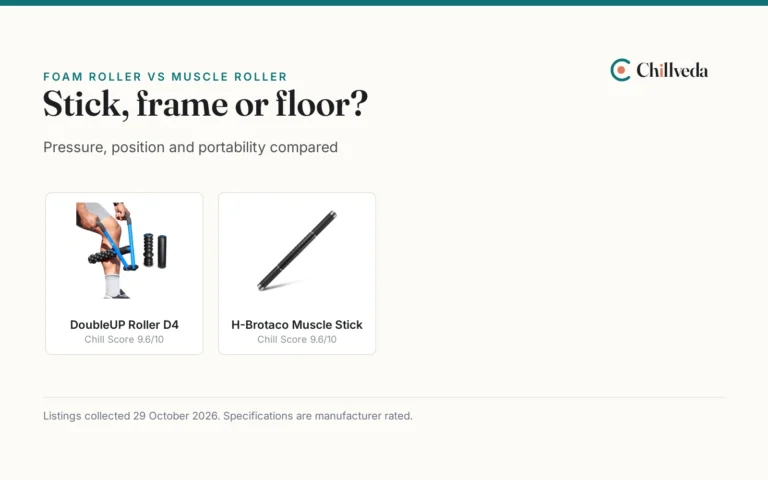
Foam roller density explained comes down to the firmness and compression resistance of the foam material. Low-density rollers feel soft and cushion sensitive tissues, standard medium-density rollers provide balanced firmness for regular post-workout recovery, and high-density rollers offer firm, deep compression with minimal surface deflection under body weight. Choosing between soft and firm depends on your muscle sensitivity, body weight, and whether you need broad surface rolling or targeted trigger point relief.
Chillveda earns a commission when you buy through links on this page, at no extra cost to you. As an Amazon Associate I earn from qualifying purchases. Affiliate disclosure.
Gear in this guide


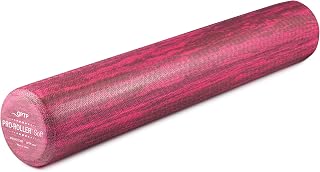
More to compare
 Amazon Basics High Density Foam Roller for Exercise andCheck price on Amazon
 Amazon Basics High-Density Foam Roller for ExerciseCheck price on Amazon
 TRIGGERPOINT Performance Therapy Grid Patented Multi-DensityCheck price on Amazon
 ProsourceFit High-Density Firm Foam RollerCheck price on Amazon
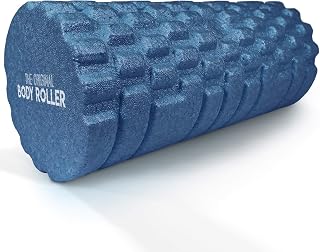 The Original Body RollerCheck price on Amazon
 Maximo Fitness Foam RollerCheck price on Amazon
This guide breaks down foam materials, firmness ratings, how density changes tissue pressure, and 0 targeted recovery tools when a standard roller is too broad for focused relief. Listings were collected 10 October 2026.
This article is informational and is not medical advice. Rolling and scraping apply concentrated pressure to soft tissue. Avoid rolling directly over the neck, spine, major arteries, joints, or acute muscle injuries. Stop at once if you feel sharp pain, numbness, or dizziness. Consult a clinician or physical therapist before starting a new myofascial routine. See our Medical Disclaimer.
Foam roller density explained: density levels and materials
| Density level | Common materials | Firmness feel | Best suited for |
|---|---|---|---|
| Low density (soft) | Polyethylene (PE) or soft EVA | Cushioned surface yield, high flex | Beginners, tender muscles, physical therapy |
| Medium density (standard) | Standard EVA | Moderate firmness with slight surface give | General post-workout recovery, full-body rolling |
| High density (firm) | Expanded polypropylene (EPP) or firm EVA | Rigid structure, minimal surface compression | Deep myofascial compression, dense muscle groups |
Foam roller density is determined by the physical composition and cellular structure of the synthetic foam. Low-density rollers are commonly manufactured from lightly cross-linked polyethylene (PE) or soft ethylene-vinyl acetate (EVA). Under applied body weight, the cellular matrix compresses easily, providing a forgiving surface that protects sensitive tissues. However, lower-density polyethylene softens with repetitive use and can eventually develop permanent flat spots.
Medium-density rollers typically use standard closed-cell ethylene-vinyl acetate (EVA). This material offers a resilient structure that yields moderately under focused pressure while maintaining its cylindrical shape across repeated rolling sessions. High-density models are commonly molded from expanded polypropylene (EPP) beads fused under heat, or high-durometer EVA foam. EPP creates a stiff, durable cylinder with minimal surface deflection under body weight, transferring mechanical force directly into underlying tissue.
Soft vs firm foam roller: how density changes tissue pressure
The difference between a soft vs firm foam roller lies in surface contact area and mechanical force distribution. When you rest your body weight on a softer roller, the foam compresses and conforms to your body contours. This compression increases the total surface area in contact with your skin, spreading your body weight over a broader zone and keeping focal pressure modest.
A firm high-density roller maintains its round contour under load. Because the cylinder does not flatten significantly, the contact patch remains narrow. Applying the same body weight over this smaller contact strip multiplies the localized pressure on the underlying muscle belly. For individuals with acute soreness or sensitive trigger points, see our guide to the best soft foam rollers for forgiving models that cushion pressure.
Core construction and diameter: why firmness ratings vary
External foam density is not the only factor that dictates how firm a roller feels. Core construction plays a major role. Solid foam rollers yield uniformly from the outer skin to the center of the cylinder. Hollow-core rollers, by contrast, wrap a layer of EVA foam around a rigid plastic tube. Even if the outer foam layer is moderately soft, the rigid inner tube prevents deep compression, creating a firmer overall rolling feel.
Roller diameter also modifies the sensation of firmness. A larger diameter cylinder creates a broader curve that disperses weight, whereas a smaller diameter cylinder concentrates body weight across a tighter arc. Understanding whether a roller relies on a solid foam core or a hollow inner pipe helps you evaluate its true firmness beyond the maker’s marketing label.
Choosing the right density in practice
- Start with softer foam before moving to firm. Muscles often tighten defensively against excessive pressure. A softer surface allows relaxation into the pass rather than bracing against it.
- Match density to the target muscle group. Broad muscle groups like the glutes and quadriceps tolerate firmer foam better than sensitive areas like the calves, thoracic spine, or lats.
- Account for floor space and footprint. Large recovery gear requires dedicated floor space.
- Keep passes smooth and controlled. Pause briefly on tender trigger spots rather than rolling aggressively back and forth.
- Inspect foam regularly for permanent sagging. Standard polyethylene foam rollers can develop a bowed center or flat spots over months of heavy use. Once a cylinder loses its circular profile, replace it to maintain even pressure.
Common mistakes
- Assuming firmer foam always produces faster muscle recovery. Excessive firmness often triggers reflexive muscle tightening rather than myofascial release.
- Rolling directly over bony joints, the lumbar spine, or the neck. Foam rollers are designed for broad muscular tissue, not joint structures.
- Confusing surface texture with internal density. A textured roller with soft ridges can feel more forgiving than a completely smooth high-density EPP roller.
- Using a broad cylindrical roller for small, contoured areas like the arches of the feet, where targeted massagers or scraping blades perform better.
Common questions
What is the difference between soft and firm foam roller density?
Soft foam rollers compress easily under body weight, spreading applied force over a wider contact area to protect tender or sensitive tissue. Firm foam rollers resist compression, focusing your body weight onto a narrow strip for deeper myofascial pressure. Beginners usually benefit from starting with softer foam before progressing to rigid rollers.
Which foam material lasts the longest without softening?
Expanded polypropylene (EPP) is known for superior durability and shape retention compared to basic polyethylene (PE). EPP features fused high-density beads that resist permanent indentations and flat spots over extended use. Closed-cell EVA foam also offers reliable longevity with a slightly softer initial surface feel.
Can a foam roller be too firm for recovery?
Yes. If a roller is excessively dense, the resulting discomfort can cause surrounding muscles to contract defensively. That reflexive guarding prevents effective tissue relaxation. If you find yourself holding your breath or tensing up during a roll, switch to a softer density.
When should you choose targeted tools instead of a foam roller?
Foam rollers excel at sweeping across large muscle groups like the hamstrings, quadriceps, and upper back. For contoured, compact zones such as the arch of the foot, shoulder blades, or calves, smaller handheld tools like scrapers, cups, or foot massagers apply localized pressure that broad cylinders cannot match.
Does foam roller density affect IT band rolling?
Rolling directly on the dense, fibrous iliotibial band with an ultra-firm roller often causes acute discomfort with minimal benefit. Many physical therapists recommend using softer or medium-density foam on the attached muscular areas, such as the tensor fasciae latae and gluteus medius, rather than compressing the fibrous band directly.
Sources: Amazon product listings for the recovery tools named above, collected 10 October 2026. Related: our guide on how to use a foam roller and our best textured foam rollers overview.
Back to all foam roller reviews.