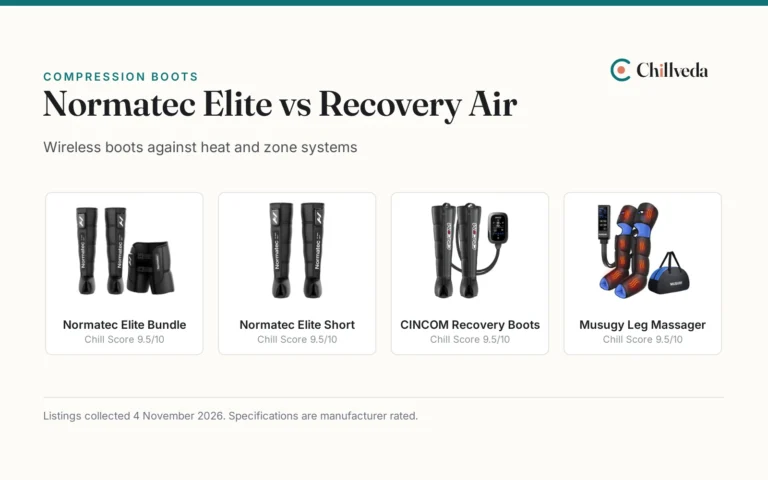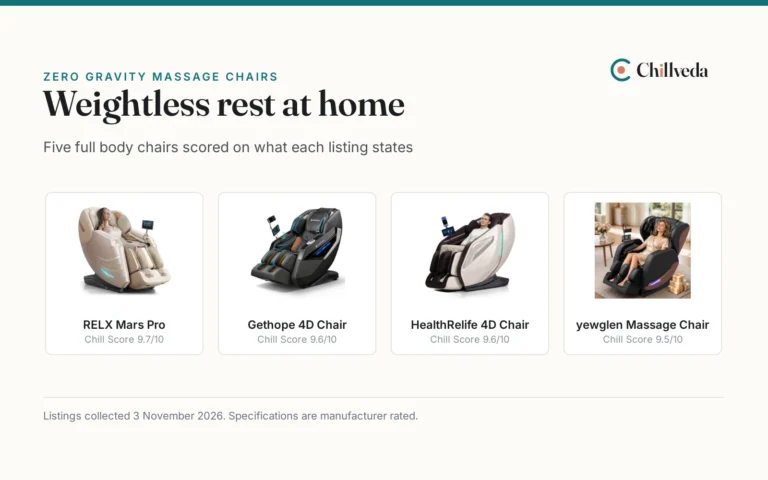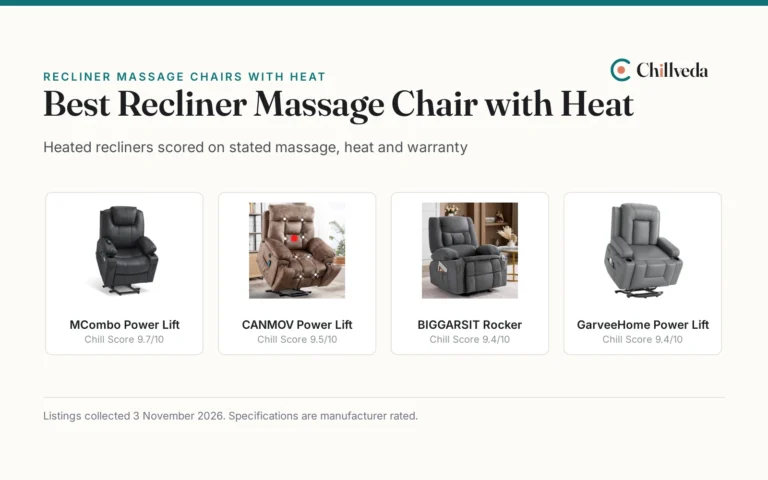
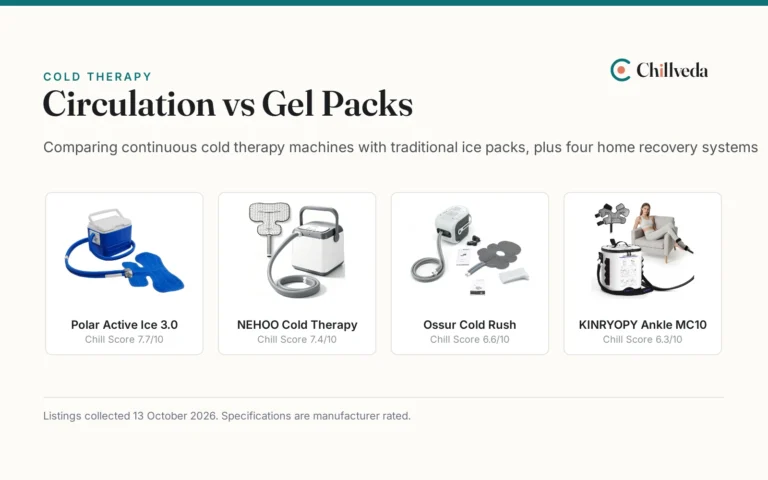
Cold therapy machine vs ice pack: which should you choose for home recovery? A cold therapy machine uses an electric pump to circulate chilled water through a targeted pad at a steady temperature, with an insulated reservoir that keeps water cold for hours between ice refills. A traditional ice pack is simpler, lower in cost, and cordless, but it gradually warms as it absorbs body heat and must be returned to the freezer between sessions. Choosing between them comes down to whether you need consistent temperature regulation for structured post-surgery recovery intervals or quick, convenient relief for everyday bumps and sprains.
This guide explains how continuous water circulation compares to static gel packs, how to plan bedside space and electrical setup, and features four cold therapy machines with stated listing specifications. Listings were collected 13 October 2026.
This article is informational and is not medical advice. Cold therapy can damage skin or nerves if applied too long or without an insulating barrier. Do not apply cold therapy to areas with poor circulation, nerve damage, or open surgical wounds without consulting your surgeon or physical therapist. Stop immediately if you feel extreme numbness, burning, or skin discoloration. See our Medical Disclaimer.
Chillveda earns a commission when you buy through links on this page, at no extra cost to you. As an Amazon Associate I earn from qualifying purchases. Affiliate disclosure.
Quick picks
-
1
 Polar Active Ice 3.0 Cold Therapy Ice Machine Chill Score 9.6/10Check price on Amazon
A 9-quart cold therapy system featuring a programmable cycle timer, broad shoulder wrap, and double-insulated cooling reservoir.
-
2
 Cold Therapy Ice Machine with Large Shoulder Pad Chill Score 9.5/10Check price on Amazon
A continuous cold circulation machine with a rigid triple-wall insulated bucket, 3-color water temperature monitor, and large shoulder wrap.
-
3
 Cold Rush Therapy Ice Machine Chill Score 9.4/10Check price on Amazon
A compact post-surgery cryotherapy unit with a high-flow circulation pump, universal joint pad, and quiet motor.
-
4
 Cold Therapy Machine for Ankle with Programmable Chill Score 9.3/10Check price on Amazon
A collapsible 15-quart cold therapy system featuring 3 timer settings, 3 water flow rates, and an ultra-quiet pump.

A 9-quart cold therapy system featuring a programmable cycle timer, broad shoulder wrap, and double-insulated cooling reservoir.
Pros & ConsViewHide
Pros
- Programmable timer allows custom on and off cycle intervals
- 9 quart double-insulated cooler fits 6 frozen water bottles
- Broad shoulder pad includes three separate elastic belts
- Stated 12-month manufacturer warranty
Cons
- Pad is shaped specifically for shoulder and upper arm
- Heavier package weight at 6.85 pounds
- No stated electrical safety certification
- Takes up more storage space than soft-sided buckets

A continuous cold circulation machine with a rigid triple-wall insulated bucket, 3-color water temperature monitor, and large shoulder wrap.
Pros & ConsViewHide
Pros
- Built-in thermometer with 3-color water temperature lights
- Adjustable flow rate and programmable cycle modes
- Stated 1-year free replacement warranty
- Triple-wall insulation in a rigid 7-liter bucket
Cons
- Heaviest unit in this group at 7.9 pounds
- Listing notes large pad causes ice to melt at a quicker rate
- Discrepancy between 7-liter bullet and 7-quart spec table
- No stated electrical safety certification

A compact post-surgery cryotherapy unit with a high-flow circulation pump, universal joint pad, and quiet motor.
Pros & ConsViewHide
Pros
- Lightweight reservoir weighs 4.6 pounds empty
- Includes universal pad suitable for multiple body joints
- Whisper-quiet motor with high-flow water circulation
- Established brand with market presence since 2010
Cons
- No warranty term is stated
- Cooling reservoir volume is not stated
- No programmable timer or automatic cycle settings listed
- No stated electrical safety certification

A collapsible 15-quart cold therapy system featuring 3 timer settings, 3 water flow rates, and an ultra-quiet pump.
Pros & ConsViewHide
Pros
- Largest stated reservoir capacity at 15 quarts
- Quiet pump with stated noise rating of 15 dB or lower
- Three timer settings of 10, 20, and 30 minutes plus three flow rates
- Foldable bucket collapses for compact storage
Cons
- No warranty term is stated
- Listing contradicts itself, naming knee machine in bullets but ankle pad in title
- Flexible bucket is less rigid and stable than hard coolers
- No stated electrical safety certification
More to compare
 Cold Therapy MachineCheck price on Amazon
 Cold Therapy Ice Machine with Digital Timer & Adjustable FlowCheck price on Amazon
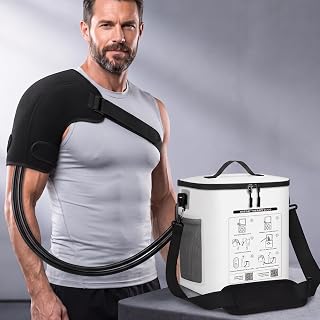 Ice Machine for Shoulder After SurgeryCheck price on Amazon
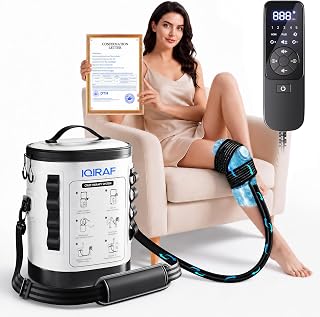 12H Long-Lasting Ice Machine for Knee After SurgeryCheck price on Amazon
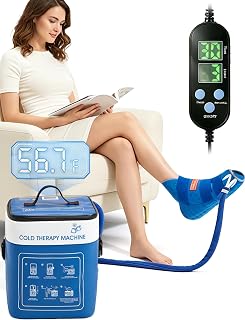 Cold Therapy Machine for Foot Ankle SurgeryCheck price on Amazon
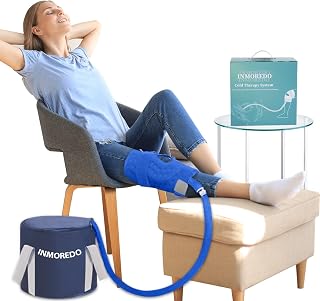 Inmoredo Cold Therapy MachineCheck price on Amazon
Cold therapy machine vs ice pack: key differences
| Feature | Cold therapy machine | Traditional ice pack |
|---|---|---|
| Temperature stability | Maintains steady circulation temperature from an ice reservoir | Warms steadily as gel or ice absorbs body heat |
| Coverage and fit | Joint-specific or universal pads secured with elastic straps | Flat gel packs or wraps that can shift during use |
| Session management | Timed sessions or intermittent cycle modes on select models | Manual timing required to avoid overcooling |
| Preparation | Requires adding ice and water or frozen bottles to a tank | Requires hours in a freezer before each application |
| Portability | Tethered to an electrical outlet and fluid hoses | Cordless and completely portable |
| Setup footprint | Requires flat bedside or floor space near an outlet | Compact storage in any kitchen freezer |
The core distinction between a cold therapy machine and an ice pack is temperature stability. A traditional gel pack warms continuously during application as it absorbs heat from the body, and once thawed, it must return to the freezer before it can be used again.
A cold therapy machine addresses this by circulating water from an insulated reservoir through internal channels in a therapy pad. As water circulates through the pad, it draws heat away from the joint, returns to the reservoir to be cooled by the ice bath, and flows back through the pad. Because the reservoir holds a substantial volume of ice and water, the circulating fluid remains at a consistent temperature throughout the prescribed session duration.
Continuous water circulation versus melting gel
In post-surgical rehabilitation and orthopedic recovery, maintaining consistent cooling during prescribed intervals offers a different experience than applying a static ice pack. Reusable ice packs begin warming as soon as they are placed against the skin, resulting in a temperature profile that changes from start to finish. In contrast, motorized cold therapy systems circulate fluid through a sealed pad, delivering a consistent cooling temperature across the entire application period.
Conformity and anatomical fit also differ between the two formats. While standard ice packs often come in flat shapes that can be difficult to position evenly around contoured joints like shoulders or ankles, cold therapy pads are typically designed with segmented fluid channels and adjustable elastic belts. This design helps maintain even surface contact and gentle compression across the target joint without shifting.
Bedside setup, floor space, and power needs
Before purchasing a cold therapy machine, you should ensure your recovery space can accommodate the equipment. While a frozen gel pack requires only freezer space, a motorized ice machine needs a flat surface near a standard electrical outlet and sufficient clearance for water hoses to reach your bed or chair comfortably.
Footprint requirements vary by model based on stated listing dimensions:
- Polar Active Ice 3.0: Package dimensions are 15.88 by 12 by 10.6 inches.
- NEHOO Cold Therapy: Package dimensions are 12.5 by 12 by 11.2 inches.
- KINRYOPY Ankle MC10: Product dimensions are 11 by 7 by 13 inches.
Position the reservoir on a stable, level floor or sturdy nightstand where it cannot tip over. To reduce the frequency of adding ice cubes, select listings state compatibility with frozen water bottles: Polar Products states its 9-quart cooler fits 6 frozen water bottles, while KINRYOPY lists capacity for 8 frozen bottles of 500 milliliters each in its 15-quart bucket. Other models, such as NEHOO, rely primarily on cubed ice inside an insulated bucket.
Cold therapy machines worth considering
These are scored on the Chill Score, which weighs performance 35, build 25, value 25, safety certifications 10 where it applies and warranty 5. None of these machines state an independent electrical safety certification, so all four score 0 for safety.
| Product | Chill Score | Perf. /35 | Build /25 | Value /25 | Safety /10 | Warranty /5 |
|---|---|---|---|---|---|---|
| Polar Active Ice 3.0 | 9.6 | 32 | 22 | 21 | 0 | 1 |
| NEHOO Cold Therapy | 9.5 | 30 | 21 | 21 | 0 | 1 |
| Ossur Cold Rush | 9.4 | 27 | 20 | 19 | 0 | 0 |
| KINRYOPY Ankle MC10 | 9.3 | 26 | 18 | 20 | 0 | 0 |
Scores run from 9.2 to 9.8: each product’s point total is placed on that range, so more points always means a higher score.
For more options, see our best cold therapy machines roundup.
Using cold therapy safely in practice
- Always place an insulating barrier between the pad and skin. Never apply a cold therapy pad or ice pack directly to bare skin. A thin towel, cotton sleeve, or specialized dressing prevents tissue freezing while allowing cooling to penetrate.
- Follow medical guidance on session length. Follow your physician’s recommended session times and use timer controls or cycle settings where available. For example, KINRYOPY provides preset timers of 10, 20, and 30 minutes, while Polar Products features a programmable on-off cycle timer.
- Use frozen water bottles where supported. For coolers that accommodate frozen water bottles, swapping them into the reservoir can reduce ice melting and eliminate frequent water draining.
- Check quick-connect hose couplings. Ensure hose fittings click firmly into place before switching on the motor to prevent water leaks on bedding or flooring.
- Place the bucket on a stable, flat surface. Keep the reservoir on the floor or a sturdy nightstand where it cannot be tipped over by moving during sleep.
Common mistakes
- Applying the circulation pad directly against bare skin without a protective cloth layer.
- Falling asleep with continuous flow active on a machine without an automatic on-off cycling timer.
- Overfilling the reservoir past the indicated water line, causing overflow when ice is added.
- Leaving stagnant water inside the bucket, pump, and lines between recovery sessions.
Common questions
How to use a cold therapy machine?
Fill the insulated reservoir with water and ice or frozen water bottles according to the maker’s instructions. Secure the therapy pad around the joint over a protective fabric barrier using the elastic belts, connect the fluid hoses until they latch, plug the unit into an electrical outlet, and configure your session duration or cycle mode on the control panel.
How to clean ice therapy machine?
Drain all water from the reservoir and circulation hoses after every recovery session to prevent stagnant moisture buildup. Clean interior surfaces with mild soap or a dilute vinegar rinse, flush the lines with clean water, and allow all components to air-dry completely before storing.
Are ice therapy machines covered by insurance or Medicare?
Coverage depends on individual health insurance policies and clinical necessity. Medicare typically does not cover cold therapy machines for home rehabilitation because they are frequently classified as convenience items rather than essential durable medical equipment. Some private insurance plans may offer partial coverage when prescribed by an orthopedic surgeon, and select models such as NEHOO state FSA and HSA eligibility.
Can you use frozen water bottles instead of cubed ice?
Select cold therapy machines are designed to accommodate frozen water bottles in their cooling reservoirs. Polar Products states its 9-quart reservoir fits 6 frozen water bottles, while KINRYOPY lists space for 8 frozen bottles of 500 milliliters each. However, not all models list this capability; units like NEHOO are designed around ice and water in a rigid bucket.
When should you choose an ice pack over a cold therapy machine?
A reusable ice pack is the practical choice for everyday bumps, minor sprains, or short recovery sessions where cordless mobility and zero equipment setup are preferred. A cold therapy machine is generally chosen for post-operative orthopedic recovery where an insulated reservoir maintaining chilled water over extended periods supports structured, repeatable treatment intervals at the bedside.
Sources: Amazon product listings for the cold therapy machines named above, collected 13 October 2026. Related: our best cold therapy machines and best reusable ice packs.
Back to all recovery tools reviews.