Side by side Choose a hanging red light panel if Choose a panel with stand if
When setting up a recovery corner in your bedroom or home gym, finding wall space near a standard electrical outlet dictates how smoothly your routine runs. Deciding between a hanging red light panel vs panel with stand comes down to your room layout, door clearance, and whether you prefer a fixed station or a portable setup. If you have an open interior door and want your floor clear, pick a hanging setup. If you want to position the light next to a couch, bed, or exercise mat without occupying a doorway, choose a panel with a stand.
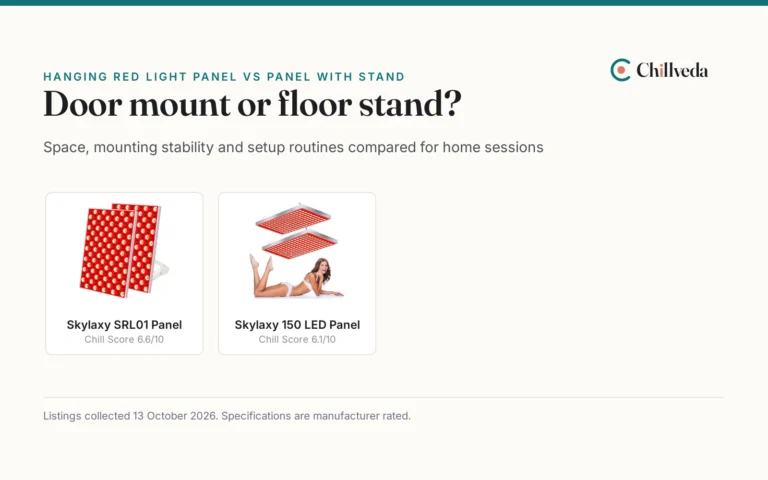
This comparison looks at mounting stability, space requirements, and daily handling using two examples from Skylaxy that provide hardware for both approaches. Listings were collected 13 October 2026.
This article is informational and is not medical advice. Red light therapy devices emit bright optical radiation that can strain the eyes; always avoid staring directly into the LEDs and wear appropriate eye protection during sessions. Ask a clinician first if you have photosensitivity, take light-sensitizing medications, or have an active eye condition. See our Medical Disclaimer and our red light therapy eye safety guide.
Chillveda earns a commission when you buy through links on this page, at no extra cost to you. As an Amazon Associate I earn from qualifying purchases. Affiliate disclosure.
Quick picks
-
1
 Red Light Therapy Lamp, Red Light Therapy Chill Score 9.4/10Check price on Amazon
A 2-pack red light panel set listed at 13 by 8.3 by 0.8 inches with 660nm and 850nm wavelengths, a 180-degree stand, and a hanger.
-
2
 Red Light Therapy for Body and Face Chill Score 9.3/10Check price on Amazon
A 2-pack red light panel set featuring 150 dual-chip LEDs with 660nm and 850nm wavelengths, an adjustable 180-degree stand, and a hanger.

A 2-pack red light panel set listed at 13 by 8.3 by 0.8 inches with 660nm and 850nm wavelengths, a 180-degree stand, and a hanger.
Pros & ConsViewHide
Pros
- Two panels included in the package
- Includes both a 180-degree stand and a hanging mount
- Dual 660nm red and 850nm near-infrared wavelengths
- Stated dimensions of 13 by 8.3 by 0.8 inches and 3 pounds
Cons
- No wattage or electrical consumption stated
- No LED count stated in the listing
- No safety certifications stated
- No warranty term is stated

A 2-pack red light panel set featuring 150 dual-chip LEDs with 660nm and 850nm wavelengths, an adjustable 180-degree stand, and a hanger.
Pros & ConsViewHide
Pros
- 150 dual-chip LEDs with two wavelengths per bead stated
- Two panels included in the package
- Includes both an adjustable 180-degree stand and a hanger
- 660nm red and 850nm near-infrared spectrum
Cons
- Listing states package dimensions rather than product size
- Spec table misspells manufacturer name as Skyalxy
- No wattage or electrical draw stated
- No warranty term is stated
More to compare
 Red Light Therapy PanelCheck price on Amazon
 FLIKEZE Red Light Therapy Panel for Full Body FaceCheck price on Amazon
 BestQool Red Light Therapy PanelCheck price on Amazon
 Red Light Therapy Panel for Body and FaceCheck price on Amazon
 Hooga Red Light Therapy Panel DeviceCheck price on Amazon
 Astarexin Red Light Lamp Infrared Light Panel with StandCheck price on Amazon
Hanging red light panel vs panel with stand at a glance
| Feature | Hanging red light panel | Panel with stand |
|---|---|---|
| Mounting method | Over-door hook or wall hanger | Floor or tabletop base |
| Floor space needed | Zero floor footprint | Requires flat floor or table space |
| Portability | Tied to a door frame or wall mount | Moves between rooms or surfaces |
| Height adjustment | Determined by hanging mount placement | Adjusted via stand angle and surface height |
| Door accessibility | Occupies a door while in use | Leaves doorways clear |
| Angle flexibility | Fixed flat against a vertical plane | Tilts or angles toward furniture |
| Storage routine | Stays hung or unhooked from door | Folds down or sits on a stand |
Mounting mechanics and space requirements
A hanging red light panel mounts to an interior door or wall using hanging brackets or hooks. Because the panel hangs vertically against the door face, it leaves the floor completely clear. That makes it practical for compact bedrooms or home offices where floor space is limited. The trade-off is door access: while the panel hangs in place, opening and closing the door requires care, and movement can cause an unsecured panel to shift against the door face.
A panel with a stand rests on a flat surface, such as a floor, desk, table, or workout bench. The Skylaxy SRL01 example includes a 180-degree adjustable stand along with a hanging mount, showing how makers sometimes combine both approaches. A stand lets you adjust the angle toward your body while you sit or recline, whereas a door hanger keeps the panel facing outward at a fixed angle from the door face. However, the base requires open surface or floor space near an outlet, and stands on lightweight panels can tip if bumped.
Power, cord reach and positioning
Both mounting styles rely on standard household power. Neither Skylaxy listing states power consumption in watts, electrical current draw in amps, or operating voltage in its technical table. When a maker publishes wattage, electrical current load can be calculated from voltage. Because neither listing publishes rated wattage, operating amperage and running costs cannot be calculated from stated figures.
Cord routing differs between the two setups. With a door-hanging setup, the power cord drops down from the door to reach a wall receptacle, requiring mindful routing so the cord does not snag when the door swings. With a panel on a stand, the unit can sit closer to existing outlets, keeping cords nearer to the floor or tabletop.
Both featured Skylaxy sets provide 660nm red and 850nm near-infrared output; see our guide to red light wavelengths for what these bands target. For guidance on positioning your body relative to the LEDs, see how far to sit from a red light panel.
Daily routine and stability
Your daily routine determines which style feels less cumbersome over time. A door-hanging panel works well if you can leave it mounted in a dedicated spare room or closet door where it is always ready for a session. If you must set up and take down the door hook every day, lifting the unit and securing the mount can become a chore.
A panel with a stand allows more flexible body positioning. You can place the stand on a nightstand for face sessions, on the floor next to a yoga mat, or on a coffee table while sitting on a couch. The Skylaxy listings highlight horizontal and vertical orientation with the included hanger, alongside angle adjustment on the 180-degree stand. Floor and surface stands require stable footing to prevent wobbling, whereas door hangers distribute the weight along the door top.
Gear for each route
These are scored on the Chill Score: performance 35, build 25, value 25, safety certifications 10 where it applies and warranty 5. Neither listing states a UL or ETL listing, so both score 0 for safety.
| Product | Chill Score | Perf. /35 | Build /25 | Value /25 | Safety /10 | Warranty /5 |
|---|---|---|---|---|---|---|
| Skylaxy SRL01 Panel | 9.4 | 26 | 20 | 20 | 0 | 0 |
| Skylaxy 150 LED Panel | 9.3 | 24 | 18 | 19 | 0 | 0 |
Scores run from 9.2 to 9.8: each product’s point total is placed on that range, so more points always means a higher score.
Choose a hanging red light panel if
- You have a dedicated door near an electrical outlet where the unit can stay mounted.
- Your room has limited floor and table surface space.
- You prefer a setup that stays mounted at standing or chair height on an interior door.
- You want to keep cords and equipment off the floor away from pets or foot traffic.
Choose a panel with stand if
- You want to use the panel while sitting on a couch, lying on a mat, or working at a desk.
- You do not want a panel or mounting bracket hanging on your interior doors.
- You plan to move the device between different rooms or surfaces.
- You need to adjust the panel angle rather than keeping it flat against a wall or door.
Check Your Space First
- Door and surface clearance: The Skylaxy SRL01 listing reports panel dimensions of 13 by 8.3 by 0.8 inches, while the second Skylaxy listing reports package dimensions of 17.13 by 8.98 by 2.4 inches without stating individual panel dimensions. Verify your door face or tabletop has clear clearance for these measurements.
- Support weight: The SRL01 listing reports a weight of 3 pounds, while the second listing reports a package weight of 3.22 pounds. Ensure your door frame or table surface comfortably supports this weight.
- Stand adjustment angle: Both listings include a 180-degree adjustable stand that requires enough flat clearance to pivot and hold position without tipping.
- Outlet access: Neither listing states power cord length or electrical wattage, so place your setup near a standard wall receptacle to avoid pulling on the cord.
Common questions
Can a hanging red light panel damage an interior door?
Door strain depends primarily on total panel weight and hardware fit. For the 3-pound Skylaxy SRL01 listing, standard interior door hinges easily carry the weight without risk of sagging. Care is mainly needed to ensure brackets do not rub against the top jamb or rattle when the door is opened and closed.
Can you use a hanging panel on a stand instead?
Some models support both mounting methods right out of the box. Both Skylaxy listings in this comparison include a 180-degree adjustable stand alongside hanging hardware, allowing tabletop, floor, or door positioning. If a model only ships with hanging hardware, you would need a compatible aftermarket stand that matches the panel’s mounting holes.
Do hanging panels provide better coverage than panels with stands?
Coverage depends on the panel’s physical dimensions and LED array rather than the mount itself. A door-hung panel holds the light at a fixed height along the door frame, providing consistent placement for recurring routines. A panel with a stand allows closer, angled positioning for targeted areas like the face, neck, or knees while seated.
How much floor space does a panel with a stand need?
A tabletop or floor stand requires a flat surface roughly the width and depth of its base. For example, the Skylaxy SRL01 has panel dimensions of 13 by 8.3 by 0.8 inches, requiring a small desk or floor footprint. Larger floor stands for full-body panels require considerably more clear floor space so they do not obstruct walking paths.
Which setup is better for daily face and neck sessions?
A panel with a stand is generally more comfortable for face and neck routines because you can adjust the angle while sitting relaxed at a desk or table. A door-hanging panel remains flat against the door, requiring you to position yourself directly in line with where the panel hangs. Having an adjustable stand makes it easier to direct the light without awkward body posture.
Back to all red light therapy reviews.