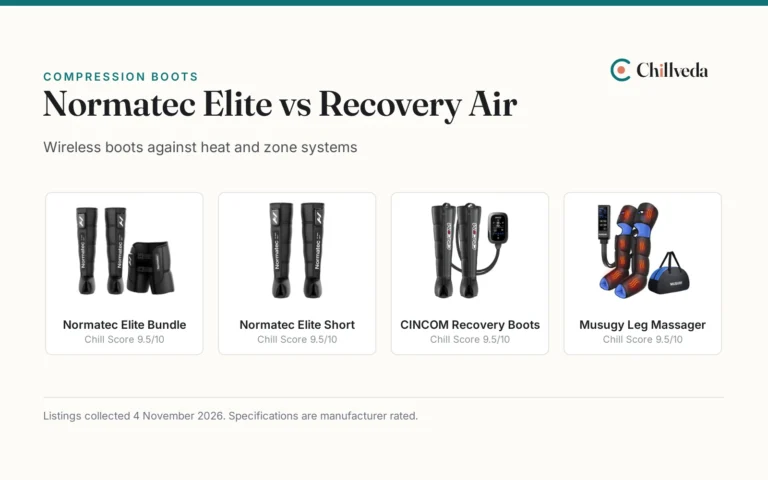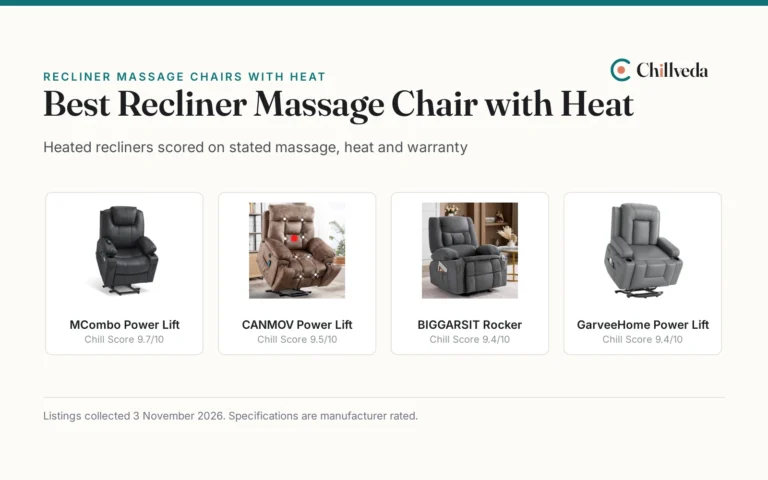
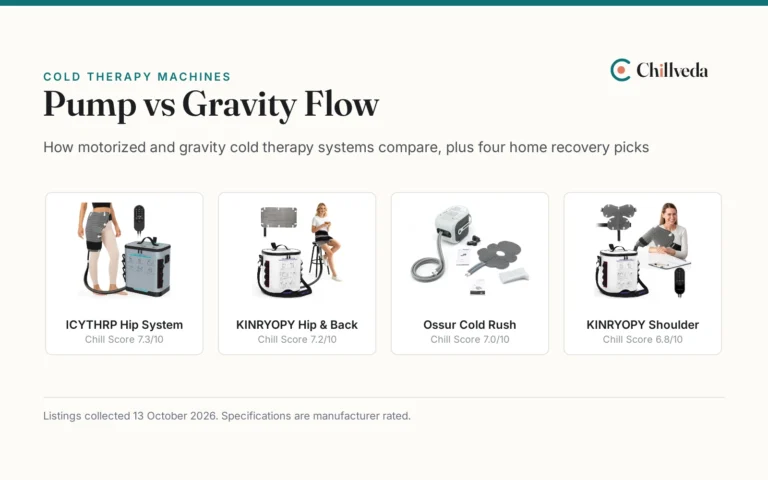
When you settle onto the sofa or into bed after joint surgery, balancing ice packs while looking for a nearby wall outlet, choosing between a motorized cold therapy machine vs gravity machine comes down to whether you want automated circulation or non-electric simplicity. A motorized cold therapy machine uses an electric pump to continuously circulate chilled water through a targeted joint pad, maintaining consistent cooling during your prescribed session without manual effort. A gravity machine relies on raising and lowering an unpowered cooler relative to your joint to fill and drain the pad by gravity alone, which requires no electrical outlet and produces no motor noise, but demands regular physical handling to refresh warm water. For post-operative recovery routines at home, a motorized machine is often more convenient because an electric pump circulates chilled water without requiring you to repeatedly lift and lower a heavy cooler.
This guide explains how pump-driven circulation compares with gravity-fed cooling in daily use, outlines the room setup and physical handling each system requires, and reviews four motorized cold therapy machines with pads for knees, hips, and shoulders. Listings were collected 13 October 2026.
This article is informational and is not medical advice. Cold therapy carries risks of tissue damage, frostbite, and nerve irritation if used improperly or applied directly to bare skin. Always place an insulating barrier between the pad and skin, follow your surgeon or physician’s exact timing instructions, and inspect your skin frequently. Discontinue use immediately if you experience numbness, burning, or skin discoloration. See our Medical Disclaimer.
Chillveda earns a commission when you buy through links on this page, at no extra cost to you. As an Amazon Associate I earn from qualifying purchases. Affiliate disclosure.
Quick picks
-
1
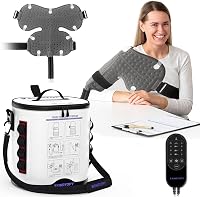
 ICYTHRP Programmable Timer Ice Machine for Hip Chill Score 9.5/10Check price on Amazon
A 12 quart cold therapy system with a programmable timer, a leak-proof hip pad, and a quiet brushless motor operating at 15 dB or lower.
-
2
 Cold Therapy Machine for Hip&Back Chill Score 9.5/10Check price on Amazon
A 15 quart cold therapy unit with a large 12.5 by 22.5 inch pad, three timer presets, and three adjustable flow rates.
-
3
 Ossur Cold Rush Cold Therapy Machine with Knee Pad Chill Score 9.5/10Check price on Amazon
A rigid cooler cold therapy system with a brushless motor, insulated tubing, a locking lid, and an ergonomic knee pad.
-
4
 Cold Therapy Machine for Shoulder Chill Score 9.4/10Check price on Amazon
A 15 quart cold therapy machine featuring a pliable shoulder pad, three timer settings, and a quiet pump rated at 15 dB or lower.

A 12 quart cold therapy system with a programmable timer, a leak-proof hip pad, and a quiet brushless motor operating at 15 dB or lower.
Pros & ConsViewHide
Pros
- Collapsible 3-tier insulated bucket with 12-quart capacity
- Programmable timer cycles on and off on a set schedule
- Brushless DC motor operates at 15 dB or lower
- Holds up to 6 frozen water bottles
Cons
- Pad is shaped specifically for hip use
- No stated electrical safety certification
- No warranty term is stated
- Requires composite bucket to be unfolded correctly
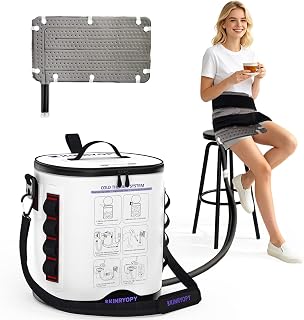
A 15 quart cold therapy unit with a large 12.5 by 22.5 inch pad, three timer presets, and three adjustable flow rates.
Pros & ConsViewHide
Pros
- Large 12.5 by 22.5 inch pad covers hip, back, or knee
- Foldable 15-quart bucket holds up to 8 frozen bottles
- Three timer settings and three flow speed options
- Pump operates at 15 dB or lower
Cons
- Large pad may require assistance to put on
- No stated electrical safety certification
- No warranty term is stated
- Plastic foldable bucket requires careful assembly

A rigid cooler cold therapy system with a brushless motor, insulated tubing, a locking lid, and an ergonomic knee pad.
Pros & ConsViewHide
Pros
- Durable brushless motor with adjustable flow control
- Locking lid prevents accidental water spills
- Rigid container with integrated carry handle
- Includes an ergonomic joint-contoured knee pad
Cons
- Cooling duration listed at 6+ hours rather than 12
- No programmable timer for automatic cycling
- No stated electrical safety certification
- No warranty term is stated
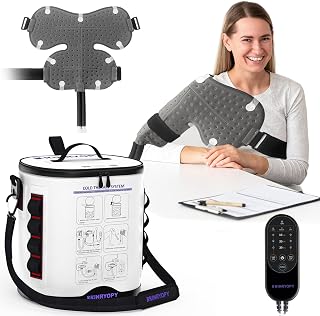
A 15 quart cold therapy machine featuring a pliable shoulder pad, three timer settings, and a quiet pump rated at 15 dB or lower.
Pros & ConsViewHide
Pros
- Soft, pliable pad contoured for broad shoulder coverage
- Three timer settings of 10, 20, and 30 minutes
- Three adjustable flow rates for customized cooling
- Foldable 15-quart bucket holds 8 frozen water bottles
Cons
- Bullet text contradicts title by mentioning a knee machine
- Foldable plastic bucket requires careful unfolded setup
- No stated electrical safety certification
- No warranty term is stated
More to compare
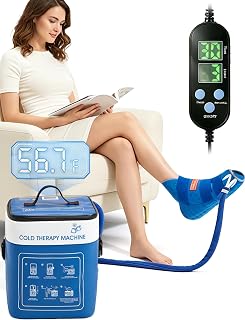 Cold Therapy Machine for Foot Ankle SurgeryCheck price on Amazon
 Longice Cold Therapy Machine with Programmable TimerCheck price on Amazon
 Elbow Cold Therapy Machine for InjuriesCheck price on Amazon
 Ice Machine for Shoulder After SurgeryCheck price on Amazon
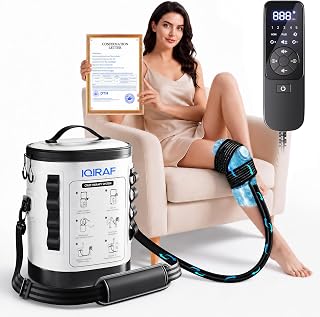 12H Long-Lasting Ice Machine for Knee After SurgeryCheck price on Amazon
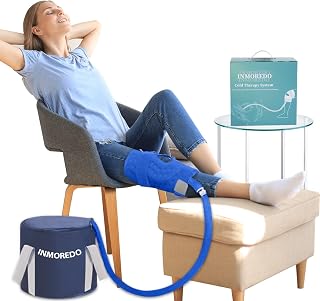 Inmoredo Cold Therapy MachineCheck price on Amazon
Motorized cold therapy machine vs gravity machine comparison
| Feature | Motorized cold therapy machine | Gravity machine |
|---|---|---|
| Circulation mechanism | Electric pump circulates chilled water through pad | Passive fluid flow via elevation height |
| Cooling delivery | Active continuous circulation while pump runs | Static chilled water in pad until drained |
| Manual intervention | Minimal once running; timer controls on some models | Requires raising to fill and lowering to drain |
| Power requirement | Requires a wall outlet and power adapter | No electricity or batteries needed |
| Operating noise | Low hum from electric motor | Silent non-electric operation |
| Placement flexibility | Cooler typically rests on floor or bedside table | Cooler raised above joint to fill, lowered to drain |
The operational gap between the two designs centers on convenience versus independence from electrical power. A motorized system keeps chilled water moving through the pad automatically during a session, whereas a gravity cooler requires you or a caregiver to raise the container above the joint to fill it, and lower it below the joint to drain the water once it warms up.
How continuous circulation differs from passive gravity flow
The primary mechanical difference between the two systems is how chilled water moves through the therapy pad. In a motorized cold therapy machine, an electric pump draws ice water from the reservoir and circulates it through internal fluid channels in the pad before returning it to the cooler. Because fresh chilled water constantly displaces water warmed by body heat, the pad maintains a stable cooling temperature throughout the session. While the insulated reservoir can hold ice for several hours, cold therapy itself should always be applied in structured cycles according to medical guidance. Our cold therapy machine vs ice pack guide details how active fluid movement compares with static gel packs.
In contrast, a gravity system operates through a static fill cycle. Raising the cooler above your joint allows cold water to flow down into the pad via gravity. Once the pad is full, fluid movement stops. As body heat warms the trapped water over time, cooling effectiveness gradually declines. To restore cold therapy, you reconnect the line if detached, lower the cooler below the joint to drain the warmed water back into the ice bath, let it chill, and then raise the cooler once again to refill the pad.
Elevation, power outlets, and room positioning
Room setup and mobility determine which machine fits your living space more comfortably. A gravity machine requires physical elevation during the filling process. You must be able to lift the cooler above the level of your joint for approximately one minute so gravity can push the chilled water into the pad. If you have limited upper body strength or your mobility is restricted following surgery, lifting a cooler filled with water and ice can be challenging without assistance from a caregiver.
A motorized cold therapy machine eliminates the need to manually lift the cooler because the internal pump pushes water through the tubing. You can place the cooler on the floor beside your bed, on a low stool, or on a nearby table. However, motorized units depend on an electrical wall outlet for their power adapter. You must position your recovery chair or bed within reach of an outlet and route cords carefully to prevent tripping hazards when moving around with crutches or a walker.
Motorized cold therapy machines for home recovery
These are scored on the Chill Score, which weighs performance 35, build 25, value 25, safety certifications 10 where it applies and warranty 5. Cold therapy machines in this group list no third-party electrical safety certification (such as UL or ETL), so all four score 0 for safety.
| Product | Chill Score | Perf. /35 | Build /25 | Value /25 | Safety /10 | Warranty /5 |
|---|---|---|---|---|---|---|
| ICYTHRP Hip System | 9.5 | 30 | 21 | 21 | 0 | 0 |
| KINRYOPY Hip & Back | 9.5 | 29 | 21 | 21 | 0 | 0 |
| Ossur Cold Rush | 9.5 | 29 | 21 | 20 | 0 | 0 |
| KINRYOPY Shoulder | 9.4 | 28 | 20 | 20 | 0 | 0 |
Scores run from 9.2 to 9.8: each product’s point total is placed on that range, so more points always means a higher score.
For more options across home recovery, see our best cold therapy machines roundup.
Using a cold therapy machine safely at home
- Always place an insulating barrier between the pad and skin. Never apply a cold therapy pad directly against bare skin. Use an elastic bandage, thin cloth, or the manufacturer barrier sleeve to guard against frostbite.
- Follow your surgeon instructions on session length. Cold therapy should be used in structured cycles. If your machine features a programmable timer, set it to cycle on and off according to your physician protocol.
- Use frozen water bottles to simplify refills. Standard frozen water bottles melt slower than loose ice cubes, maintain cold water circulation, and eliminate the chore of scooping out melted ice water.
- Route and protect tubing carefully. Ensure insulated lines have gentle curves without kinks. Kinks stop water flow and cause fluid pressure to back up into the pump.
- Check skin condition periodically. Inspect the joint area regularly during use. If the skin turns pale, red, or numb, turn off the machine and remove the wrap immediately.
Common mistakes
- Placing a gravity cooler lower than the joint and expecting water to fill the pad.
- Applying cold therapy pads directly to bare skin without an insulating cloth layer.
- Running a motorized machine continuously for hours without on-and-off rest periods.
- Allowing supply and return hoses to kink under blankets or furniture edges.
- Using warm tap water when refilling instead of chilled water and ice.
Common questions
How does a gravity cold therapy machine work?
A gravity cold therapy machine relies on gravity to move water between the cooler and the joint wrap. You place the cooler higher than the joint to allow chilled water to fill the pad. When the water warms from body heat, you lower the cooler below the joint to drain it back into the ice reservoir for re-cooling.
Can you sleep with a motorized cold therapy machine on?
Most clinicians advise against sleeping while using any cold therapy machine. When asleep, you cannot sense whether your skin is becoming excessively cold or numb, increasing the risk of frostbite or nerve injury. If you use a machine at night, run it only while awake before resting or follow strict medical protocols with an insulating barrier.
Do gravity ice machines need batteries or electricity?
No. Gravity machines operate without any electric pumps, batteries, or power cords. They rely purely on gravity and manual height adjustments, making them suitable for travel or locations where an electrical wall outlet is out of reach.
Why do people use frozen water bottles in cold therapy machines?
Frozen water bottles take longer to melt than loose ice cubes and keep the water cold for hours. They also stay sealed, which means you do not have to repeatedly drain excess water from the bucket or buy bags of ice every day.
Which is better for post-surgery recovery, motorized or gravity?
A motorized cold therapy machine is generally better for post-surgery recovery because an electric pump provides steady, continuous circulation without demanding manual effort. Gravity units work well when power is unavailable, but having to repeatedly raise and lower a heavy cooler can be difficult when mobility is limited.
Sources: Amazon product listings for the cold therapy machines named above, collected 13 October 2026. Related: our cold therapy machine vs ice pack and knee ice machine cold therapy reviews.
Back to all recovery tools reviews.