Side by side Choose a ceiling mount if Choose a floor stand red light if
Setting up a recovery space in a bedroom or home office often comes down to where your gear lives when morning sessions end. Choosing between a ceiling mount vs floor stand red light hinges on whether you want a permanent overhead fixture that keeps the floor completely clear or a freestanding frame you can position, adjust, and plug into any nearby standard wall outlet. If you have a dedicated treatment table or bed and want an uncluttered room, pick a ceiling mount. If you rent, share the room, or need to direct light at different angles while sitting or standing, pick a floor stand.
This comparison covers installation demands, room space, targeting flexibility, stability, and upkeep for each mounting method, using published specifications from current listings as concrete examples. Listings were collected 15 October 2026.
This article is informational and is not medical advice. Red light and near-infrared devices emit concentrated optical radiation, so always use appropriate protective eyewear and avoid looking directly into the LEDs. Consult a clinician before use if you take photosensitizing medications or have an underlying medical condition. See our Medical Disclaimer and our red light therapy eye safety guide.
Chillveda earns a commission when you buy through links on this page, at no extra cost to you. As an Amazon Associate I earn from qualifying purchases. Affiliate disclosure.
Quick picks
-
1
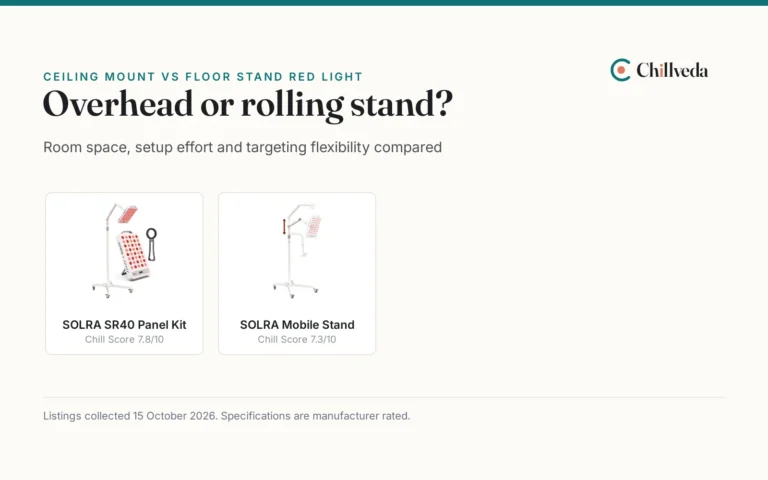
 SOLRA SR40 Red Light Panel with Magnetic Mount Chill Score 9.6/10Check price on Amazon
A 40-LED red and near-infrared light panel with a magnetic mount and floor stand, rated at 150 mW/cm² at 3 inches by the maker.
-
2
 SOLRA Mobile Floor Stand for Red Light Therapy Chill Score 9.5/10Check price on Amazon
A rolling aluminum and iron floor stand with a VESA 75x75mm mount, lockable wheels, and an included C-clamp for desk mounting.

A 40-LED red and near-infrared light panel with a magnetic mount and floor stand, rated at 150 mW/cm² at 3 inches by the maker.
Pros & ConsViewHide
Pros
- 660nm and 850nm dual wavelengths with 40 LEDs
- LCD touchscreen with timer and pulse modes
- Magnetic mount connects to the included floor stand
- Protective glasses and silicone handle included
Cons
- Small 10.4 by 6.28 inch panel size
- Minor dimension contradiction between title and spec table
- No warranty term is stated
- No safety certifications listed

A rolling aluminum and iron floor stand with a VESA 75x75mm mount, lockable wheels, and an included C-clamp for desk mounting.
Pros & ConsViewHide
Pros
- Height adjusts from 45.5 to 57.1 inches plus 30cm telescopic pole
- Dual-joint arm rotates 360 degrees and tilts 180 degrees
- Four lockable universal wheels with an anti-tip base
- Includes a C-clamp for desks or headboards up to 2.5 inches thick
Cons
- Stand only with no red light panel included
- Listing misspells brand name as SOERA in the text
- Stand weight is not stated in the listing
- No warranty term is stated
Ceiling mount vs floor stand red light at a glance
| Feature | Ceiling mount | Floor stand |
|---|---|---|
| Mounting location | Ceiling joists or structural studs overhead | Freestanding base resting on the floor |
| Floor space needed | Zero floor clearance required | Requires clear floor area for base legs or pedestal |
| Targeting angles | Fixed downward overhead orientation | Adjustable height and angle depending on the stand |
| Mobility | Stationary permanent installation in one room | Moveable frame or wheeled base between rooms |
| Installation effort | Structural anchoring, drilling, and high cable routing | Assembly of stand parts with no ceiling holes |
| Typical position | Lying flat on a bed, massage table, or mat | Sitting at a desk, reclining on a couch, or standing |
Mounting mechanics, reach, and floor space
The physical structure of your space determines which mounting style functions smoothly day to day. A ceiling mount suspends a panel directly over a bed, couch, or massage table, pointing light downward. Because it hangs overhead, it uses zero square feet of floor clearance. However, securing hardware overhead requires anchoring directly into ceiling framing members like joists. The listings reviewed provide no ceiling mount brackets, leaving overhead weight limits and suspension hardware unstated.
Floor stands handle positioning through adjustable mechanical frames rather than ceiling anchors. The SOLRA Mobile Stand example pairs an aluminum and iron frame with an anti-tip X-shaped base and 4 silent universal caster wheels that lock with a step-down lever. The stand lists a base height range of 45.5 to 57.1 inches, plus an additional 30 centimeters of adjustment through a telescopic pole. A dual-joint mechanical arm adds 360-degree horizontal rotation and 180-degree tilt.
For rooms where floor area is tight, the SOLRA Mobile Stand example also includes a dual-purpose C-clamp that fastens to a table, desk, or headboard up to 2.5 inches (6.35 cm) thick. The SOLRA SR40 example takes a different approach by using a magnetic mount on its included floor stand, holding a compact 2-pound panel that measures 10.43 by 6.30 inches (or 10.4 by 6.28 inches in its spec table). Neither listing publishes electrical power consumption in watts or volts, so ongoing electrical running costs cannot be calculated from stated figures.
Installation, room space, and power needs
Installation is where ceiling mounts and floor stands diverge most sharply. A ceiling mount demands tools, a ladder, a stud finder, and overhead drilling into structural ceiling joists. For renters or anyone living in an apartment, drilling into ceilings is rarely permitted and risks security deposit deductions. Power routing also requires attention: running an electrical cord from an overhead fixture to a wall outlet leaves a dangling wire unless you run surface raceways or install an outlet high on the wall.
A floor stand avoids structural alteration entirely. You assemble the frame and position it near any standard grounded wall outlet in a bedroom, home office, or living room. The trade-off is the physical footprint on your floor. While the SOLRA Mobile Stand example has front legs that slide under a couch or bed, a floor base still occupies room around your furniture. To keep cords organized during height changes, the SOLRA stand example provides dedicated cable management clips. For more standalone frames, see our red light therapy stands roundup. If you want an overhead or door-hanging setup without floor legs, compare our hanging red light panel vs panel with stand review.
Daily routine and adjustments
How you use red light daily depends on how easily you can adjust the beam. A ceiling mount is fixed in one spot, which works smoothly if you lie flat on a bed or treatment table at the same time each day. It provides a consistent distance overhead, but it cannot pivot to reach your neck at a desk, your lower back while reading on a couch, or your knees while sitting in an armchair.
A floor stand accommodates varied daily routines. The SOLRA SR40 example allows you to position its 40-LED panel beside an office desk, vanity, sofa, or exercise mat. Its built-in LCD touchscreen lets you set session durations between 5 and 60 minutes, adjust brightness from 10% to 100%, and select pulse rates from 10 to 100 Hz. The panel combines 660nm red and 850nm near-infrared wavelengths with a focused 30-degree beam angle, delivering a maker-rated irradiance of at least 150 mW/cm² at 3 inches under manufacturer conditions. When your session ends, wheeled frames roll into a corner, while compact models like the SR40 lift easily off their mount for storage. Learn more about wavelength output in our red light wavelengths guide.
Gear for each route
These are scored on the Chill Score: performance 35, build 25, value 25, safety certifications 10 where it applies, and warranty 5. Neither listing states a UL or ETL safety certification, so both score 0 for safety. Neither listing states a warranty term, so both score 0 for warranty.
| Product | Chill Score | Perf. /35 | Build /25 | Value /25 | Safety /10 | Warranty /5 |
|---|---|---|---|---|---|---|
| SOLRA SR40 Panel Kit | 9.6 | 29 | 20 | 21 | n/a | 0 |
| SOLRA Mobile Stand | 9.5 | 28 | 19 | 19 | n/a | 0 |
Scores run from 9.2 to 9.8: each product’s point total is placed on that range, so more points always means a higher score. Safety counts only for powered gear or where the listing states safety features; where it does not apply, the score is taken over the remaining 90 points.
Choose a ceiling mount if
- You have a dedicated wellness room or treatment table and want zero gear on the floor.
- You own your home and have permission to drill into structural ceiling joists.
- You primarily use red light while lying flat on your back or stomach.
- You do not need to move the panel between different rooms or chairs.
Choose a floor stand red light if
- You rent your home or prefer avoiding overhead drilling and ceiling drywall damage.
- You want to target different body areas while sitting, standing, or relaxing on a sofa.
- You want the flexibility to move your setup between rooms or store the stand between sessions.
- You want flexible positioning with multi-angle tilt and telescopic height adjustments.
Check Your Space First
- If choosing a stand with an X-shaped base like the SOLRA example, check under-bed and under-sofa clearance to ensure the front legs can slide beneath your furniture.
- Measure vertical clearance against the stand height range of 45.5 to 57.1 inches plus the 30 cm telescopic pole adjustment on adjustable models.
- Confirm that any table, desk, or headboard edge intended for the C-clamp does not exceed 2.5 inches (6.35 cm) in thickness.
- Verify that your red light panel uses standard VESA 75x75mm mounting holes with M4 screws, or choose a dedicated kit like the 2-pound SR40 with magnetic docking.
Common questions
Can any red light panel be mounted to a ceiling?
Not all panels are built for ceiling mounting. Panels require dedicated reinforced mounting points, rated suspension brackets, and secure anchoring into ceiling joists to prevent falling hazards. Always verify that a panel is specifically rated by its manufacturer for overhead suspension before attempting installation.
What are the main advantages of a floor stand for red light therapy?
A floor stand provides flexible positioning without damaging walls or ceilings. The SOLRA stand example allows height adjustments from 45.5 to 57.1 inches, 360-degree rotation, and 180-degree tilt, enabling targeted sessions while sitting, standing, or resting. Stands with caster wheels also roll easily out of the way when sessions finish.
Does a ceiling mount save floor space compared to a floor stand?
Yes, a ceiling mount keeps the floor entirely clear because the panel remains suspended overhead. In contrast, a floor stand requires room for its base and legs, though some models feature low-profile legs designed to slide under a couch or bed. For small rooms with a permanent treatment table, ceiling mounting maximizes usable floor area.
Can I use a red light floor stand with a bed or couch?
Yes, floor stands with low-profile legs can slide beneath a bed or sofa frame. The SOLRA Mobile Stand example includes an arm that tilts 180 degrees and rotates 360 degrees to direct light over reclining users. In addition, its included C-clamp allows mounting directly to a headboard or desk up to 2.5 inches (6.35 cm) thick.
Do these red light floor stands include safety certifications or warranties?
Neither of the SOLRA listings examined states a UL or ETL electrical safety certification. Furthermore, neither product listing states a manufacturer warranty term. Always check with the seller to confirm electrical safety standards and warranty coverage prior to purchase.
Back to all red light therapy reviews.