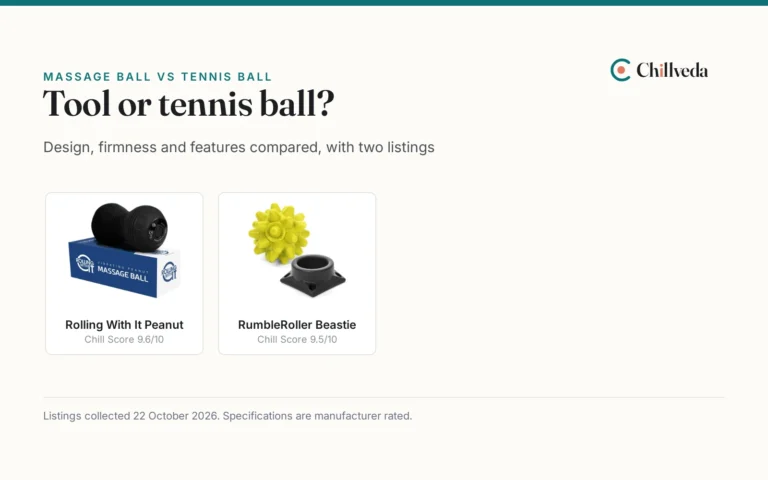
Side by side Choose a massage ball if Choose a tennis ball if
The massage ball vs tennis ball question comes down to a purpose-built tool versus a handy substitute. A massage ball is shaped and textured for pressing into muscle, and its maker states the firmness; a tennis ball is a soft sphere designed for the court that many people press into service for the same job. Pick the massage ball if you want features aimed at self-massage; pick the tennis ball if you want the simplest, lowest-commitment way to try the idea.
This comparison looks at design, firmness, features and stated specs, using two massage ball listings as concrete examples. Court tennis balls are sold for play, and their listings state nothing about self-massage, so we describe that side in general terms and do not score a tennis ball listing. It does not compare health effects, because a ball treats nothing on its own. Listings were collected 22 October 2026.
This article is informational and is not medical advice. Massage tools press on soft tissue: avoid the neck, spine and arteries, and do not use them on acute injuries or if a clinician has told you to avoid them. See our Medical Disclaimer.
Chillveda earns a commission when you buy through links on this page, at no extra cost to you. As an Amazon Associate I earn from qualifying purchases. Affiliate disclosure.
Quick picks
-
1
 Rolling With It Vibrating Peanut Massage Ball Chill Score 9.6/10Check price on Amazon
A cordless rechargeable vibrating peanut massage ball with 4 intensity levels, a 10-minute auto shut-off and a stated 300 LBS weight limit, sold with a charger, carry bag and instructions.
-
2
 RUMBLE ROLLER Beastie Extra Firm Massage Ball Deep Chill Score 9.5/10Check price on Amazon
An extra firm nubbed massage ball with a high-grip surface and an included base, sold as a deep tissue trigger point tool for targeted self-massage.

A cordless rechargeable vibrating peanut massage ball with 4 intensity levels, a 10-minute auto shut-off and a stated 300 LBS weight limit, sold with a charger, carry bag and instructions.
Pros & ConsViewHide
Pros
- 4 intensity levels with a 4-speed motor for variable pressure
- 10-minute auto shut-off with LED indicators for battery and intensity
- Cordless and rechargeable with a stated 2-hour charging time
- Charger, carry bag and instructions included
Cons
- 2 pounds, the heavier of the two picks here
- No warranty term is stated; the lifetime customer support is a support promise
- The listing makes pain and health claims we do not repeat
- Peanut shape suits fewer positions than a plain sphere

An extra firm nubbed massage ball with a high-grip surface and an included base, sold as a deep tissue trigger point tool for targeted self-massage.
Pros & ConsViewHide
Pros
- Extra firm, stated for experienced users wanting deeper pressure
- Nubbed high-grip surface the maker says keeps pressure focused
- Base included so the ball sits steady on the floor
- Latex-free and phthalate-free, smooth non-porous material
Cons
- No warranty term is stated
- Spec table says 3 in cube; product dimensions say 3.15 x 4.02 x 3.15 in
- Extra firm may be too much for beginners
- Stated as not water resistant
More to compare
 Penn Championship Tennis BallsCheck price on Amazon
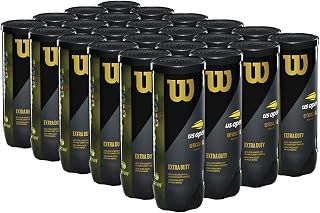 WILSON US Open Extra Duty Tennis BallsCheck price on Amazon
 Teloon Championship Tennis BallsCheck price on Amazon
 KSONE Massage Lacrosse Balls -Massage Balls for MyofacialCheck price on Amazon
 TRIGGERPOINT Performance Grid X Massage Ball for Deep TissueCheck price on Amazon
 Deep Tissue Massage Ball for Exercise & RecoveryCheck price on Amazon
Massage ball vs tennis ball at a glance
| Massage ball side | Tennis ball side | |
|---|---|---|
| Designed for | Self-massage, per the makers | Tennis play, per the makers of court balls |
| Firmness stated | Extra firm (Beastie); 4 intensity levels (peanut) | Not stated for bodywork |
| Shape | Nubbed sphere (Beastie); two-sphere peanut | Smooth felted sphere |
| Vibration | One listing: 4-speed motor, 10-minute auto shut-off | Not stated |
| Water resistance | Beastie stated as not water resistant; peanut stated as waterproof | Not stated |
| Warranty term | None stated | Not applicable here |
Where the massage ball side stands apart
The two massage ball listings are written for the task. The RumbleRoller Beastie is stated as extra firm with a nubbed, high-grip surface and a spherical form, sold as a deep tissue trigger point tool; its stated uses are deep tissue work, focused massage and tight muscle spots, and a base is included so it sits steady on the floor. The Rolling With It peanut adds electronics: a 4-speed motor with 4 intensity levels, cordless rechargeable power with a stated 2-hour charging time, a 10-minute auto shut-off with LED indicators, and a stated 300 LBS weight limit. Its kit includes a charger, a carry bag and instructions.
Texture and firmness are the honest separators. The Beastie maker describes a high-grip surface meant to keep pressure focused, while a court tennis ball has a smooth felt cover made for consistent bounce. The Beastie listing itself names tennis balls and lacrosse balls as the things people commonly use, and presents its shape as made for targeted self-massage instead. The listings do not share firmness units, so take the wording as each maker’s own description rather than a shared measurement. A lacrosse ball is the other common substitute people reach for; our foam roller vs lacrosse ball comparison covers that pairing, and the massage ball vs peanut ball guide compares the two massage ball shapes head to head.
Where the tennis ball side stands apart
A tennis ball is made for the court, and that is its strength as a substitute: it is a soft, familiar sphere with nothing to charge and nothing to maintain, and it is easy to find. That simplicity is exactly why people press it into service for self-massage.
The trade-off is that court ball listings do not discuss self-massage, firmness for bodywork, or vibration; those are simply not the product’s stated purpose, so there is no maker-stated firmness to compare against the Beastie. We left court ball packs out of the scored picks for that reason. See our best massage balls roundup for purpose-built options if you outgrow the substitute.
The massage ball listings
These are scored on the Chill Score across performance, build, value, safety where it applies and warranty, with scores out of 10. Only the vibrating peanut states a safety-relevant feature, a 10-minute auto shut-off with a stated weight limit, so it is the only pick with a safety score above zero; neither listing states a warranty term, so both score zero for warranty.
| Product | Chill Score | Perf. /35 | Build /25 | Value /25 | Safety /10 | Warranty /5 |
|---|---|---|---|---|---|---|
| Rolling With It Peanut | 9.6 | 28 | 21 | 20 | 7 | 0 |
| RumbleRoller Beastie | 9.5 | 30 | 21 | 21 | 0 | 0 |
Scores run from 9.2 to 9.8: each product’s point total is placed on that range, so more points always means a higher score.
Choose a massage ball if
- You want a stated firmness level and a shape made for pressing into muscle.
- You want extras the listings state: a base, vibration, intensity levels or a carry kit.
- You plan to use it often enough that a purpose-built tool makes sense.
Choose a tennis ball if
- You want the simplest way to try the idea, with nothing to charge.
- You already have one at home and want to see whether ball-based self-massage suits you.
- You do not need a stated firmness level or extra features.
Check Your Space First
- You need floor space to lie on or a wall to lean against; the Beastie listing describes use on the floor, against a wall or seated in a chair.
- The vibrating peanut is cordless and rechargeable with a stated 2-hour charging time, so keep an outlet handy between sessions.
- The peanut measures 3.75 by 6.75 inches at 2 pounds; the Beastie is listed at 3.15 by 4.02 by 3.15 inches and 6.35 ounces, so both fit in a gym bag.
- The peanut’s kit includes a charger and a carry bag, and the Beastie includes a base; give both a dry shelf between uses.
- The Beastie is stated as not water resistant, so wipe it clean rather than soaking it.
Common questions
Can a tennis ball work as a massage ball?
Many people use one that way. Tennis ball listings describe court play, not bodywork, while the massage ball listings state firmness and features aimed at self-massage. If you are curious, a tennis ball is the simplest way to try the idea before buying a purpose-built tool.
Which is firmer, a massage ball or a tennis ball?
The Beastie example is stated as extra firm, while court tennis ball listings do not state a firmness for bodywork. Because there is no shared firmness unit, treat the Beastie wording as the maker’s own description rather than a measured comparison.
Do vibrating massage balls need charging?
The peanut example does. It is cordless and rechargeable with a stated 2-hour charging time, LED indicators for battery life and intensity level, and a 10-minute auto shut-off. The manual Beastie needs no power at all.
Is an extra firm massage ball suitable for beginners?
The Beastie listing says its extra firm grade is for experienced users who want a deeper, more aggressive feel. Someone new to self-massage may prefer to start with something less firm, and should avoid the neck, spine and arteries.
Back to all recovery tools reviews.