Short answer
What is the difference between open toe and closed toe compression socks?
Open toe socks leave the toes uncovered, while closed toe socks cover the whole foot. The compression level is stated separately on each listing, so the toe style is a comfort choice, not a compression choice.
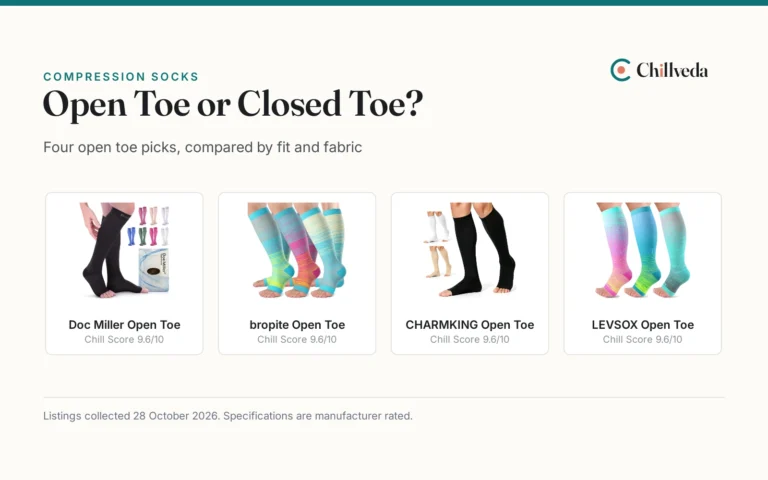
Open toe vs closed toe compression socks comes down to one difference: open toe socks leave the toes uncovered, while closed toe socks cover the whole foot. Choose open toe if you want your toes free and easy to check, and choose closed toe if you want full coverage and a warmer foot. The four picks below are all open toe styles, so this guide uses them to show what open toe looks like in practice, and where closed toe would differ.
This guide sets out the trade offs between the two styles, then compares four open toe listings by compression level, fabric, length, and pack size. Listings were collected 28 October 2026.
This article is informational and is not medical advice. Compression socks are not a treatment for a medical condition. If you have a circulation condition, diabetes, swelling that is new or one sided, or an acute injury, ask a clinician before choosing a compression level. See our Medical Disclaimer.
Chillveda earns a commission when you buy through links on this page, at no extra cost to you. As an Amazon Associate I earn from qualifying purchases. Affiliate disclosure.
Quick picks
-
1
 Doc Miller Open Toe Compression Socks, 20-30 mmHg Chill Score 9.6/10Check price on Amazon
An open toe, knee high sock with 20-30 mmHg graduated compression and sizing guidance based on calf measurement.
-
2
 3 Pairs Copper Toeless Compression Socks for Women Chill Score 9.6/10Check price on Amazon
An open toe, knee high sock in a 3 pair pack with 15-20 mmHg graduated compression.
-
3
 CHARMKING 3 Pairs Open Toe Compression Socks Chill Score 9.6/10Check price on Amazon
An open toe sock in a 3 count pack with 15-20 mmHg compression and machine wash care.
-
4
 LEVSOX Open Toe Compression Socks for Women & Men Chill Score 9.6/10Check price on Amazon
An open toe, knee high sock with 20-30 mmHg compression and machine wash care.

An open toe, knee high sock with 20-30 mmHg graduated compression and sizing guidance based on calf measurement.
Pros & ConsViewHide
Pros
- 20-30 mmHg graduated compression, per the listing
- Sizing guidance: measure the widest part of the calf
- Knee high, toeless design for all day wear
- Description covers everyday wear, work, and workouts
Cons
- No warranty term is stated
- No safety certification is stated
- Listing makes condition related claims we do not repeat as fact
- Firm 20-30 mmHg level may be too much for readers wanting lighter support
An open toe, knee high sock in a 3 pair pack with 15-20 mmHg graduated compression.
Pros & ConsViewHide
Pros
- 15-20 mmHg graduated compression, per the listing
- 3 pairs, per the title
- Fabric listed as 75% Nylon, 25% Polyester
- Five sizes listed, per the listing
Cons
- Title names copper, but the fabric line lists only nylon and polyester
- No warranty term is stated
- No safety certification is stated
- Listing makes circulation and recovery claims we do not repeat as fact

An open toe sock in a 3 count pack with 15-20 mmHg compression and machine wash care.
Pros & ConsViewHide
Pros
- 15-20 mmHg compression, per the spec table
- 3 count pack, per the spec table
- Fabric listed as 85% Nylon, 15% Spandex
- Machine wash care, per the spec table
Cons
- No description bullets are given in the listing data
- No warranty term is stated
- No safety certification is stated
- Size range is given as size labels, so check the chart before ordering
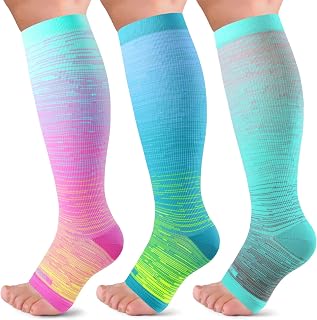
An open toe, knee high sock with 20-30 mmHg compression and machine wash care.
Pros & ConsViewHide
Pros
- 20-30 mmHg compression, per the spec table
- Fabric listed as 55% Nylon, 30% Polyester, 15% Spandex
- Knee high, per the spec table
- Machine wash care, per the spec table
Cons
- Pack size is unclear: spec table says 1 count, color field mentions 3 pairs
- No description bullets are given in the listing data
- No warranty term is stated
- No safety certification is stated
More to compare
 CTHH Toeless Compression Socks for Women & Men Open Toe KneeCheck price on Amazon
 CHARMKING 3 Pairs Open Toe Compression Socks for Women & MenCheck price on Amazon
 Doctor's Select 3 Pairs Copper Toeless Compression SocksCheck price on Amazon
 Lin Performance Compression Socks for Women and MenCheck price on Amazon
 bropite Open Toe Compression Socks for Women,3 Pairs TolessCheck price on Amazon
 Plus Size Toeless Compression Socks 20-30mmHg Wide Calf forCheck price on Amazon
Open toe vs closed toe compression socks at a glance
| Style | Toes | Coverage | Suits |
|---|---|---|---|
| Open toe | Uncovered | Knee high where the listing states a length | Readers who want free toes and easy foot checks |
| Closed toe | Covered | Whole foot | Readers who want full coverage and a warmer foot |
The trade off is simple. Open toe gives up toe coverage in exchange for toes that stay free, while closed toe gives up that freedom in exchange for a fully covered foot. The level is stated separately from the toe style on each listing: the listings below state 15-20 mmHg or 20-30 mmHg, so pick the level from the listing, then pick the toe style for comfort.
Why open toe suits some wearers
Open toe socks keep the toes out of the fabric, which suits readers whose toes feel cramped in a closed foot, or who want to look at their feet without removing the sock. The bropite listing describes graduated compression that is firmest at the ankle and eases toward the calf, and that shaping is about the leg, not the toes. Doc Miller states graduated compression without that ankle detail, and CHARMKING and LEVSOX state a level without describing graduation. For all day wear at a desk or on your feet, an open toe may feel cooler on the toes than a fully covered foot, since no fabric wraps them.
Open toe has limits worth stating plainly. It does not warm or protect the toes, so it is a poor match for cold rooms or for readers who want their whole foot covered. If toe coverage matters more than toe freedom, skip the open toe picks below and look for a closed toe listing with the same compression level.
When closed toe makes more sense
Closed toe suits readers who want one continuous covering over the whole foot, with no exposed toes. It keeps the whole foot covered, which matters in cold weather and for readers who dislike the feeling of bare toes inside shoes. The compression level still comes from the listing, so a closed toe sock at 15-20 mmHg and an open toe sock at 15-20 mmHg state the same level, and the choice between the two styles at the same level is about the foot.
Closed toe is not the better choice by default. Readers who want to check their feet during the day, or whose toes feel squeezed by a closed foot, may find the open toe picks below more comfortable. Match the style to the foot, and check the compression level on the listing.
Open toe compression socks worth comparing
These are scored on the Chill Score, which weighs performance, build, value, safety certifications, and warranty. No listing here states a safety certification or a warranty term, so all four score 0 for safety and warranty.
| Product | Chill Score | Perf. /35 | Build /25 | Value /25 | Safety /10 | Warranty /5 |
|---|---|---|---|---|---|---|
| Doc Miller Open Toe | 9.6 | 30 | 21 | 21 | n/a | 0 |
| bropite Open Toe | 9.6 | 29 | 20 | 21 | n/a | 0 |
| CHARMKING Open Toe | 9.6 | 28 | 20 | 21 | n/a | 0 |
| LEVSOX Open Toe | 9.6 | 28 | 20 | 20 | n/a | 0 |
Scores run from 9.2 to 9.8: each product’s point total is placed on that range, so more points always means a higher score. Safety counts only for powered gear or where the listing states safety features; where it does not apply, the score is taken over the remaining 90 points.
For sport use, see our compression socks for running roundup, and for other supports, see compression sleeves for weekend warriors.
Getting the fit right
- Measure the calf, not the shoe size. The Doc Miller listing warns against relying on clothing sizes and says to measure the widest part of the calf and check the sizing chart.
- Check the stated level. These listings state 15-20 mmHg or 20-30 mmHg, and the two levels are not interchangeable, so confirm the level before ordering.
- Confirm the pack size. CHARMKING lists 3 pairs, while LEVSOX is unclear on pack size and bropite’s title lists 3 pairs against a spec table Unit Count of 2 Count, so read the listing carefully before assuming a multi pack.
- Check the length. Three listings state knee high and CHARMKING states no length, so readers who want a shorter sock should check each listing’s stated length before ordering.
Common questions
What is the difference between open toe and closed toe compression socks?
Open toe socks leave the toes uncovered, while closed toe socks cover the whole foot. The compression level is stated separately on each listing, so the toe style is a comfort choice, not a compression choice.
What compression levels do these listings state?
CHARMKING and bropite state 15-20 mmHg, while LEVSOX and Doc Miller state 20-30 mmHg. Only bropite describes graduated compression, firmest at the ankle and easing toward the calf; Doc Miller states graduated compression without that detail, and CHARMKING and LEVSOX state a level without describing graduation. The level should be chosen with a clinician if you have a medical condition.
Are these open toe socks knee high?
Three of them are: Doc Miller, bropite and LEVSOX state knee high, while CHARMKING states no length. All four state a pull on closure. Readers who want a shorter length should check each listing’s stated length.
How do I pick a size?
Measure the widest part of the calf and check the sizing chart on the listing, as the Doc Miller listing advises, rather than relying on clothing sizes. CHARMKING lists sizes from Small-Medium to XX-Large, so the range varies by listing.
Sources: Amazon product listings for the socks named above, collected 28 October 2026. Related: our compression sleeves for weekend warriors.
Back to all recovery tools reviews.