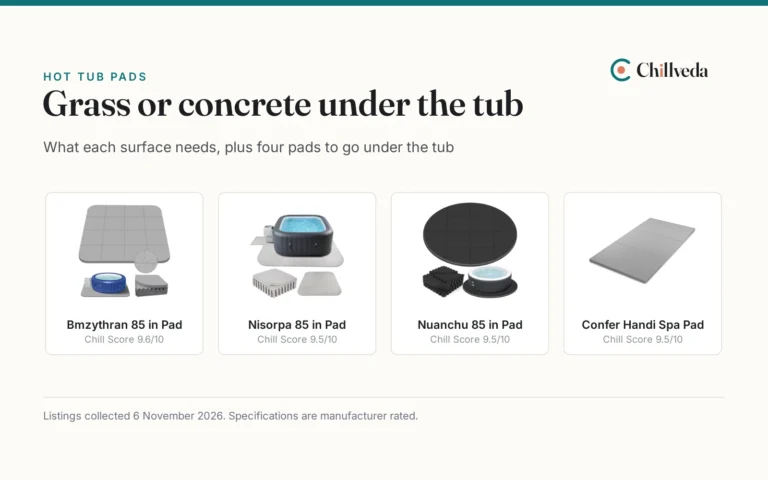
Grass vs concrete hot tub pad: a concrete pad is the straightforward base, while grass needs a pad between the tub and the ground, and the ground underneath still has to be flat, stable and load-bearing. No foam mat here levels uneven ground or replaces a structural base. This guide sets out what each surface asks of you, and the pads below: three foam mats made for inflatable tubs, and a hard pad set made as a concrete substitute base for hot tubs and spas.
Listings were collected 6 November 2026. The pads below cover both surfaces: a hard pad set that stands in for poured concrete, and three foam mats that cushion and insulate an inflatable tub. The foam mats are made for inflatable tubs, so measure the spa base and external pump layout before ordering.
This article is informational and is not medical advice. Follow your tub manual for water care and temperature, and ask a clinician first if you have a health condition or are pregnant. See our Medical Disclaimer.
Chillveda earns a commission when you buy through links on this page, at no extra cost to you. As an Amazon Associate I earn from qualifying purchases. Affiliate disclosure.
Quick picks
-
1
 1/2" Extra Thickness Hot Tub Mat & Pad Chill Score 9.6/10Check price on Amazon
A 1/2 inch thick interlocking EVA foam mat, 85 by 85 inches, made of 16 foam pads plus a small pump pad.
-
2
 Nisorpa 85 Inch Hot Tub Pad Foundation Chill Score 9.5/10Check price on Amazon
An 85 by 85 inch EVA foam pad, 1/2 inch thick, of 17 interlocking pieces that splice in 5 minutes.
-
3
 Nuanchu 85" Round Hot Tub Pad Chill Score 9.5/10Check price on Amazon
An 85 by 85 inch interlocking EVA foam mat, 0.6 inch thick, that cushions an inflatable spa and adds ground insulation.
-
4
 Confer Plastics Handi Spa Pad - 3 Pack (4'x8') Chill Score 9.5/10Check price on Amazon
A 3 pack of high-density polyethylene pads that lock together into a 4 by 8 foot pad, a concrete substitute base for hot tubs and spas.

A 1/2 inch thick interlocking EVA foam mat, 85 by 85 inches, made of 16 foam pads plus a small pump pad.
Pros & ConsViewHide
Pros
- 85 by 85 inches from 16 EVA pads plus a small pump pad
- High-density EVA foam with thermal insulation to reduce heat loss
- Double-sided non-slip frosted texture, waterproof
- Splices in 4, 8, 12 or 16 pieces for different size scenarios
Cons
- Title and bullets state 1/2 inch thick while the spec table lists 1.0 inches
- No warranty term stated
- No weight stated in the listing
- Multi-use design also serves as a pool, pet, camping and yoga mat

An 85 by 85 inch EVA foam pad, 1/2 inch thick, of 17 interlocking pieces that splice in 5 minutes.
Pros & ConsViewHide
Pros
- 17 pieces: 16 foam tiles plus 1 small mat for the pump
- 1/2 inch thick foam insulates against heat loss toward the floor
- Non-slip, wear-resistant EVA material
- Splices in 5 minutes and stores compactly
Cons
- Title and bullets state 85 by 85 inches while the spec table lists 87.0 inches
- No warranty term stated
- Normal odor on arrival, fades after time in an open place
- No weight stated in the listing

An 85 by 85 inch interlocking EVA foam mat, 0.6 inch thick, that cushions an inflatable spa and adds ground insulation.
Pros & ConsViewHide
Pros
- Assembles to 85 by 85 inches from interlocking tiles
- Dense EVA foam cushions the spa and adds ground insulation
- Water-resistant textured surface wipes clean and adds grip
- Tiles stack compactly for seasonal storage or transport
Cons
- Title says round while the mat assembles to a square 85 by 85 inch footprint
- Not intended to level uneven ground or replace a structural base
- No warranty term stated
- No small pump pad stated in the listing

A 3 pack of high-density polyethylene pads that lock together into a 4 by 8 foot pad, a concrete substitute base for hot tubs and spas.
Pros & ConsViewHide
Pros
- 3 pads lock together with built-in connectors to reduce shifting
- High-density polyethylene, listed to withstand 300 pounds of pressure per square foot
- Built-in strength pockets on the floor underside for durability
- Doubles as a mat under pool filter equipment, plastic sheds and trash cans
Cons
- Spec table lists a 47.0 pound item weight beside a stated 15 pounds per mat in the bullets
- No warranty term stated
- Avoid placing beneath gas heaters, a stated safety risk
- Extra pads are sold separately to increase the pad size
More to compare
 90 * 90 inch Hot Tub PadCheck price on Amazon
 8 Pack Outdoor Tub Foundation Base PadCheck price on Amazon
 Standartpark Vodaland Permeable PaversCheck price on Amazon
 BEAUTYOVO Interlocking Pool Pad 24 Sq FtCheck price on Amazon
 Confer Plastics Handi Spa PadCheck price on Amazon
 VERVESYS 85 in Hot Tub Mat & Pad for Inflatable TubsCheck price on Amazon
Choosing between grass vs concrete hot tub pad
Concrete is the straightforward base for a permanent setup. It stays where it is put, and a tub set on it sits on a firm, steady base. Grass asks more of you: the ground underneath still has to be flat, stable and load-bearing, and a pad cushions the tub and keeps it off wet ground. That is the whole difference in one sentence: concrete is the base, grass needs a base.
| Surface | Base | Watch out for |
|---|---|---|
| Concrete pad | Firm and permanent; a pad set can stand in for poured concrete | A poured pad stays where it is poured |
| Grass with a pad | The pad cushions the tub and keeps it off wet ground | Ground underneath must be flat, stable and load-bearing |
| Grass, bare tub | No pad, no cushion, no insulation | Uneven ground and wet grass under the tub |
Grass also brings water. A tub on bare grass sits on wet ground after rain, with no cushion and no insulation under it. A foam mat changes that: the EVA foam cushions the tub, adds ground insulation, and keeps the bottom of the tub off the ground. The hard pad set does the same job differently: it locks together into a firm pad that stands in for poured concrete, and it can also sit between a rough-surfaced wood deck and a concrete pad.
The pads in this guide
These are scored on the Chill Score, which weighs performance, build, value, safety and warranty. No pad here carries a safety listing, so the safety scores reflect only the grip and non-slip features the listings state, and the hard pad set scores zero on safety.
| Product | Chill Score | Perf. /35 | Build /25 | Value /25 | Safety /10 | Warranty /5 |
|---|---|---|---|---|---|---|
| Bmzythran 85 in Pad | 9.6 | 29 | 21 | 21 | 5 | 0 |
| Nisorpa 85 in Pad | 9.5 | 29 | 20 | 21 | 5 | 0 |
| Nuanchu 85 in Pad | 9.5 | 28 | 20 | 21 | 4 | 0 |
| Confer Handi Spa Pad | 9.5 | 30 | 22 | 19 | 0 | 0 |
Scores run from 9.2 to 9.8: each product’s point total is placed on that range, so more points always means a higher score.
For the tub itself, see our plug and play vs inflatable hot tub guide.
Setting up on grass
Start with the ground, not the pad. The Nuanchu listing is clear: use the mat beneath an inflatable hot tub on a flat, stable and load-bearing patio, deck, garage or indoor floor, and the design is not intended to level uneven ground or replace a structural base. Measure the spa base and external pump layout before ordering to confirm the inflatable hot tub fits the square footprint.
On grass, lay the pad first, then the tub. The interlocking tiles connect with puzzle-style edges into one large square pad without permanent installation, and the pieces stack compactly for seasonal storage or transport. The Confer pads lock together with built-in connectors to reduce shifting.
Setting up on concrete
Concrete is the easy surface: the Nuanchu listing asks for a flat, stable and load-bearing surface and names a patio, deck, garage or indoor floor. A foam mat on concrete still earns its place, because it cushions the tub and helps reduce contact with cold concrete while adding ground insulation. The Bmzythran and Nisorpa mats insulate against heat loss toward the floor, which is one thing a mat adds on a hard surface.
If you do not want to pour concrete, the Confer set is the middle path: 3 pads lock together into a 4 by 8 foot pad, and extra pads are sold separately to increase the pad size. The same pads can sit between a rough-surfaced wood deck and a concrete pad, or under pool filter equipment, plastic sheds and trash cans.
Common questions
Can I put a hot tub directly on grass?
A pad is the better route. The ground underneath must be flat, stable and load-bearing, and no foam mat here levels uneven ground or replaces a structural base. A concrete pad, or a pad set that stands in for one, gives the steadier base.
Is a concrete pad better than grass for a hot tub?
For a permanent setup, yes. Concrete stays where it is put, while grass needs a pad and flat ground underneath. If you do not want to pour concrete, the Confer set locks together into a 4 by 8 foot pad, and extra pads are sold separately to increase the pad size.
What size pad does an inflatable hot tub need?
The foam mats here assemble to 85 by 85 inches, and the Confer set makes a 4 by 8 foot pad. Measure the spa base and external pump layout before ordering to confirm the inflatable hot tub fits the footprint.
Do foam hot tub mats insulate?
Yes, according to the listings. The EVA foam adds ground insulation and reduces heat loss toward the floor, and the Nuanchu mat helps reduce contact with cold concrete, decking, tile or garage floors.
How do I clean a hot tub pad?
For the foam tile mats, rinse the tiles as needed, allow them to dry fully, then reassemble or store for the next setup. The Bmzythran mat wipes clean with a cleaning cloth, and the Nuanchu surface wipes clean after use.
Sources: Amazon product listings for the pads named above, collected 6 November 2026. Related: our concrete vs gravel hot tub pad, best inflatable hot tub mat for 85 inch round tub and best hot tub steps.
Back to all hot tub reviews.