Short answer
What is the main difference between a back stretcher and an inversion table?
A back stretcher is a small, curved arch placed on the floor or chair that provides localized passive extension to the lumbar curve under torso weight. An inversion table is a mechanical frame that suspends the user by the ankles, allowing gravity to decompress the body while hanging at an angle.
Side by side Choose a back stretcher if Choose an inversion table if
When back stiffness sets in at the end of a long workday, deciding between a compact floor tool and a dedicated piece of gym equipment comes down to your space, routine, and comfort with inverting. Choosing between a back stretcher vs inversion table means comparing passive floor arching against inverted gravitational traction. If you have limited floor space and want a simple, portable arch for passive lumbar stretching on the floor or a chair, choose a back stretcher; if you have dedicated room space, want full-body inverted traction, and can safely hang by your ankles, choose an inversion table.
This comparison examines how both options differ in body positioning, room requirements, setup, and safety, using concrete specifications from published listings. Listings were collected 14 October 2026.
This article is informational and is not medical advice. Inverting increases blood pressure and eye pressure, and spinal arches place direct pressure on lumbar vertebrae. Never invert alone, and consult a clinician first if you have high blood pressure, heart disease, glaucoma, a hernia, spinal instability, or are pregnant. See our Medical Disclaimer.
Chillveda earns a commission when you buy through links on this page, at no extra cost to you. As an Amazon Associate I earn from qualifying purchases. Affiliate disclosure.
Quick picks
-
1
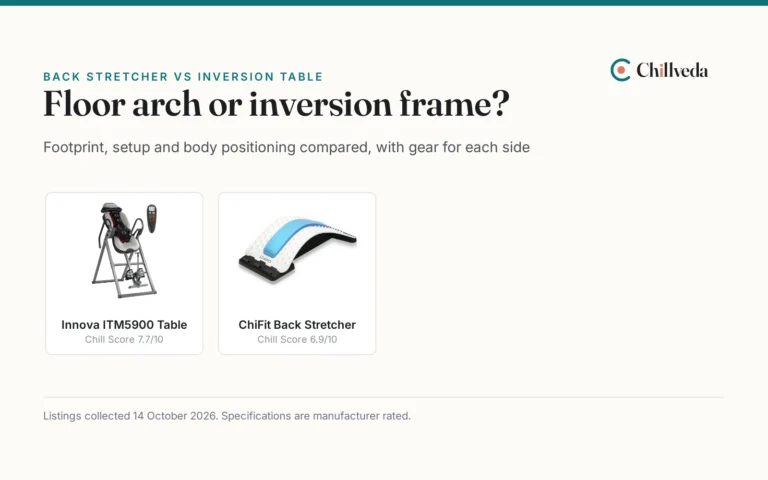
 Innova Advanced Heat and Massage Inversion Table Chill Score 9.6/10Check price on Amazon
An inversion table with a 6-position pin system, integrated heat and vibration massage, and a 300-pound capacity.
-
2
 ChiFit Multi-Level Back Stretching Device Chill Score 9.4/10Check price on Amazon
A lightweight multi-level lumbar arch with 3 gear adjustments and 92 acupressure points for floor or chair use.

An inversion table with a 6-position pin system, integrated heat and vibration massage, and a 300-pound capacity.
Pros & ConsViewHide
Pros
- 6-position pin system for angle adjustment
- Vertical massage pad covering spine with lumbar heat and vibration
- Accommodates users from 4 ft 10 in to 6 ft 6 in
- 1 year limited warranty stated
Cons
- Heavy 65-pound frame requires dedicated floor space
- Bullets list 46x28x61 inches while table lists 47x28x62 inches
- No electrical safety certification stated
- Assembly required before use

A lightweight multi-level lumbar arch with 3 gear adjustments and 92 acupressure points for floor or chair use.
Pros & ConsViewHide
Pros
- Lightweight at 1.12 pounds
- Compact 15 by 4 by 2.8 inch dimensions
- 3-gear adjustment slots for arch height
- 92 acupressure stimulation points
Cons
- No warranty term is stated
- No electrical heat or motorized massage
- Listing makes medical claims we do not repeat
- Care instructions specify dry clean only
More to compare
 MINOLL Back Stretcher for Lower Back Pain ReliefCheck price on Amazon
 Everlasting Comfort Lumbar Support Board Back Stretcher forCheck price on Amazon
 YESINDEED Back Stretcher PillowCheck price on Amazon
 Back StretcherCheck price on Amazon
 YAJIACLONE Back Stretcher for Lower BackCheck price on Amazon
 Back Stretcher for Lower Back Pain ReliefCheck price on Amazon
Back stretcher vs inversion table at a glance
| Feature | Back stretcher | Inversion table |
|---|---|---|
| Primary mechanism | Passive spinal arching over a floor or chair support | Inverted gravitational traction hanging from ankles |
| Assembly required | None stated, ready out of the box | Assembly required (hardware and frame components included) |
| Adjustability | 3 gear height levels (ChiFit example) | 6 position angle pin system (Innova example) |
| Footprint | 15 x 4 x 2.8 inches (ChiFit example) | 46 x 28 x 61 inches in bullets, 47 x 28 x 62 inches in table (Innova example) |
| Weight | 1.12 pounds (ChiFit example) | 65 pounds (Innova example) |
| User height limits | Not stated on the ChiFit listing | Accommodates users 4 ft 10 in to 6 ft 6 in (Innova example) |
| User weight limits | Not stated on the ChiFit listing | Accommodates users up to 300 pounds (Innova example) |
| Power needed | None | None for inverting; electrical outlet needed only for heated massage features (Innova example) |
| Stated warranty | None stated (ChiFit example) | 1 year limited warranty (Innova example) |
How body positioning and traction differ
The fundamental distinction between these options is body positioning and the mechanical force applied.
A back stretcher, illustrated by the ChiFit model, uses an arched plastic bridge placed flat on a floor, bed, or chair. The user reclines directly over the curve, allowing gravity to pull the torso downward over the apex. This creates localized passive extension through the lumbar region. The ChiFit example incorporates 92 acupressure massage points and 3 gear slots to vary arch height. It does not invert the body or pull lengthwise through the joints.
An inversion table, represented by the Innova example, uses an entirely different mechanical approach. The user stands against a padded bench, secures their ankles into an ankle holding system, and tilts back to rotate the table frame. Because the ankles are anchored, gravity pulls the user’s body weight downward away from the feet, creating axial traction along the spine. The Innova example incorporates a 6-position pin system to select the maximum inversion angle, and accommodates users measuring from 4 feet 10 inches to 6 feet 6 inches with a weight capacity of up to 300 pounds. It also integrates a vertical massage pad covering the spine area with lumbar heat and vibration.
Space, weight, and electrical requirements
Physical footprint and storage separate these tools as much as their mechanics.
The ChiFit back stretcher listing states dimensions of 15 by 4 by 2.8 inches and an item weight of 1.12 pounds. Because of its compact footprint, it requires no permanent room space and stores in a closet or drawer when not in use. It is completely mechanical and requires no electrical power or cords. For other compact recovery options, see our guide to the best foam rollers for back and best stretching straps.
By contrast, the Innova inversion table is a large, semi-permanent fixture. Its bullet points list assembled dimensions of 46 inches high by 28 inches wide by 61 inches deep, while its spec table lists 47 by 28 by 62 inches. It weighs 65 pounds, with package dimensions of 51 by 21 by 7.5 inches and a package weight of 29.94 kg. Beyond the floor footprint, an inversion table requires clear vertical and horizontal clearance so the user can rotate without hitting walls or low ceilings. Furthermore, the Innova example includes heat and vibration massage pads that require proximity to a standard wall outlet. For standalone inversion models, read our review of the best inversion tables, or browse general best back massagers.
Setup and daily routine
Ease of setup directly affects how consistently recovery equipment gets used.
A back stretcher requires virtually no preparation. The ChiFit example has no hardware assembly: you select one of the 3 gear height slots and place it on a firm surface. However, users must be comfortable getting down onto the floor and rising back up afterward, or use it seated in a chair.
An inversion table involves a structured setup process. The Innova example ships with parts that require initial assembly. Before each session, the user must adjust the frame height to match their body (supporting users between 4 feet 10 inches and 6 feet 6 inches), set the 6-position pin to the desired angle, step onto the foot platform, and secure the ankle holding system. Stepping in and out requires balance and comfort with inverted positioning.
Gear for each route
These are scored on the Chill Score: performance 35, build 25, value 25, safety certifications 10 where it applies and warranty 5. The Innova listing states no UL or ETL electrical certification for its heated pad, and the ChiFit listing states no independent safety certification, so both score 0 for safety.
| Product | Chill Score | Perf. /35 | Build /25 | Value /25 | Safety /10 | Warranty /5 |
|---|---|---|---|---|---|---|
| Innova ITM5900 Table | 9.6 | 28 | 20 | 19 | n/a | 2 |
| ChiFit Back Stretcher | 9.4 | 24 | 18 | 20 | n/a | 0 |
Scores run from 9.2 to 9.8: each product’s point total is placed on that range, so more points always means a higher score. Safety counts only for powered gear or where the listing states safety features; where it does not apply, the score is taken over the remaining 90 points.
Choose a back stretcher if
- You have limited room and need a tool that stores in a drawer or under a bed.
- You want a lightweight, portable device you can pack for travel or use on an office chair.
- You prefer a simple, non-electrical tool that requires zero assembly.
- You want localized passive lumbar extension rather than full-body inverted traction.
Choose an inversion table if
- You have dedicated floor space to house a full-size frame, plus ceiling clearance for inverted rotation.
- You want gravitational traction where hanging inverted pulls along the length of the spine.
- You have clearance from your physician and no medical contraindications such as high blood pressure or glaucoma.
- You are comfortable locking your ankles into a frame and hanging upside down or at steep angles.
Check Your Space First
- Floor footprint: The Innova inversion table lists assembled dimensions of 46 inches high by 28 inches wide by 61 inches deep in its bullets (and 47 by 28 by 62 inches in its table), requiring a dedicated open floor area.
- Ceiling and rotation clearance: The Innova table accommodates users from 4 feet 10 inches to 6 feet 6 inches and features a 6-position pin system to limit the inversion angle; confirm your room ceiling height before setting up the frame, as inverting swings the bed and user upward.
- Storage and weight: The ChiFit back stretcher weighs 1.12 pounds and measures 15 by 4 by 2.8 inches, storing easily in a drawer, while the Innova table weighs 65 pounds (29.94 kg in its shipping package) and remains a semi-permanent room installation.
- Power access: The Innova table features an integrated vertical massage pad with lumbar heat and vibration that requires a nearby electrical outlet, whereas the ChiFit arch is entirely passive and non-electrical.
Common questions
What is the main difference between a back stretcher and an inversion table?
A back stretcher is a small, curved arch placed on the floor or chair that provides localized passive extension to the lumbar curve under torso weight. An inversion table is a mechanical frame that suspends the user by the ankles, allowing gravity to decompress the body while hanging at an angle.
Can a back stretcher provide the same traction as an inversion table?
No. A back stretcher provides localized arching over its curved surface, such as the 3 gear height settings on the ChiFit example. An inversion table uses gravity to pull traction through the entire lower body and spine, as demonstrated by the Innova example with its 6-position angle pin system.
How much floor space does an inversion table require compared to a back stretcher?
The ChiFit back stretcher measures 15 by 4 by 2.8 inches and rests on any floor or chair. The Innova inversion table lists assembled dimensions of 46 inches high by 28 inches wide by 61 inches deep in bullets (and 47 by 28 by 62 inches in its table), and requires additional surrounding clearance to rotate safely.
Is an inversion table harder to assemble than a back stretcher?
Yes. The ChiFit back stretcher arrives ready to use with no assembly required. The Innova inversion table weighs 65 pounds and includes installation parts that require assembly, along with adjustments for user height between 4 feet 10 inches and 6 feet 6 inches.
Who should avoid using an inversion table?
Inverting places the body upside down or at steep angles, which elevates blood pressure and intraocular pressure. Individuals with high blood pressure, glaucoma, heart conditions, hernias, or spinal instability should consult a physician before using an inversion table. Anyone using an inversion table should avoid inverting alone.
Back to all recovery tool reviews.