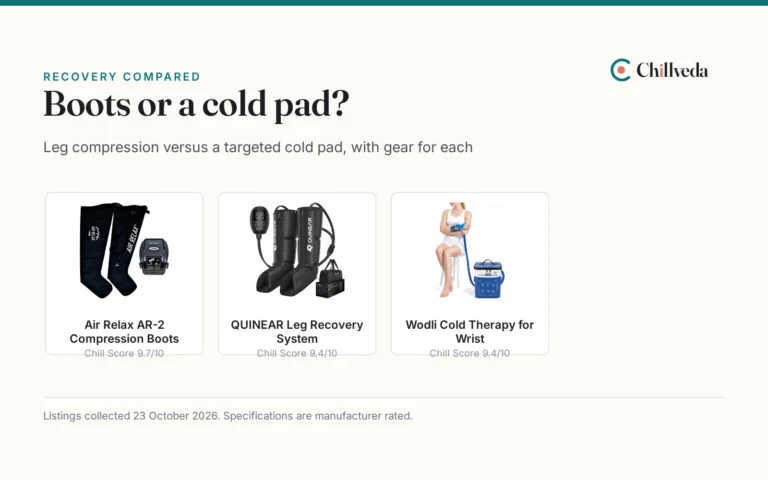
Short answer
Can compression boots replace a cold pad for a sore joint?
Not directly. Boots squeeze the legs; they do not cool a joint. A cold therapy pad is built to sit on one joint, such as the Wodli wrist wrap.
Side by side Choose compression boots if Choose a cold therapy machine if
Compression boots vs cold therapy machine comes down to what you are recovering and where. Compression boots inflate air chambers around the legs in cycles; a cold therapy machine circulates ice water through a pad strapped to one joint. Pick boots for leg recovery after training or long days on your feet. Pick a cold therapy machine when a single joint, such as a wrist, is your focus.
This comparison covers mechanism, body coverage, setup and upkeep, with the gear for each route. It does not compare health effects, because recovery claims belong to the listings, not to us. Listings were collected 23 October 2026.
This article is informational and is not medical advice. Talk to your clinician about recovery after surgery or injury.
Chillveda earns a commission when you buy through links on this page, at no extra cost to you. As an Amazon Associate I earn from qualifying purchases. Affiliate disclosure.
Quick picks
-
1
 Air Relax AR-2 Professional Compression Boots Chill Score 9.7/10Check price on Amazon
FDA-cleared compression boots for legs, battery powered, with a 1-year warranty and lifetime support stated.
-
2
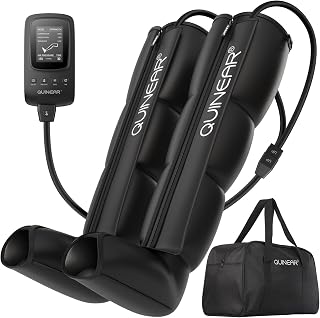
 QUINEAR Leg Recovery System for Athletes Chill Score 9.4/10Check price on Amazon
Corded electric compression boots for feet and legs, with 3-channel air compression and 10 programs on an LED controller.
-
3
 16QT Portable Cold Therapy Machine for Wrist After Chill Score 9.4/10Check price on Amazon
16QT portable cold therapy machine with a wrist pad, stating 12 hours of continuous cooling.
FDA-cleared compression boots for legs, battery powered, with a 1-year warranty and lifetime support stated.
Pros & ConsViewHide
Pros
- FDA-cleared (USA) and CE MDD (EU) cleared, per the listing
- 1-year warranty plus lifetime support stated
- Battery powered for use away from an outlet
- Listed for circulation, flexibility and muscle relief
Cons
- Legs only; no arm or hip coverage stated
- Battery means charging between sessions
- 8 lb unit plus boots to store between sessions
- No auto shut-off stated in the listing

Corded electric compression boots for feet and legs, with 3-channel air compression and 10 programs on an LED controller.
Pros & ConsViewHide
Pros
- 3-channel air compression with 3 modes and 3 intensities
- 10 massage programs on an LED handheld controller
- Covers feet and legs, not legs only
- Auto shut-off stated in the listing
Cons
- No safety certification stated
- No warranty term stated
- Corded electric; needs an outlet nearby
- Relief claims are the listing's, not independently verified

16QT portable cold therapy machine with a wrist pad, stating 12 hours of continuous cooling.
Pros & ConsViewHide
Pros
- 16QT with 12 hours of continuous cooling stated
- Wrist-specific pad for a hard-to-ice joint
- Leak-proof and lightweight wrap
- Timer with 4 settings and 3 cold intensity levels
Cons
- Wrist only; not for hips or larger joints
- No safety certification stated
- No warranty term stated
- Needs ice and water to run
More to compare
 QUINEAR Air Compression Recovery Boots for AthletesCheck price on Amazon
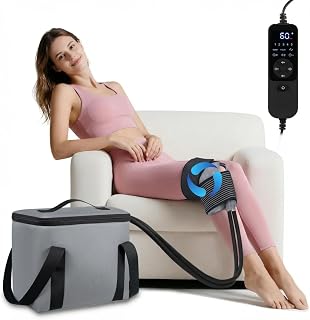 Ice Machine for Knee After SurgeryCheck price on Amazon
 Inmoredo Ice Machine for Knee After SurgeryCheck price on Amazon
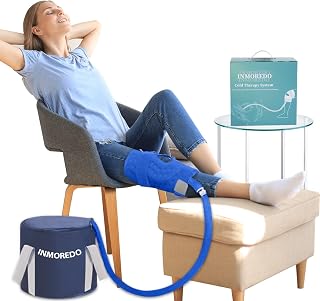 Inmoredo Cold Therapy MachineCheck price on Amazon
 Air Relax AR-2 Professional Compression BootsCheck price on Amazon
 Programmable Ice Machine for Shoulder After Surgery w/TimerCheck price on Amazon
Compression boots vs cold therapy machines at a glance
Boots wrap the legs and inflate in cycles; the two examples here cover legs (Air Relax) and feet plus legs (QUINEAR). The cold therapy machine example pumps ice water through a shaped pad and targets the wrist (Wodli). Boots need power and a place to sit; the machine needs ice, water and a pad that fits the joint. Neither side replaces the other: legs versus one joint is the whole decision.
How each side works
Compression boots
Boots use air chambers that inflate and deflate in sequence, squeezing the leg from foot upward. The Air Relax runs on battery and lists FDA clearance; the QUINEAR plugs in and offers 3-channel compression with 10 programs. Both are sit-down devices: you put the boots on, run a cycle and take them off.
Cold therapy machines
Machines circulate cold water from an iced reservoir through a pad strapped to the joint. The Wodli example holds 16QT and states 12 hours of continuous cooling for the wrist. Setup means filling with ice and water and strapping the pad on; the machine then runs on its own with a timer.
Body coverage and fit
Boots cover a region: legs, or feet and legs. That suits general leg fatigue, post-training recovery and long days standing. The cold therapy example covers one joint, the wrist. If your focus is a specific joint, a pad shaped for it beats a boot that never touches it. If your issue is tired legs with no single trouble spot, boots cover more ground.
Setup, space and upkeep
Boots need the least setup: plug in or charge, put them on, press start. The QUINEAR’s cord ties it to an outlet; the Air Relax’s battery frees it. The Wodli needs ice and water every session and a pad that fits; the listing claims a leak-proof design, but you still fill, drain and dry the reservoir. For daily use, boots are the lower-effort habit. For a targeted cold pad, the machine’s setup is the price of precision.
Gear for each route
These are scored on the Chill Score: performance 30, build 20, value 20, safety certifications 15 and warranty 15. Only the Air Relax states a safety clearance and a warranty term, so it leads the scoring; the other two score 0 for safety and warranty.
| Product | Chill Score | Perf. /35 | Build /25 | Value /25 | Safety /10 | Warranty /5 |
|---|---|---|---|---|---|---|
| Air Relax AR-2 Compression Boots | 9.7 | 30 | 21 | 20 | 8 | 3 |
| QUINEAR Leg Recovery System | 9.4 | 28 | 20 | 21 | 0 | 0 |
| Wodli Cold Therapy for Wrist | 9.4 | 26 | 20 | 20 | 0 | 0 |
Scores run from 9.2 to 9.8: each product’s point total is placed on that range, so more points always means a higher score.
Choose compression boots if
- Your recovery is your legs: after training, running or long shifts on your feet.
- You want a sit-down routine with no ice, water or filling.
- You can use the device near an outlet, or you pick the battery-powered Air Relax.
- Stated safety clearance matters to you; the Air Relax is FDA-cleared per its listing.
Choose a cold therapy machine if
- Your focus is one joint, such as the wrist covered by the Wodli.
- You want hours of continuous cooling; the Wodli states 12 hours.
- You have ice and water on hand and a place to set the reservoir.
- You want a pad shaped for the joint, not a boot that covers the whole leg.
For more machine options, see cold therapy machines for home use.
Common questions
Can compression boots replace a cold pad for a sore joint?
Not directly. Boots squeeze the legs; they do not cool a joint. A cold therapy pad is built to sit on one joint, such as the Wodli wrist wrap.
How long does a cold therapy machine run?
The Wodli lists 12 hours of continuous cooling. The listing also describes 4 timer settings, including a continuous mode.
Do compression boots need a prescription?
The listings do not state that one is required. The Air Relax notes FDA clearance as a device; ask your clinician if you have a medical condition.
Which is better after leg day?
For general leg fatigue after training, boots match the need: they cover the legs. For a specific sore joint, a shaped cold pad fits better. See also compression boots vs cold plunge.
Back to all compression boots reviews.