Short answer
What is the difference between pulsed and continuous red light therapy?
Continuous mode delivers a steady, unbroken stream of light for the entire duration of a session. Pulsed mode turns the LEDs on and off rapidly at a set frequency, such as 10Hz. Because the diodes cycle off during parts of the session, pulsed mode delivers less total optical energy unless peak power or session time is increased.
Pulsed vs continuous red light therapy comes down to how the LEDs emit light during a session. Continuous mode delivers a steady, unbroken stream of light from start to finish. Pulsed mode rapidly cycles the LEDs on and off at a set frequency, such as 10Hz, introducing dark intervals between light pulses. Because consumer listings do not document proven differences in results, choosing between modes comes down to the controls and comfort settings provided on each device.
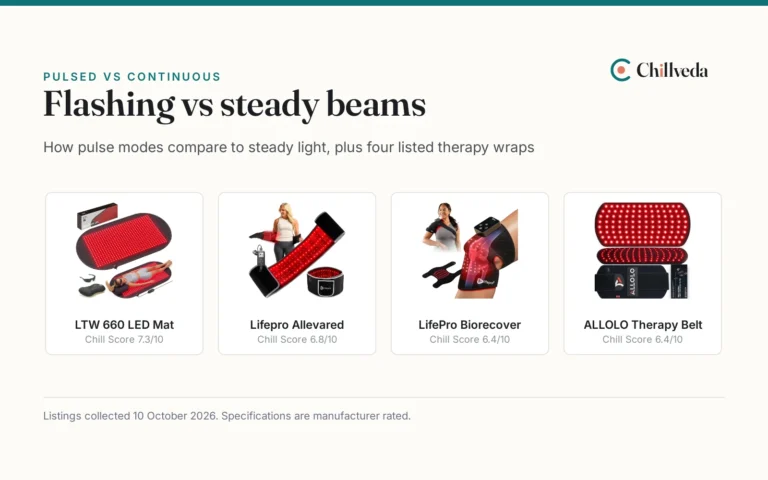
This guide explains how pulse frequencies differ from continuous output, how to read stated irradiance across operating modes, and four red light therapy wraps with listed pulse settings. Listings were collected 10 October 2026.
This article is informational and is not medical advice. Red light therapy devices emit bright optical radiation. Do not stare directly into the LEDs, and use appropriate eye protection during sessions. Consult a physician before beginning light therapy if you take light-sensitizing medications, have retinal conditions, or are pregnant. See our Medical Disclaimer.
Chillveda earns a commission when you buy through links on this page, at no extra cost to you. As an Amazon Associate I earn from qualifying purchases. Affiliate disclosure.
Quick picks
-
1
 LTW Flagship 660 LEDs Red Light Therapy Mat Chill Score 9.5/10Check price on Amazon
A 46.8 by 25.6 inch red light mat with 660 LEDs, five intensity levels, two pulse modes, and a manufacturer rating of 90 mW/cm².
-
2
 Lifepro Allevared Red Light Therapy Belt -105 Chill Score 9.4/10Check price on Amazon
A 49.5 by 7.8 inch neoprene belt with 105 triple chip LEDs, continuous red and near infrared modes, and pulse settings.
-
3
 LifePro Biorecover - Red Light Therapy for Knee Chill Score 9.4/10Check price on Amazon
A wrap for knees and joints with 40 triple chip LEDs, a 10Hz pulse mode, and a 3000mAh rechargeable battery.
-
4
 ALLOLO Red Light Therapy for Body Chill Score 9.4/10Check price on Amazon
A 16.7 by 7.9 inch red light pad with 112 triple chip beads, a 10Hz pulse mode, and a wired USB controller.

A 46.8 by 25.6 inch red light mat with 660 LEDs, five intensity levels, two pulse modes, and a manufacturer rating of 90 mW/cm².
Pros & ConsViewHide
Pros
- Largest coverage here, 46.8 by 25.6 inches
- 660 triple chip LEDs with 660nm and 850nm wavelengths
- Manufacturer-rated irradiance of 90 mW/cm² and 50W power
- Offers 5 intensity levels and 2 pulse modes
Cons
- No warranty term is stated
- No safety certifications listed
- Heaviest unit here at 5.9 pounds package weight
- Listing confusingly refers to red light as heat therapy
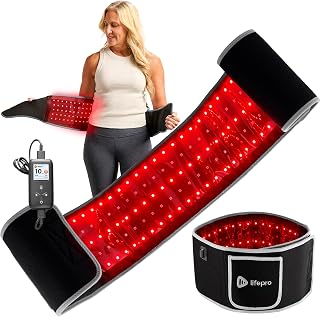
A 49.5 by 7.8 inch neoprene belt with 105 triple chip LEDs, continuous red and near infrared modes, and pulse settings.
Pros & ConsViewHide
Pros
- Long 49.5 inch belt fits back, waist, or legs
- 105 triple chip LEDs with 660nm and 850nm wavelengths
- Timer adjustable from 1 to 30 minutes
- Listing states lifetime customer support
Cons
- No irradiance figure or power wattage stated
- Pulse frequency in Hz is not specified
- No safety certifications listed
- Claims rechargeable use without stating battery capacity

A wrap for knees and joints with 40 triple chip LEDs, a 10Hz pulse mode, and a 3000mAh rechargeable battery.
Pros & ConsViewHide
Pros
- Cordless design with 3000mAh battery rated up to 2 hours
- 10Hz pulse mode plus 3 intensity levels
- Form-fitting wrap for knees, shoulders, and elbows
- Listing states lifetime customer support
Cons
- Listing title states 60 and 40 LEDs while bullets state 40
- Contradiction on thickness, listed as 0.3 and 1 inch
- No irradiance figure or wattage stated
- No safety certifications listed

A 16.7 by 7.9 inch red light pad with 112 triple chip beads, a 10Hz pulse mode, and a wired USB controller.
Pros & ConsViewHide
Pros
- Pulse mode specifies 10Hz rate at 600 flicks per minute
- 112 lamp beads with 3 chips per bead (112 red and 224 infrared)
- Includes 31.1 inch strap and 31.1 inch extension belt
- Timer offers preset options from 5 to 30 minutes
Cons
- No warranty term is stated
- No built-in battery, requires wired USB power
- No irradiance figure or wattage stated
- No safety certifications listed
More to compare
 72"x33" Medical-Grade TPU Full Body Red Light Therapy Mat forCheck price on Amazon
 iRestore EssentialCheck price on Amazon
 INIA FLARE 3-in-1 Red Light Therapy Beauty Device for Face &Check price on Amazon
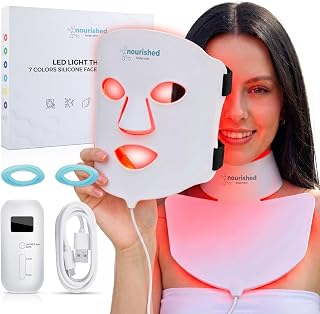 Nourished Bodynskin LED Light Therapy Face & Neck MaskCheck price on Amazon
 LED-Red-Light-Therapy-DeviceCheck price on Amazon
 iRestore Professional Laser Red Light Therapy for Hair GrowthCheck price on Amazon
Understanding pulsed vs continuous red light therapy
| Device | Stated modes | Pulse rate | Timer range |
|---|---|---|---|
| LTW 660 LED Mat | 5 intensity levels, 2 pulse modes | 2 modes (Hz not stated) | 10 to 90 minutes |
| Lifepro Allevared | Red, NIR, both (pulsed in title) | Not stated | 1 to 30 minutes |
| ALLOLO Therapy Belt | Red, NIR, red+NIR, pulse mode | 10Hz (600 flicks per min) | 5 to 30 minutes |
| LifePro Biorecover | 3 intensity levels, 10Hz pulse | 10Hz | Not stated (up to 2 hr battery) |
The listings show clear variation in how makers present pulse settings. ALLOLO and LifePro Biorecover specify a concrete frequency of 10Hz, with ALLOLO clarifying that 10Hz corresponds to 600 flicks per minute. In contrast, LTW advertises two pulse modes without listing their frequency in hertz, while Lifepro features pulsed modes in the product title but defines its three selectable settings as red, near-infrared, or both together.
How pulsing changes energy delivery and duty cycle
In continuous wave mode, LEDs stay constantly lit. When a pad runs in continuous mode for a set timer duration, such as 10 or 30 minutes, the body receives steady light without pauses. In pulsed mode, the diodes alternate rapidly between on and off states. For example, a 10Hz frequency means the diodes pulse 10 times every second. During each pulse cycle, the diodes alternate between active emission and dark intervals. Because the LEDs are turned off during portions of each cycle, pulsing delivers light for only a fraction of the total elapsed time at a given peak output.
When peak irradiance remains the same, pulsing delivers less total light energy over an identical session duration compared to continuous illumination. To reach a comparable total exposure, a pulsed session must run longer, or the device must deliver higher peak output during its on intervals. When comparing continuous output to pulse mode red light devices, the primary technical difference is how optical energy accumulates over time. Our guide to how to read a red light irradiance number explains how power density and time combine to determine total optical exposure.
Coverage area and power format differences
Red light therapy devices also differ substantially in coverage area, power sources, and rated output. The LTW mat provides the largest surface among the four listings, measuring 46.8 by 25.6 inches with a manufacturer-rated power output of up to 50W and stated irradiance up to 90 mW/cm². Operating a large mat requires dedicated space, while flexible wraps allow targeted positioning directly against joints and muscles.
Power delivery ranges from corded connections to internal batteries. The ALLOLO pad uses a wired setup with a 122 inch USB controller line, powered by an adapter or mobile power supply, and states a maximum operating temperature of 111.56 F. In contrast, the LifePro Biorecover knee wrap houses a 3000mAh rechargeable battery rated for up to 2 hours of cordless use. The Lifepro Allevared belt measures 49.5 by 7.8 by 0.4 inches with a stated weight of 15.2 ounces, securing with neoprene wraps around the torso or limbs.
Red light wraps and mats with pulsed modes
These are scored on the Chill Score, which weighs performance 35, build 25, value 25, safety certifications 10 where it applies and warranty 5. Because none of these four listings state third-party electrical safety certifications like ETL or UL, all four score 0 for safety.
| Product | Chill Score | Perf. /35 | Build /25 | Value /25 | Safety /10 | Warranty /5 |
|---|---|---|---|---|---|---|
| LTW 660 LED Mat | 9.5 | 30 | 21 | 21 | 0 | 0 |
| Lifepro Allevared | 9.4 | 27 | 20 | 20 | 0 | 1 |
| LifePro Biorecover | 9.4 | 26 | 19 | 19 | 0 | 1 |
| ALLOLO Therapy Belt | 9.4 | 27 | 19 | 21 | 0 | 0 |
Scores run from 9.2 to 9.8: each product’s point total is placed on that range, so more points always means a higher score.
For more choices across compact formats, see our best targeted red light devices roundup.
Choosing and using modes in practice
- Check whether pulse rate is stated. If your routine requires a specific frequency, verify that the listing states the rate in hertz. ALLOLO and LifePro Biorecover state 10Hz, while others list pulse modes without specifying frequency.
- Account for session duration. Because pulsing turns the diodes off during part of each cycle, total light delivered is lower than continuous mode over the same period when peak irradiance is unchanged. Stated timers range from 1 to 30 minutes on the Lifepro belt, 5 to 30 minutes on ALLOLO, and 10 to 90 minutes on LTW.
- Wear eye protection. Red and near-infrared LEDs emit intense optical radiation. LTW includes red light blocking glasses with its mat, and protective eyewear is sensible whenever facing active diodes.
- Review power requirements. Cordless wraps like the Biorecover offer portability via a 3000mAh battery rated up to 2 hours, whereas larger pads require a continuous USB connection or wall outlet.
- Inspect fit and closure. Flexible belts use hook-and-loop closures to secure around the waist, back, or joints. Ensure the strap dimensions match your target area before purchasing.
Common mistakes
- Assuming pulsed mode always delivers more light energy than continuous mode during a session of equal length.
- Expecting unstated pulse frequencies to match published research when the maker does not list hertz.
- Looking directly into active red or near-infrared diodes without appropriate eye protection.
- Assuming all red light pads are non-thermal, even when high-powered listings describe heat therapy or reach temperatures like 111.56 F.
Common questions
What is the difference between pulsed and continuous red light therapy?
Continuous mode delivers a steady, unbroken stream of light for the entire duration of a session. Pulsed mode turns the LEDs on and off rapidly at a set frequency, such as 10Hz. Because the diodes cycle off during parts of the session, pulsed mode delivers less total optical energy unless peak power or session time is increased.
What does a 10Hz pulse mode mean on a red light device?
A 10Hz pulse mode means the LEDs cycle on and off 10 times every second. On consumer listings, this is sometimes described as 600 flicks per minute. The rapid cycling creates short pauses between light pulses rather than a constant beam.
Does continuous mode deliver more light than pulse mode?
Yes, over an identical session time with identical peak irradiance, continuous mode delivers more total optical energy. Because pulsed light turns off during portions of each cycle, the LEDs emit light for less cumulative time. To match the total energy delivered by continuous light, a pulsed session must run longer.
Do red light therapy pads generate heat?
While red light therapy relies on optical emission rather than heating elements, active diodes and electrical components can warm up during use. For example, ALLOLO notes its pad reaches a maximum temperature of 111.56 F while clarifying it is not a heating pad, whereas LTW markets its 50W mat for consistent heat therapy. Users should follow stated session timers and avoid sleeping on plugged-in devices.
Do you need eye protection when using red light wraps?
Makers advise avoiding direct eye exposure to active LED diodes. Near-infrared wavelengths like 850nm are largely invisible to the human eye, which means the blink reflex will not protect against high optical power. Devices like the LTW mat include dedicated red light blocking glasses in the package, and wearing protective eyewear is a sensible precaution.
Sources: Amazon product listings for the red light therapy wraps and mats named above, collected 10 October 2026. Related: our red light wavelengths explained and red light therapy eye safety.
Back to all red light therapy reviews.