Short answer
What is the main difference between 810nm and 850nm in red light therapy?
Both wavelengths sit in the near-infrared spectrum and penetrate beneath the skin surface. The 810nm wavelength aligns with absorption peaks for mitochondrial cytochrome c oxidase enzymes, making it common in targeted clinical panels. The 850nm wavelength is the industry-standard near-infrared band in consumer equipment, widely utilized for muscle and joint recovery.
Whether you are setting up a recovery corner in your bedroom before work or unwinding on the living room sofa in the evening, choosing the right near-infrared equipment depends on understanding 810nm vs 850nm red light therapy. If you want targeted cellular stimulation aimed at mitochondrial enzyme absorption, choose an 810nm device, such as the multi-wavelength panel in our review. If you want the most widely available near-infrared band for joint and muscle recovery across flexible pads and panels, choose 850nm.
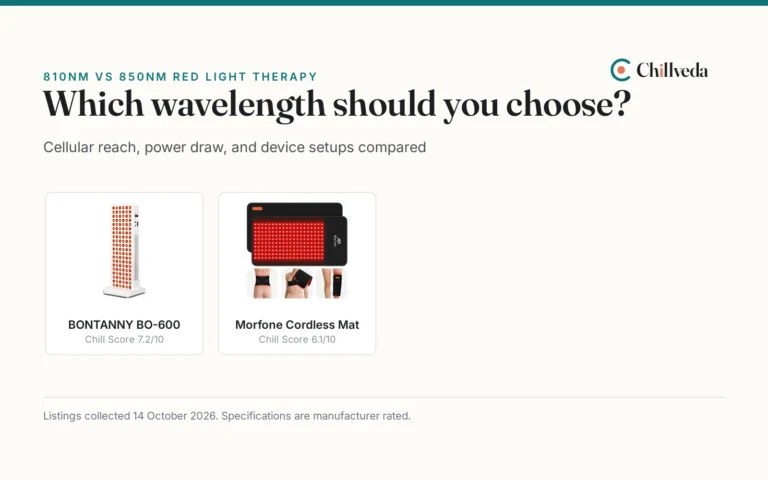
This head-to-head comparison examines penetration depth, power source, device format, and daily maintenance across two real examples from our research. Listings were collected 14 October 2026.
This article is informational and is not medical advice. Red light and near-infrared light penetrate tissue and can affect vision. Always wear appropriate protective eyewear during sessions, avoid staring directly into the LEDs, and consult a healthcare professional before starting light therapy if you are pregnant, take photosensitizing medication, or have an underlying skin condition. See our Medical Disclaimer and our guide on red light therapy eye safety.
Chillveda earns a commission when you buy through links on this page, at no extra cost to you. As an Amazon Associate I earn from qualifying purchases. Affiliate disclosure.
Quick picks
-
1
 BONTANNY Red Light Therapy with Base Chill Score 9.5/10Check price on Amazon
A freestanding floor panel combining 5 wavelengths from 630nm to 850nm across 120 dual-chip LEDs with a stated 3-year warranty.
-
2
 Morfone Red Light Therapy for Body Chill Score 9.3/10Check price on Amazon
A cordless 24 by 12 inch flexible red light wrap powered by a 10000mAh battery with 200 LEDs emitting 660nm and 850nm light.
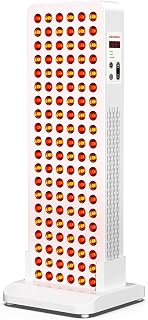
A freestanding floor panel combining 5 wavelengths from 630nm to 850nm across 120 dual-chip LEDs with a stated 3-year warranty.
Pros & ConsViewHide
Pros
- Features 5 wavelengths: 630nm, 660nm, 810nm, 830nm, and 850nm
- 120 dual-chip LEDs with 60-degree beam angle
- Freestanding base with 35 by 18 inch coverage area stated at 6 inches
- 3-year manufacturer warranty stated
Cons
- Spec table lists wattage as 130 milliwatts
- Remote control requires 23A 12V battery that is not included
- Heavy at 14.2 pounds package weight
- No safety certifications stated

A cordless 24 by 12 inch flexible red light wrap powered by a 10000mAh battery with 200 LEDs emitting 660nm and 850nm light.
Pros & ConsViewHide
Pros
- Cordless design with built-in 10000mAh rechargeable battery
- 200 LEDs combining 660nm red and 850nm near-infrared
- Generous 24 by 12 inch pad with elastic strap
- Lightweight design weighing 0.56 kg
Cons
- Irradiance figure is not stated
- Spec table says 1 setting while text lists 2 modes
- No warranty term is stated
- No safety certifications stated
More to compare
 Cold Light Therapy MachineCheck price on Amazon
 Red Light Therapy DeviceCheck price on Amazon
 Red Light TherapyCheck price on Amazon
 Red Light Therapy and Near Infrared Light Therapy Wand forCheck price on Amazon
 Hooga Red Light Therapy Panel DeviceCheck price on Amazon
 Red Light Therapy for Face and BodyCheck price on Amazon
810nm vs 850nm red light therapy at a glance
| Feature | 810nm wavelength | 850nm wavelength |
|---|---|---|
| Spectrum band | Near-infrared | Near-infrared |
| Primary cellular target | Cytochrome c oxidase (mitochondria) | Mitochondria and deep tissue chromophores |
| Common tissue application | Neurological, deep tissue, and targeted recovery | Muscles, tendons, ligaments, and joints |
| Typical device formats | Multi-wavelength panels and specialized targeted units | Full-body panels, tabletop panels, wraps, and pads |
| Common wavelength pairings | 630nm, 660nm, 830nm, 850nm | 660nm deep red |
| Featured example in our review | BONTANNY BO-600 (includes 810nm in a 5-wave array) | Morfone cordless mat (combines 660nm and 850nm) |
| Format of our featured example | Freestanding floor panel | Flexible wearable wrap |
| Power source of our featured example | Corded electric | 10000mAh built-in battery |
Wavelength depth and cellular target
Both 810nm and 850nm belong to the near-infrared spectrum, which sits immediately past visible red light. Human tissue absorbs optical energy differently depending on the wavelength, and our red light wavelengths explained guide outlines how these bands interact with cells.
The 810nm band corresponds closely with peak absorption for cytochrome c oxidase, a photoreceptor enzyme inside cellular mitochondria. Because of this targeted interaction, manufacturers often include 810nm in clinical-style arrays intended for neurological, deep tissue, or localized recovery. The BONTANNY BO-600 example incorporates 810nm alongside 630nm, 660nm, 830nm, and 850nm across 120 dual-chip LEDs.
The 850nm band is the most widespread near-infrared wavelength in home wellness products. Near-infrared diodes operating at 850nm are efficient to manufacture and penetrate effectively into muscle tissue, tendons, and joint capsules. In the Morfone example, 850nm diodes are paired with 660nm visible red light across 200 LEDs to support daily physical wellness.
Power, irradiance, and electrical setup
Light delivery depends heavily on power delivery and radiant output, as detailed in our guide on how to read a red light irradiance number. Comparing these two listings highlights distinct engineering approaches.
The BONTANNY BO-600 panel relies on corded electric power and publishes a stated irradiance of 130mW/cm² at 6 inches across a 35 by 18 inch coverage area. However, the listing creates confusion in its spec table by listing wattage as 130 milliwatts, mistakenly copying the irradiance figure into the electrical rating. It also includes a remote control that requires a 23A 12V battery, which is not supplied in the box.
The Morfone cordless mat does not publish an irradiance figure, leaving its radiant power density unstated. Instead, it prioritizes cordless mobility with a built-in 10000mAh battery that the listing states powers 5 to 8 sessions of 30 minutes on a single charge. The spec table lists 1 setting, but the description details 2 operating modes including a 10Hz Relaxation Mode and 4 timer intervals of 10, 15, 20, and 30 minutes.
Form factor and daily routine
When comparing devices that offer these wavelengths, shoppers encounter different form factors tailored to specific routines. Our reviews of full body red light panels and red light therapy belts explore these setups in depth.
A multi-wavelength panel like the BONTANNY BO-600 requires a stationary space. It features a freestanding floor mount with a package weight of 14.2 pounds and dimensions of 24.5 by 9.75 by 6.32 inches. Sessions involve standing, sitting, or lying at a set distance of 6 inches from the 60-degree LED lenses, keeping the built-in cooling fan unobstructed.
In contrast, a flexible mat like the Morfone example measures 24 by 12 inches and weighs 0.56 kg (with a package weight of 1.23 pounds). Made of polyester fabric with an elastic strap, it wraps directly around the waist, back, shoulder, or knee while you sit on a sofa or recline in bed.
Gear for each route
These devices are evaluated on our Chill Score framework: performance 35, build 25, value 25, safety certifications 10 where it applies, and warranty 5. Neither listing publishes a third-party electrical safety listing such as UL or ETL, so both earn 0 for safety.
| Product | Chill Score | Perf. /35 | Build /25 | Value /25 | Safety /10 | Warranty /5 |
|---|---|---|---|---|---|---|
| BONTANNY BO-600 | 9.5 | 29 | 20 | 20 | 0 | 3 |
| Morfone Cordless Mat | 9.3 | 24 | 18 | 19 | 0 | 0 |
Scores run from 9.2 to 9.8: each product’s point total is placed on that range, so more points always means a higher score.
Choose 810nm if
- You want near-infrared light focused on peak cytochrome c oxidase absorption for cellular and deep tissue stimulation.
- You are looking for a multi-wavelength array that pairs 810nm with other bands like 630nm, 660nm, 830nm, and 850nm, as in the BONTANNY example.
- You prefer a stationary panel setup that delivers stated irradiance across a larger treatment zone.
- You want to target localized recovery areas where 810nm research is concentrated.
Choose 850nm if
- You want the industry-standard near-infrared wavelength for routine muscle, joint, and connective tissue recovery.
- You want the widest selection of device formats, from large home panels to wearable wraps and pads.
- You prefer the flexibility of cordless, battery-powered recovery gear like the Morfone example.
- You want a proven near-infrared pairing with 660nm red light for daily wellness routines.
Check Your Space First
- Floor footprint: The BONTANNY BO-600 panel has package dimensions of 24.5 by 9.75 by 6.32 inches at 14.2 pounds, requiring a level indoor floor space with room to position yourself 6 inches away from the 60-degree lenses.
- Outlet proximity: The BONTANNY unit runs on corded electric power and needs an outlet nearby, plus a 23A 12V battery for the remote control that you must purchase separately.
- Storage and portability: The Morfone mat measures 24 by 12 inches and weighs 0.56 kg (1.23 pounds package weight), allowing it to fit into an ordinary drawer or travel bag between recovery sessions.
- Recharging access: The Morfone mat relies on an internal 10000mAh battery that provides 5 to 8 sessions of 30 minutes, so plan a convenient spot near an outlet to recharge the battery pack.
Common questions
What is the main difference between 810nm and 850nm in red light therapy?
Both wavelengths sit in the near-infrared spectrum and penetrate beneath the skin surface. The 810nm wavelength aligns with absorption peaks for mitochondrial cytochrome c oxidase enzymes, making it common in targeted clinical panels. The 850nm wavelength is the industry-standard near-infrared band in consumer equipment, widely utilized for muscle and joint recovery.
Can 810nm and 850nm wavelengths be used in the same session?
Yes, many recovery panels combine both wavelengths in a single array. The BONTANNY BO-600 panel in our review includes 810nm, 830nm, and 850nm alongside visible red light. Using multiple near-infrared bands allows you to cover different tissue depths simultaneously.
Is 810nm or 850nm better for joint and muscle recovery?
Neither wavelength is universally better, as both reach deep into tissue. The 850nm wavelength is supported by a large volume of consumer gear and is standard for joint wraps like the Morfone mat. The 810nm wavelength is commonly selected for deep cellular stimulation in structured panel setups.
Do near-infrared wavelengths require eye protection?
Yes, eye protection is essential when using any near-infrared device. Because near-infrared light at 810nm and 850nm is largely invisible to the human eye, your natural blink reflex does not trigger. Always wear dedicated protective goggles rather than looking toward the LEDs.
Does 810nm penetrate deeper than 850nm?
Both 810nm and 850nm penetrate effectively through the skin into deeper tissues because both fall within the near-infrared optical window. The 810nm wavelength aligns with absorption peaks for mitochondrial cytochrome c oxidase enzymes, while 850nm experiences relatively low tissue scattering, allowing both to reach deep muscle and joint layers depending on irradiance and tissue composition.
Back to all red light therapy reviews.