Short answer
Which stays warm longer, a heating pad or a hot water bottle?
An electric heating pad produces warmth for the duration of its timer setting before automatically shutting off. The Ruqiji pad offers timer settings for 0.5, 1, 1.5, and 2 hours, while the GENIANI pad shuts off after 2 hours. A hot water bottle delivers warmth that peaks immediately after filling and steadily cools as its 2 liters of water lose heat.
Side by side Choose a heating pad if Choose a hot water bottle if
Heating pad vs hot water bottle comes down to power source, heat delivery, and safety. An electric heating pad plugs into an outlet to provide steady, continuous warmth with multi-level heat settings and automatic shut-off timers. A hot water bottle is a cordless, non-electric container filled with heated tap water that provides portable warmth that gradually cools over time. Pick a heating pad if you want adjustable, continuous warmth while resting on a couch or sitting at a desk without boiling water. Pick a hot water bottle if you want cordless portability, natural cooling heat, or a way to warm a bed before sleep without power cords.
This comparison covers temperature control, burn safety, power draw, upkeep, and convenience, using four catalog examples to illustrate each design. It evaluates practical tradeoffs rather than medical claims. Listings were collected 10 October 2026.
This article is informational and is not medical advice. Heat therapy carries risks of thermal burns and skin damage. Never fall asleep while using an electric heating pad or place it underneath your body, never apply boiling water directly to bare skin, and check your skin frequently. Consult a healthcare provider before use if you have diabetes, reduced skin sensitivity, neuropathy, or circulatory conditions. See our Medical Disclaimer.
Chillveda earns a commission when you buy through links on this page, at no extra cost to you. As an Amazon Associate I earn from qualifying purchases. Affiliate disclosure.
Quick picks
-
1
 Ruqiji 17''x33'' XXXL King Size Heating Pad Chill Score 9.5/10Check price on Amazon
A 150-watt electric heating pad listed with 10 heat settings, four auto-off timers, and a stated UL certification, though its spec table contradicts its dimensions.
-
2
 samply 2L Hot Water Bottle with Knitted Cover Chill Score 9.4/10Check price on Amazon
A 2-liter PVC hot water bottle with a transparent body, wide filling mouth, and a soft purple knitted cover for non-electric warmth.
-
3
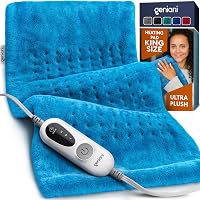 GENIANI Electric Heating Pad for Back Pain Chill Score 9.4/10Check price on Amazon
A 12 by 24 inch microplush electric heating pad with three heat settings and a two-hour auto shut-off, leaving wattage unstated.
-
4
 samply 2L Hot Water Bottle with Knitted Cover Chill Score 9.3/10Check price on Amazon
A 2-liter hot water bottle with a pink knitted cover and BPA-free PVC construction that omits product dimensions in its listing.

A 150-watt electric heating pad listed with 10 heat settings, four auto-off timers, and a stated UL certification, though its spec table contradicts its dimensions.
Pros & ConsViewHide
Pros
- 10 temperature settings from 95 F to 140 F stated
- Stated UL certification with built-in overheat protection
- Four auto-off countdown timer options from 0.5 to 2 hours
- 150 watts on 60 hertz power listed
Cons
- Spec table contradicts title on dimensions: 19 by 24 inches versus 17 by 33 inches
- Spec table lists 12 heat settings while title and bullets state 10
- Spec table lists flannel while bullets state microfiber
- No warranty term is stated

A 2-liter PVC hot water bottle with a transparent body, wide filling mouth, and a soft purple knitted cover for non-electric warmth.
Pros & ConsViewHide
Pros
- 2 liter capacity listed (2000 ml)
- BPA-free polyvinyl chloride body with knitted cover
- Transparent bag body allows visible water level
- Wide mouth design for easier water injection
Cons
- No safety certification is stated
- No warranty term is stated
- Heat declines continuously as water cools
- Requires handling hot water during filling
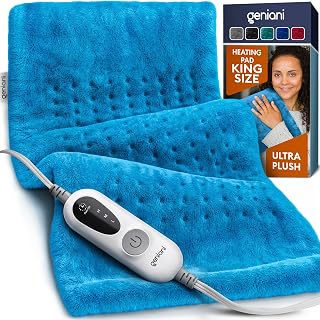
A 12 by 24 inch microplush electric heating pad with three heat settings and a two-hour auto shut-off, leaving wattage unstated.
Pros & ConsViewHide
Pros
- 12 by 24 inch coverage with flexible microplush fabric
- Three heat settings with moist and dry heat options
- Two-hour automatic shut-off feature
- Machine washable fabric after unplugging controller
Cons
- Wattage is not stated in the listing
- No safety certification is stated
- No warranty term is stated
- Fewer heat settings than larger digital pads

A 2-liter hot water bottle with a pink knitted cover and BPA-free PVC construction that omits product dimensions in its listing.
Pros & ConsViewHide
Pros
- 2 liter capacity listed (item volume 2 liters)
- BPA-free polyvinyl chloride construction with soft knitted cover
- Transparent body helps monitor water level while filling
- Can be used for hot or cold compress
Cons
- Product dimensions are not stated, only package dimensions (12.87 x 11.85 x 1.89 inches)
- No safety certification is stated
- No warranty term is stated
- Heat fades over time without continuous power
More to compare
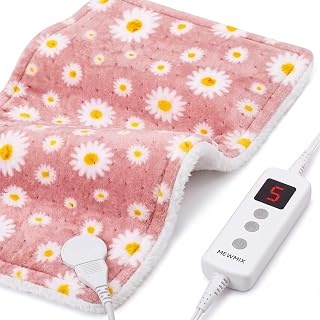 Electric Heating Pad for Back Period Cramp Neck Shoulder PainCheck price on Amazon
 HELLOMOTO Heating Pad for BackCheck price on Amazon
 Weighted Heating Pad for Back Neck and ShouldersCheck price on Amazon
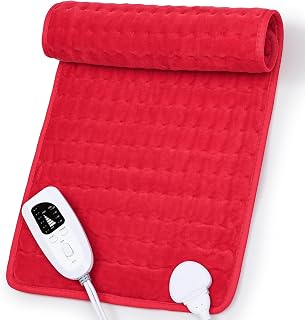 Heating PadCheck price on Amazon
 Heating Pad Electric Heat PadCheck price on Amazon
 GENIANI Electric Heating Pad for Back Pain & Cramps ReliefCheck price on Amazon
Heating pad vs hot water bottle at a glance
| Heating pad | Hot water bottle | |
|---|---|---|
| Heat source | Electric heating elements | Pre-heated or boiled water |
| Heat control | Multi-level heat settings | Declines steadily as water cools |
| Heat duration | Continuous until timer shuts off | Gradually cools over time |
| Portability | Tethered to a wall outlet and cord | Completely cordless and portable |
| Electrical draw | Active power draw (150 watts on Ruqiji) | No electrical draw during use |
| Moisture options | Dry and moist heat (select models) | Hot compress or cold compress |
| Cleaning | Machine washable fabric cover or pad | Wipe clean body with washable knit cover |
| Safety controls | Automatic shut-off and overheat protection | Protective knit cover and wide mouth |
Power draw and energy use compared
A primary difference between an electric heating pad and a hot water bottle is how each device handles energy. An electric pad draws active electrical power continuously while operating, whereas a hot water bottle consumes no electrical power during use.
Among the catalog listings, the Ruqiji heating pad is the only model that states an electrical rating, specifying 150 watts on 60 hertz. The GENIANI example leaves its wattage unstated, meaning buyers cannot verify its power consumption before purchasing. A pad running at 150 watts draws energy for the duration of its operating cycle, with the Ruqiji pad offering timer settings up to 2 hours and the GENIANI pad featuring an automatic shut-off after 2 hours.
In contrast, both samply hot water bottles hold 2 liters (2000 ml) of water and draw no electricity while warming. The only energy requirement occurs beforehand when heating water on a stove or in a kettle. Once filled and closed, the bottle radiates heat without an electrical connection or power draw.
| Model | Stated power rating | Stated operating duration |
|---|---|---|
| Ruqiji electric pad | 150 watts, 60 hertz | 0.5, 1, 1.5, or 2 hours (timer) |
| GENIANI electric pad | Not stated | 2 hours (auto shut-off) |
| samply purple bottle | No draw (cordless) | Declines as 2 liters cool |
| samply pink bottle | No draw (cordless) | Declines as 2 liters cool |
Temperature regulation and heat delivery
Electric heating pads maintain sustained warmth until their auto-off timers expire. The Ruqiji pad provides 10 distinct temperature settings ranging from 95 F to 140 F, paired with four countdown timer options spanning 0.5 to 2 hours. The GENIANI example offers three preset heat levels (low, medium, and high) with a fixed two-hour automatic shut-off. Both pads deliver steady heat that does not drop until the timer expires. In addition, the GENIANI pad advertises both dry and moist heat options, though the listing does not detail the moist heat application method.
In contrast, hot water bottles offer no active temperature regulation. When filled with hot tap or boiled water, both 2-liter samply bottles deliver their highest heat immediately, which then steadily declines as thermal energy dissipates into the surrounding room and body. This natural cooling curve provides built-in protection against prolonged high temperatures, but it means users must refill the bottle with fresh hot water to restore heat. Both samply examples also list dual-use functionality, allowing them to serve as cold packs when filled with chilled water.
For dedicated shopping guides on each category, see our best heating pads and our best hot water bottles roundups.
Burn safety and handling precautions
Both heat methods require careful attention to burn prevention, but they present entirely different risk profiles. An electric heating pad introduces electrical and contact burn hazards. The Ruqiji listing specifically notes that the pad must never be used on a sleeping, disabled, or unconscious person, or on anyone insensitive to heat. Users must not sit on, lie underneath, or sharply fold the pad, and the controller must remain uncovered to prevent overheating. The Ruqiji example carries a stated UL certification with overheat protection, whereas the GENIANI listing states no independent electrical certification.
Hot water bottles eliminate electrical components, cord tripping hazards, and electromagnetic fields entirely, but they introduce scalding risks. Pouring hot water into an open container carries a risk of accidental splashes on hands and arms. Both samply listings incorporate a wide mouth design and a transparent polyvinyl chloride body to make water injection easier and keep the fill level visible. Furthermore, hot water bottles must never be placed against bare skin without a buffer; both samply models include a soft knitted cover to reduce the risk of contact burns. Hot water bottles can also leak if the stopper is cross-threaded or if the bladder ruptures under excessive body weight.
Upkeep and convenience
Convenience depends on whether you value cord-free movement or hands-off operation. Electric heating pads require no water preparation: plugging in the cord and pressing a button starts the heat immediately. Cleaning is straightforward on both electric models featured here: the GENIANI pad is listed as machine washable once the power cord is detached, and the Ruqiji pad features a removable controller with washable fabric. However, electric pads restrict you to the length of the electrical cord and proximity to an electrical outlet.
Hot water bottles require an external heat source, such as a kettle or stove, plus careful pouring, capping, and draining. Once filled and closed, however, they are completely portable. You can move freely around the house, carry them in a vehicle, or pre-warm a bed without managing power cables. The samply listings state the bottles are reusable and include a knitted cover, but they do not list specific washing or drying instructions.
Gear for each route
These products are scored on the Chill Score: performance 35, build 25, value 25, safety certifications 10 where it applies, and warranty 5. The Ruqiji heating pad is the only model stating an independent UL certification, earning 12 points for safety. The GENIANI heating pad and both samply hot water bottles leave safety certifications unstated, scoring zero in that category. None of the four listings states a concrete manufacturer warranty term, so all score zero for warranty.
| Product | Chill Score | Perf. /35 | Build /25 | Value /25 | Safety /10 | Warranty /5 |
|---|---|---|---|---|---|---|
| Ruqiji Heating Pad | 9.5 | 29 | 18 | 20 | 8 | 0 |
| samply Purple Bottle | 9.4 | 27 | 20 | 21 | 0 | 0 |
| GENIANI Heating Pad | 9.4 | 26 | 20 | 20 | 0 | 0 |
| samply Pink Bottle | 9.3 | 24 | 19 | 20 | 0 | 0 |
Scores run from 9.2 to 9.8: each product’s point total is placed on that range, so more points always means a higher score.
Choose a heating pad if
- You want consistent warmth that remains steady until the automatic shut-off timer turns the pad off.
- You want multiple heat settings, such as the 10 temperature levels on the Ruqiji example or three heat levels on the GENIANI.
- You want rapid heat while seated or relaxing near an electrical outlet without boiling and pouring water.
- You value washable fabric construction with a detachable controller.
Choose a hot water bottle if
- You want portable, cordless warmth that can move anywhere or pre-warm a bed without electrical cords.
- You want no active electricity consumption while using the product.
- You prefer heat that gradually tapers off naturally rather than running continuously.
- You want a reusable container that is also listed for cold compress use.
Common questions
Which stays warm longer, a heating pad or a hot water bottle?
An electric heating pad produces warmth for the duration of its timer setting before automatically shutting off. The Ruqiji pad offers timer settings for 0.5, 1, 1.5, and 2 hours, while the GENIANI pad shuts off after 2 hours. A hot water bottle delivers warmth that peaks immediately after filling and steadily cools as its 2 liters of water lose heat.
Can you sleep with a heating pad or a hot water bottle?
You should not sleep directly on an active electric heating pad because prolonged contact heat can cause burns. The Ruqiji listing explicitly notes the pad is not for use on sleeping or unconscious persons, and warns against lying or sitting on the pad. A hot water bottle poses less risk of continuous overheating because it gradually cools down, making it popular for warming a bed before sleeping.
Does an electric heating pad use more energy than a hot water bottle?
An electric heating pad draws active power from an outlet while running, such as the 150 watts specified on the Ruqiji listing. The GENIANI example leaves its wattage unstated, though both electric pads include auto-off timers to prevent indefinite operation. A hot water bottle consumes no electricity during use, requiring energy only when heating its 2 liters of water.
Which is better for travel and outdoor use?
A hot water bottle is more adaptable for travel, camping, or outdoor settings because it does not require an electrical outlet. As long as you have access to heated water, a 2-liter bottle provides portable warmth anywhere. Electric heating pads require a household power outlet and restrict movement to the reach of the cord.
Can hot water bottles burst or leak?
Hot water bottles can leak if the threaded stopper is improperly closed, worn out, or subjected to excessive pressure. The samply models feature polyvinyl chloride construction and a wide mouth opening to facilitate filling. To reduce risks, inspect the container regularly, avoid filling with vigorously boiling water, and never sit or lie directly on the bottle.
Back to all recovery tools reviews.