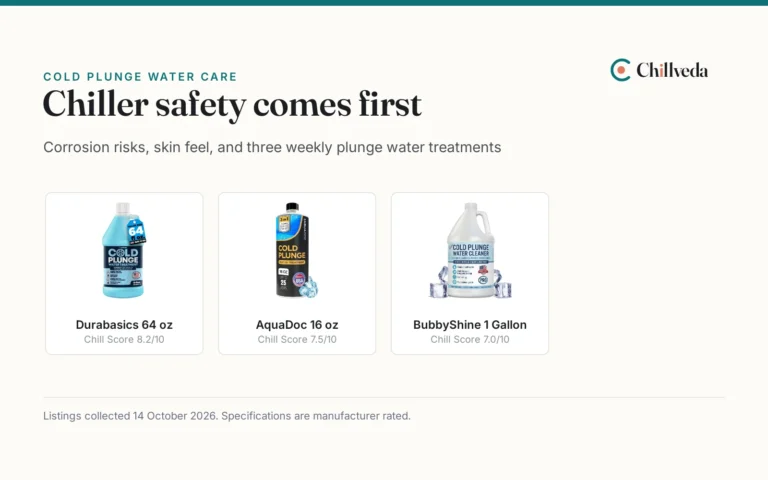
Stepping out to your garage or patio in the early morning for a cold session requires clean, balanced water, and choosing between a salt water vs chlorine cold plunge comes down to equipment protection and maintenance style. For dedicated cold plunge tubs with an electric chiller, direct liquid water treatments or hypochlorous acid solutions are generally safer for heat exchangers than salt water systems. Dissolved salt can accelerate corrosion on stainless steel chiller coils, internal pumps, and fittings unless the manufacturer explicitly rates every component for salt use. Direct liquid cleaners avoid this corrosion risk while maintaining water clarity on a simple weekly schedule.
This guide sets out how salt systems and direct water treatments work in cold water, how corrosion affects chillers, what to expect for daily skin feel, and water treatments to help keep your tub clear. Listings were collected 14 October 2026.
This article is informational and is not medical advice. Cold water immersion causes intense cold shock, rapid breathing, and afterdrop where core temperature continues falling after exiting. Never plunge alone or while impaired. Do not use a cold plunge if you are pregnant, or have cardiovascular conditions, high blood pressure, or peripheral vascular disease without medical clearance. Exit immediately if you feel lightheaded, numb, or unwell. See our Medical Disclaimer.
Chillveda earns a commission when you buy through links on this page, at no extra cost to you. As an Amazon Associate I earn from qualifying purchases. Affiliate disclosure.
Quick picks
-
1
 Durabasics 3in1 Cold Plunge Water Treatment Chill Score 9.7/10Check price on Amazon
A 64-ounce water stabilizer and cleaner made in the USA that requires 2 ounces per 100 gallons every two weeks.
-
2
 AquaDoc Cold Plunge Water Treatment Chill Score 9.5/10Check price on Amazon
A 16-ounce weekly liquid water cleaner made in the USA that requires 1 ounce per 100 gallons for routine cold plunge care.
-
3
 Cold Plunge Water Treatment, Cold Plunge Cleaner Chill Score 9.5/10Check price on Amazon
A 1-gallon hypochlorous acid liquid cleaner requiring 8 ounces weekly per 100 gallons for cold plunge tubs and chillers.

A 64-ounce water stabilizer and cleaner made in the USA that requires 2 ounces per 100 gallons every two weeks.
Pros & ConsViewHide
Pros
- Large 64-ounce volume provides up to 64 weeks of maintenance
- Clear instructions for 100, 200, and 300-gallon setups
- Requires only 2 ounces per 100 gallons every two weeks
- Made in the USA
Cons
- No warranty term is stated
- No safety certifications stated
- Requires an initial addition of 16 ounces per 100 gallons
- Heavier 4-pound bottle to store

A 16-ounce weekly liquid water cleaner made in the USA that requires 1 ounce per 100 gallons for routine cold plunge care.
Pros & ConsViewHide
Pros
- Compact 16-ounce bottle suits smaller tubs and barrels
- Low routine requirement of 1 ounce per 100 gallons weekly
- Includes cloudy-water instructions of 1 ounce per 250 gallons
- Made in the USA
Cons
- No warranty term is stated
- No safety certifications stated
- Model number ColdPlunge32 contradicts the 16-ounce package size
- 16-ounce bottle covers only 16 weeks of routine care

A 1-gallon hypochlorous acid liquid cleaner requiring 8 ounces weekly per 100 gallons for cold plunge tubs and chillers.
Pros & ConsViewHide
Pros
- Large 1-gallon (128 fluid ounce) bottle volume
- Hypochlorous acid formula free of bleach and ammonia
- Formulated for tubs running with water chillers
- Aims to help protect water filter life
Cons
- No warranty term is stated
- No safety certifications stated
- Listing contradicts itself between HOCl and an enzyme formula
- High usage rate of 8 ounces weekly depletes 1 gallon in 16 weeks
More to compare
 Water StabilizerCheck price on Amazon
 Oh Yuk 5-in-1 Cold Plunge Water TreatmentCheck price on Amazon
 Spazazz Regul8 Cold Plunge Stabilizer Water Treatment for IceCheck price on Amazon
 VEVOR Ice Bath Tub XLCheck price on Amazon
 Active Aqua Water Chiller with BoostCheck price on Amazon
 The Pod Company Standard Water ChillerCheck price on Amazon
Salt water vs chlorine cold plunge: comparison overview
| Comparison factor | Salt water system | Chlorine / HOCl treatment |
|---|---|---|
| Sanitizing agent | Hypochlorous acid generated by salt cell | Direct liquid treatment or hypochlorous acid |
| Chiller compatibility | Requires titanium or salt-rated heat exchanger | Broadly compatible with standard chillers |
| Skin comfort | Soft water feel from dissolved salt | Comfortable with low-odor plunge formulas |
| Setup complexity | Requires dedicated salt cell and monitoring | Simple weekly liquid additions into the tub |
| Equipment risk | Corrosion on unrated stainless steel and seals | Low equipment risk when following directions |
The operational difference between these two approaches centers on equipment design rather than water cleanliness alone. Both methods rely on hypochlorous acid to purge contaminants, but circulating dissolved salt through a system not engineered for marine conditions introduces significant mechanical risk.
How salt water systems work and the chiller corrosion risk
Simply dissolving salt in a cold plunge does not sanitize the water. To sanitize using salt, a setup requires an electrolytic salt chlorinator cell in the plumbing line. When saline water passes over charged plates inside the cell, electrolysis converts dissolved sodium chloride into hypochlorous acid. In effect, a salt water system still sanitizes with chlorine, but the active agent is generated from dissolved salt rather than poured from a bottle.
The primary consideration for cold plunge owners is equipment compatibility. Salt water accelerates corrosion on common metals. Many cold plunge chillers use stainless steel heat exchanger coils and standard pump seals. Unless the chiller maker explicitly lists a titanium heat exchanger and salt-compatible components, circulating salt water can corrode coils, degrade seals, and damage cooling mechanisms.
How liquid water treatments work in cold water
Direct liquid water treatments provide routine care without requiring specialized electrolytic plumbing. In cold water, organic residue from sweat and body oils can accumulate and cause cloudiness or odors if left untreated. Specialized cold plunge formulas, including hypochlorous acid (HOCl) cleaners and 3-in-1 water stabilizers, break down body oils, sweat, and residue while avoiding the strong chemical scents of traditional swimming pool shock.
Using a direct liquid treatment also eliminates the corrosion danger to your chiller. Because you are not maintaining high salt concentrations, standard stainless steel evaporator coils and water pumps operate safely. Routine care involves checking clarity with water strips for cold plunge and adding measured amounts on a regular schedule.
Cold plunge water treatments worth considering
These are scored on the Chill Score, which weighs performance 35, build 25, value 25, safety certifications 10 where it applies, and warranty 5. Because none of these liquid listings publish third-party safety certifications or formal warranty terms, each scores 0 for safety and 0 for warranty.
| Product | Chill Score | Perf. /35 | Build /25 | Value /25 | Safety /10 | Warranty /5 |
|---|---|---|---|---|---|---|
| Durabasics 64 oz | 9.7 | 30 | 21 | 22 | n/a | 0 |
| AquaDoc 16 oz | 9.5 | 29 | 19 | 20 | n/a | 0 |
| BubbyShine 1 Gallon | 9.5 | 27 | 18 | 19 | n/a | 0 |
Scores run from 9.2 to 9.8: each product’s point total is placed on that range, so more points always means a higher score. Safety counts only for powered gear or where the listing states safety features; where it does not apply, the score is taken over the remaining 90 points.
For more options and tub maintenance supplies, see our guide to the best cold plunge water treatments.
Maintaining cold plunge water in practice
- Check chiller compatibility before adding salt. Verify that your chiller manual states titanium heat exchanger construction before adding any salt to your tub. When in doubt, stick to liquid plunge cleaners.
- Follow listed application rates. In a 100-gallon setup, Durabasics calls for 2 ounces every two weeks, providing a 64-week supply from a 64-ounce bottle. For larger setups, the maker lists 4 ounces for 200 gallons and 6 ounces for 300 gallons. AquaDoc requires 1 ounce per 100 gallons weekly from a 16-ounce bottle, with an alternate rate of 1 ounce per 250 gallons for cloudy water.
- Run water circulation during additions. Always run your water chiller pump when adding liquid cleaner to ensure the formula distributes evenly throughout the water.
- Shower before plunging. Rinsing off lotions, sweat, and skin oils before entering your plunge drastically reduces organic residue, helping your filter and water stabilizer last longer.
- Maintain physical filtration. Liquid treatments clarify water and break down oils, but a mechanical sediment filter is still needed to trap hair and physical particles.
Common water care mistakes
- Assuming salt water contains no chlorine, when electrolysis actually produces hypochlorous acid.
- Adding pool-grade salt to an unrated chiller and corroding stainless steel heat exchanger coils.
- Using standard swimming pool chlorine tablets that overconcentrate and damage tub liners.
- Skipping weekly cleaner additions until water turns visibly cloudy or develops residue.
- Relying solely on liquid treatments while neglecting to rinse or replace the mechanical water filter.
Common questions
Can you use salt water in any cold plunge tub?
Check your tub and chiller documentation before introducing salt. Dissolved salt accelerates corrosion on stainless steel heat exchanger coils, pumps, and metal fittings unless the manufacturer explicitly rates the equipment for salt water. For setups with standard metal components, makers advise against salt additions to avoid damaging internal cooling parts.
Does salt water eliminate the need for chlorine?
Salt water systems do not eliminate chlorine; they generate it. An electrolytic salt cell converts dissolved sodium chloride into hypochlorous acid, which is the same active sanitizing agent found in chlorine water care. The difference is continuous on-site generation rather than pouring liquid cleaner into the water.
How often do you change water in a cold plunge?
AquaDoc indicates that regular weekly water care helps maintain fresh water between changes, while Durabasics notes that biweekly maintenance helps minimize water changes. How often a tub needs refilling depends on bather frequency, whether users rinse off before entering, and consistent adherence to the treatment schedule.
Is hypochlorous acid gentler on skin than pool chlorine tablets?
Hypochlorous acid (HOCl) formulas are significantly gentler than pool chlorine tablets or household bleach. Specialized cold plunge HOCl cleaners are formulated without harsh additives or strong chemical odors, helping keep water clear while remaining comfortable for daily full-body immersion.
Can you use regular pool chlorine in an ice bath?
Standard pool chlorine tablets and granular shocks are formulated for large, warm swimming pools with high sunlight exposure, not small, cold tubs. In a 100-gallon setup, standard pool chlorine can easily overconcentrate, creating harsh fumes, skin irritation, and corrosion on tub surfaces and chiller fittings.
Sources: Amazon product listings for the water treatments named above, collected 14 October 2026. Related: our bromine vs chlorine for cold plunge and hydrogen peroxide vs chlorine cold plunge guides.
Back to all cold plunge reviews.