Short answer
What is the difference between high density and low density foam rollers?
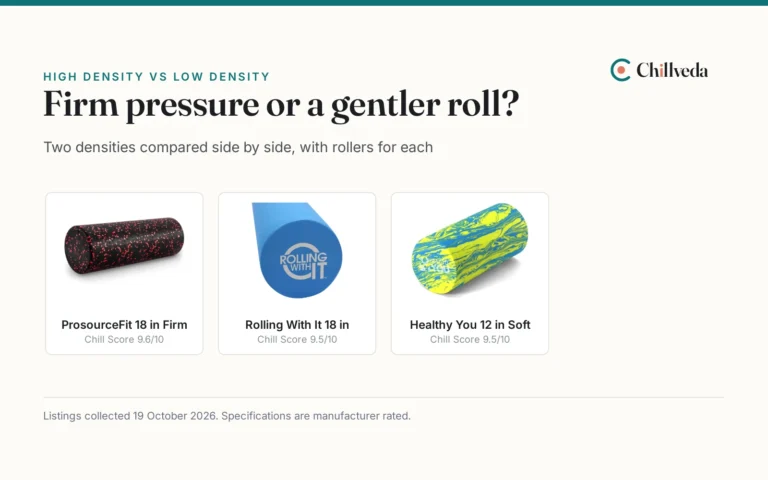
Firmness. The two high density listings here describe firm foam with minimal cushioning, while the low density listing describes soft/medium foam for gentle compression. The listings also name different materials, but firmness is the difference you feel. See our foam roller density explained guide for more.
A corner of the living room floor and a few quiet minutes before dinner: that is the whole setup for a high density vs low density foam roller comparison. The two densities feel nothing alike under body weight, and three listings, two high density and one low density, show why. We compared them from their Amazon listings, collected 19 October 2026.
This article is informational and is not medical advice. Foam rolling puts pressure on muscles and soft tissue, so avoid the neck, spine and arteries, and do not roll over acute injuries. Ask a clinician first if you have a health condition or are recovering from an injury. See our Medical Disclaimer.
Chillveda earns a commission when you buy through links on this page, at no extra cost to you. As an Amazon Associate I earn from qualifying purchases. Affiliate disclosure.
Quick picks
-
1
 ProsourceFit High-Density Firm Foam Roller Chill Score 9.6/10Check price on Amazon
A firm high-density EPP foam roller in 18 x 6 in with a water-resistant wipe-clean surface and a stated limited lifetime warranty.
-
2
 Rolling With It High Density Foam Roller Chill Score 9.5/10Check price on Amazon
A firm high-density EVA foam roller in 18 x 6 in with a stated 300 lb weight limit and a Life Time Pledge checkmark.
-
3
 Low Density Soft/Medium Foam Physical Therapy Chill Score 9.5/10Check price on Amazon
A soft/medium low-density foam roller in a 12 in full round, in thermoplastic rubber with a non-porous wipe-clean surface.

A firm high-density EPP foam roller in 18 x 6 in with a water-resistant wipe-clean surface and a stated limited lifetime warranty.
Pros & ConsViewHide
Pros
- Firm high-density EPP foam with minimal cushioning, per the listing
- 18 x 6 in at 9.6 oz, with 12, 24 and 36 in lengths also listed
- Water-resistant surface that wipes clean with a damp cloth
- Limited lifetime warranty stated
Cons
- Spec table lists Density as Low, contradicting the high-density title and bullets
- Spec table says EPE foam structure while the bullets say EPP
- No stated weight limit
- The listing itself warns its firm feel may be too much for gentler-pressure users

A firm high-density EVA foam roller in 18 x 6 in with a stated 300 lb weight limit and a Life Time Pledge checkmark.
Pros & ConsViewHide
Pros
- Firm high-density EVA foam core with a smooth surface, listed as keeping its shape
- Stated 300 lb weight limit
- EVA listed as formamide-free and phthalate-free
- Life Time Pledge checkmark with lifetime customer support listed
Cons
- Size field says 3.75 x 6.75 in, contradicting the 18 x 6 in bullets and dimensions
- Spec table lists a charger and carry bag as included, which fits a different product
- No formal warranty term stated
- Bullets make pain, sleep and skin claims we do not repeat

A soft/medium low-density foam roller in a 12 in full round, in thermoplastic rubber with a non-porous wipe-clean surface.
Pros & ConsViewHide
Pros
- Soft/medium foam for gentler pressure, per the listing
- 12 x 6 x 6 in at 8 oz, the lowest weight of the three
- Non-porous surface that wipes clean
- Listed for gentle compression, positioned for users who find firm rollers too much
Cons
- Item Diameter field says 12 in, contradicting the 12 x 6 x 6 in dimensions
- No warranty term is stated
- No stated weight limit
- The 12 in length covers less ground per roll than longer rollers
More to compare
 Amazon Basics High Density Foam Roller for Exercise andCheck price on Amazon
 ProsourceFit High Density Foam RollersCheck price on Amazon
 Krightlink 5 in1 Foam Roller Set High Density Foam RollerCheck price on Amazon
 OPTP AXIS Firm Density Foam RollerCheck price on Amazon
 TONE Fitness Firm High-Density Foam Roller for ExerciseCheck price on Amazon
 Black Mountain Products High Density Extra Firm Foam RollerCheck price on Amazon
High density vs low density foam roller: the short verdict
Pick high density if you want firm pressure with minimal cushioning: both high density listings describe a firm feel under body weight, and the ProsourceFit listing itself warns that users who prefer gentler pressure may find it too firm. Pick low density if you want a softer, gentler roll: the Healthy You listing describes soft/medium foam for gentle compression and positions it for users who find firm rollers too much. Neither side wins on paper, so the listings below show where each density’s claims hold up and where the listing text contradicts itself.
The two sides, side by side
| High density | Low density | |
|---|---|---|
| Example rollers | ProsourceFit 18 in; Rolling With It 18 in | Healthy You 12 in full round |
| Stated firmness | Firm (both listings) | Soft / Medium |
| Stated materials | EPP; EVA | Thermoplastic rubber |
| Stated sizes | 18 x 6 in; 12, 24 and 36 in also listed | 12 in full round; 36 in full/half round also listed |
| Stated weights | 9.6 oz; 15.84 oz | 8 oz |
| Stated weight limit | 300 lbs (one listing); not stated (one listing) | Not stated |
| Stated warranty | Limited lifetime warranty; Life Time Pledge | Not stated |
A figure from one listing describes that listing only. ProsourceFit’s roller weighs 9.6 ounces; that says nothing about high density rollers as a class, and the 300 lb weight limit belongs to the Rolling With It listing alone.
What separates the two sides
Firmness and feel
This is the real difference. The ProsourceFit bullets describe dense foam with minimal cushioning and a firm feel under body weight, and warn that users who prefer gentler pressure may find it too firm. The Rolling With It listing describes a firm solid core with a soft-to-the-touch exterior. The Healthy You listing describes soft/medium foam for gentle compression. The two sides do not share a firmness spec: firm on one side, soft/medium on the other.
Materials
The listings name three different materials: EPP (expanded polypropylene) for the ProsourceFit roller, EVA (ethylene vinyl acetate) for the Rolling With It roller, and thermoplastic rubber for the Healthy You roller. See our EVA vs EPP foam roller comparison for more on the first two.
Sizes and weights
The two high density examples are 18 in long with a 6 in diameter per the bullets; the low density example is a 12 in full round; its spec table lists a 12 in diameter, which clashes with the 12 in length and reads as a listing error, so treat its diameter as unstated. ProsourceFit also lists 12, 24 and 36 in lengths, and Healthy You lists a 36 in full/half round. Stated weights run from 8 oz to 15.84 oz across the three listings.
Rollers for each side
One card per roller, with the full spec breakdown and score below. If you are new to the tool, our how to use a foam roller guide covers the basics.
These are scored on the Chill Score across performance, build, value, safety and warranty, with the score tables below. No listing states a safety certification, so none earns safety points.
| Product | Chill Score | Perf. /35 | Build /25 | Value /25 | Safety /10 | Warranty /5 |
|---|---|---|---|---|---|---|
| ProsourceFit 18 in Firm | 9.6 | 29 | 20 | 20 | n/a | 3 |
| Rolling With It 18 in | 9.5 | 27 | 19 | 19 | n/a | 1 |
| Healthy You 12 in Soft | 9.5 | 28 | 19 | 20 | n/a | 0 |
Scores run from 9.2 to 9.8: each product’s point total is placed on that range, so more points always means a higher score. Safety counts only for powered gear or where the listing states safety features; where it does not apply, the score is taken over the remaining 90 points.
Choose high density if
- You want firm pressure with minimal cushioning, as both listings describe.
- You have rolled before and find softer rollers unconvincing.
- You want the strongest stated warranty here: a limited lifetime warranty on the ProsourceFit listing.
- You want a stated weight limit: the Rolling With It listing names 300 lbs.
Choose low density if
- You prefer gentler pressure, or the firm listings’ own too-firm warning applies to you.
- You want the lowest-weight roller here: 8 oz at 12 in.
- You want the gentlest option of the three, with a wipe-clean non-porous surface.
- You want the simplest listing of the three: no contradictions, just soft/medium foam in a 12 in round.
Check Your Space First
- The 18 in rollers need about 18 in of clear floor; the 12 in roller needs about 12 in.
- The two 18 in rollers are 6 in in diameter; the Healthy You spec table lists a 12 in diameter that reads as a listing error, so measure that roller yourself before planning storage.
- Stated weights run from 8 oz to 15.84 oz, light enough for a shelf or closet.
- All three list wipe-clean surfaces; the ProsourceFit listing says to let the roller dry completely before storing.
Common questions
What is the difference between high density and low density foam rollers?
Firmness. The two high density listings here describe firm foam with minimal cushioning, while the low density listing describes soft/medium foam for gentle compression. The listings also name different materials, but firmness is the difference you feel. See our foam roller density explained guide for more.
Which density should a beginner choose?
The listings point beginners toward low density. The ProsourceFit listing itself warns that users who prefer gentler pressure may find its firm roller too firm, while the Healthy You listing describes its soft/medium foam for gentle compression. Start gentle; you can move to a firmer roller later. Our beginner foam rollers roundup collects gentle options.
What size foam roller should I get?
The ProsourceFit listing gives the rule from its own bullets: a shorter roller for portability and targeted rolling, a longer roller for a wider surface, with 12, 18, 24 and 36 in lengths listed. The two high density examples here are 18 in; the low density example is a 12 in full round. Pick the length that fits where you will roll and store it.
How do I clean a foam roller?
All three listings describe wipe-clean surfaces. The ProsourceFit listing specifies a damp cloth and says to let the roller dry completely before storing, and the Healthy You listing calls its foam non-porous and easy to wipe clean and reuse. No listing describes a machine-washable construction, so stick to wiping.
Do foam rollers lose their shape?
The Rolling With It listing claims its EVA roller will not flake, chip or lose its shape and describes a firm solid core; those are the maker’s words. The ProsourceFit listing describes firm EPP construction that provides support during sessions. Neither listing gives a lifespan figure, so treat shape-holding as a claim rather than a promise.
What does the 300 lb weight limit mean?
The Rolling With It listing states a 300 lb weight limit, the only such figure among the three listings. It is the maker’s stated maximum for that roller. The other two listings state no weight limit at all.
Back to all foam roller reviews.