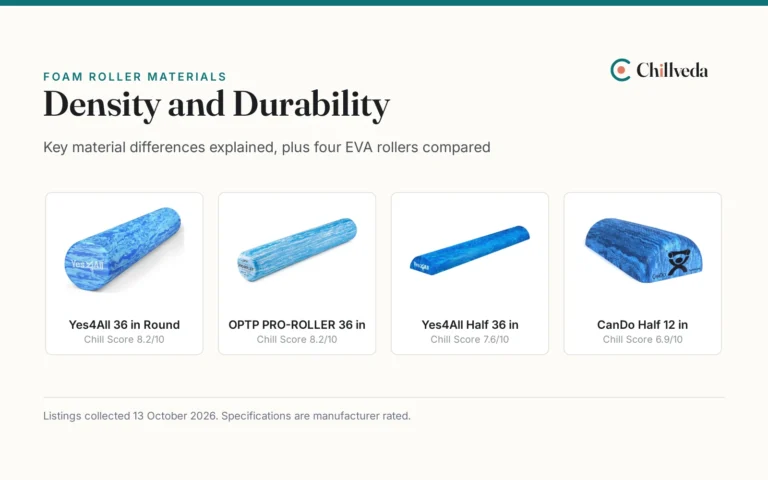
Short answer
What is the difference between an EVA foam roller and an EPP foam roller?
EVA (ethylene vinyl acetate) is a closed-cell polymer that provides resilient firmness with slight surface give and elasticity. EPP (expanded polypropylene) is made from fused foam beads that create an extra-firm, rigid surface with minimal compression under body weight. EVA is generally preferred for general mobility and beginners, while EPP is chosen for intense, deep myofascial pressure.
When you roll out an exercise mat on the living room floor after an evening workout, choosing between an eva foam roller vs epp foam roller comes down to firmness and cushion. EVA foam provides a moderate, resilient surface with slight elasticity that cushions soft tissues and muscle groups, making it better suited for beginners, physical therapy routines, and daily mobility work. EPP foam is significantly stiffer and more rigid, offering deep, unyielding pressure for athletes targeting dense muscle tissue without surface give.
This guide explains the structural differences between EVA and EPP materials, how density affects recovery routines, and four EVA rollers from current listings to help you choose the right surface. Listings were collected 13 October 2026.
This article is informational and is not medical advice. Foam rolling applies mechanical pressure to soft tissues. Avoid rolling directly over the neck, cervical spine, lower back arches, major blood vessels, or acute injuries. Consult a healthcare provider before starting a rolling routine if you have osteoporosis, circulatory issues, or joint conditions. See our Medical Disclaimer.
Chillveda earns a commission when you buy through links on this page, at no extra cost to you. As an Amazon Associate I earn from qualifying purchases. Affiliate disclosure.
Quick picks
-
1
 Yes4All EVA Firm Foam Roller for Back Chill Score 9.7/10Check price on Amazon
A 36-inch full-round EVA foam roller with closed-cell construction, firm density, and a stated 1-year warranty.
-
2
 OPTP PRO-ROLLER Standard Density Foam Roller Chill Score 9.7/10Check price on Amazon
A 36-inch standard-density roller made from heat-molded closed-cell EVA foam designed for studio and home use.
-
3
 Yes4All EVA Firm Foam Roller for Stretching Chill Score 9.6/10Check price on Amazon
A 36-inch half-round EVA roller featuring a textured hexagonal surface, 35 kg/m³ density, and a 1-year warranty.
-
4
 CanDo Premium Blue Marble EVA Foam Roller Chill Score 9.4/10Check price on Amazon
A compact 12-inch half-round EVA foam roller designed for targeted muscle stretching and balance routines.

A 36-inch full-round EVA foam roller with closed-cell construction, firm density, and a stated 1-year warranty.
Pros & ConsViewHide
Pros
- Full 36-inch length with 15 cm diameter
- Closed-cell EVA construction resists moisture
- Firm density suitable for full-body routines
- 1-year warranty and 30-day return stated
Cons
- Bullet text has an awkward phrasing about formamide
- Heaviest roller among these four picks at 1.9 pounds
- Firm surface may feel intense for sensitive areas
- No safety certifications listed

A 36-inch standard-density roller made from heat-molded closed-cell EVA foam designed for studio and home use.
Pros & ConsViewHide
Pros
- Heat-molded closed-cell EVA foam
- Full 35.9 by 6.3 by 6-inch dimensions
- Medium firmness balances give and support
- Wipes clean with a damp cloth
Cons
- No warranty term is stated
- Single pack with no included accessories
- At 36 inches it requires dedicated floor space
- No safety certifications listed

A 36-inch half-round EVA roller featuring a textured hexagonal surface, 35 kg/m³ density, and a 1-year warranty.
Pros & ConsViewHide
Pros
- Stated 35 kg/m³ foam density
- Textured surface with hexagonal bumps
- Flat base stays stable on flat floors
- 1-year warranty and 30-day return stated
Cons
- Spec table lists diameter as 36 inches instead of length
- Product benefits and material-free fields show corrupt 0.3 text
- Half-round profile cannot roll under the body
- No safety certifications listed

A compact 12-inch half-round EVA foam roller designed for targeted muscle stretching and balance routines.
Pros & ConsViewHide
Pros
- Compact 12-inch length fits small spaces
- Lightweight at 0.13 kg (4.59 oz)
- Flat bottom prevents rolling during balance work
- High-density EVA foam construction
Cons
- Contradictory firmness listed as Extra Firm and Soft
- Spec table claims Plastic Free despite EVA polymer material
- No warranty term is stated
- 12-inch length is too short for full-back support
More to compare
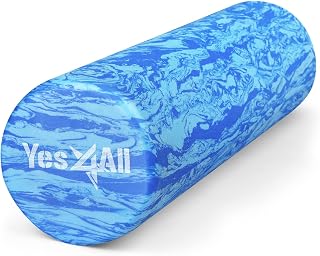 Yes4All Foam RollerCheck price on Amazon
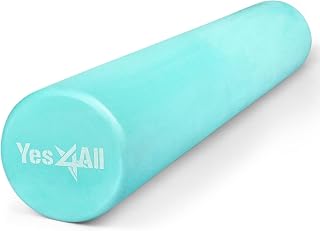 Yes4All EVA Firm Foam Roller for BackCheck price on Amazon
 Yes4All EVA Foam Roller for Deep MassageCheck price on Amazon
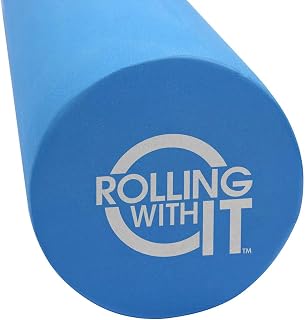 Rolling With It High Density Foam Roller for Physical TherapyCheck price on Amazon
 Fitizen Foam RollerCheck price on Amazon
 Oceanfoam Tidal RollerCheck price on Amazon
Understanding eva foam roller vs epp foam roller differences
| Characteristic | EVA foam roller | EPP foam roller |
|---|---|---|
| Material structure | Closed-cell ethylene vinyl acetate polymer | Expanded polypropylene fused bead foam |
| Firmness and feel | Medium to firm with moderate cushion and elasticity | Firm to extra firm with rigid density and minimal give |
| Surface texture | Smooth or molded textured patterns (e.g. hex bumps) | Slightly pebbled beaded texture |
| Weight | Moderate weight with solid polymer construction | Lightweight expanded bead construction |
| Common uses | Physical therapy, Pilates, yoga, gentle muscle rolling | Deep trigger-point release, dense muscle rolling |
| Shape retention | Maintains shape under regular home and clinic use | Resists deformation under heavy repeated use |
The pattern is clear. EVA foam provides a resilient, slightly yielding surface that cushions muscle tissue while supporting body weight. EPP foam, by contrast, uses expanded beads fused under heat to create a stiff, lightweight cylinder with negligible give. If you are starting out or rolling sensitive areas, EVA offers a more forgiving feel, whereas EPP delivers uncompromising rigidity for deep myofascial pressure.
Why foam density and material give change the feel
Foam rollers work by distributing body weight over a contact surface to compress muscle tissue. Because EVA is an elastomeric polymer, its closed-cell structure compresses slightly when you lie on it. That slight deflection increases the contact surface area, which spreads the pressure across surrounding tissue and reduces discomfort on tender trigger points. Our foam roller density explained guide covers how cell structure influences tissue response.
EPP foam behaves differently. Fused polypropylene beads form a rigid lattice that barely compresses under body weight. Because the foam does not yield, the contact area remains narrow, delivering concentrated pressure directly into tight muscle bands. If you are deciding between different tools, see our massage gun vs foam roller comparison.
How roller shape and diameter affect your routine
Diameter and profile determine how a roller functions on the floor. Standard 6-inch cylindrical rollers rotate freely, allowing you to sweep across long muscle groups such as the quadriceps, hamstrings, and upper back muscles. Half-round rollers feature a flat base that stays anchored to the floor, providing a stable platform for back extension, balance training, and calf stretching without slipping. For step-by-step techniques, refer to our guide on how to use a foam roller.
Storage and floor space: A full-length roller measuring 36 inches by 6 inches stores upright in a corner or lays flat alongside an exercise mat. Shorter options such as the 12-inch, 18-inch, or 24-inch sizes fit easily on a closet shelf or inside a gym bag.
EVA foam rollers worth considering
These are scored on the Chill Score, which weighs performance 35, build 25, value 25, safety certifications 10 where it applies, and warranty 5. Foam rollers carry no electrical or mechanical safety certifications, so all four score 0 for safety.
| Product | Chill Score | Perf. /35 | Build /25 | Value /25 | Safety /10 | Warranty /5 |
|---|---|---|---|---|---|---|
| Yes4All 36 in Round | 9.7 | 29 | 21 | 22 | n/a | 1 |
| OPTP PRO-ROLLER 36 in | 9.7 | 30 | 22 | 21 | n/a | 0 |
| Yes4All Half 36 in | 9.6 | 28 | 19 | 20 | n/a | 1 |
| CanDo Half 12 in | 9.4 | 26 | 18 | 19 | n/a | 0 |
Scores run from 9.2 to 9.8: each product’s point total is placed on that range, so more points always means a higher score. Safety counts only for powered gear or where the listing states safety features; where it does not apply, the score is taken over the remaining 90 points.
For more choices across different firmness levels and lengths, see our best foam rollers roundup.
Choosing between EVA and EPP in practice
- Consider your experience level. Beginners and those returning from injury generally benefit from the forgiving cushion of EVA foam.
- Match the foam to your muscle density. Athletes and regular lifters with dense, tight muscle groups often prefer the rigid compression of EPP foam.
- Select the right roller length. A 36-inch roller supports your entire back lengthwise during stationary posture drills, whereas a 12-inch roller is easier to pack and store.
- Use body weight to modulate pressure. Rather than forcing hard pressure immediately, support part of your body weight with your hands and feet.
- Avoid direct pressure on sensitive structures. Roll slowly over muscle bellies rather than pressing into joints, the neck, or the lower spine.
Common mistakes
- Choosing an extra-firm EPP roller as a beginner and finding it too painful to use consistently.
- Rolling directly over the lower back arch or neck rather than focusing on large muscle groups.
- Assuming a half-round roller will roll like a cylindrical model.
- Spending too much time on a single painful knot instead of rolling gently across the surrounding muscle tissue.
Common questions
What is the difference between an EVA foam roller and an EPP foam roller?
EVA (ethylene vinyl acetate) is a closed-cell polymer that provides resilient firmness with slight surface give and elasticity. EPP (expanded polypropylene) is made from fused foam beads that create an extra-firm, rigid surface with minimal compression under body weight. EVA is generally preferred for general mobility and beginners, while EPP is chosen for intense, deep myofascial pressure.
Is an EVA foam roller better for beginners?
Yes. Because EVA foam compresses slightly under body weight, it distributes pressure more evenly across muscle tissue. This cushioning makes rolling less painful on tender spots compared to the unyielding surface of an EPP roller.
Does an EPP foam roller last longer than EVA?
EPP foam is exceptionally resistant to permanent deformation and retains its rigid shape under heavy daily use. High-quality closed-cell EVA rollers also last for years, though softer EVA models may eventually develop slight indentations over extended periods.
Can you use an EVA or EPP roller on the lower back?
Healthcare professionals advise against rolling directly across the unsupported lumbar spine (lower back) with either material. The rigid pressure can cause muscles to guard and place undue stress on spinal joints. Focus rolling on the upper back, glutes, hamstrings, and calves instead.
What length foam roller should I choose?
A standard 36-inch roller is long enough to support your entire back from head to tailbone during balance and chest-opening exercises. Shorter 12-inch or 18-inch models take up less floor space and pack easily into a gym bag for calf and leg rolling.
Sources: Amazon product listings for the foam rollers named above, collected 13 October 2026. Related: our best foam rollers for back and how to use a foam roller.
Back to all foam rollers and accessories reviews.