Short answer
Which is better for back pain, a stretcher or a massager?
The listings make no comparative medical claim. A stretcher inverts the body; a massager works the muscles without inversion. Speak to a doctor about which suits your condition.
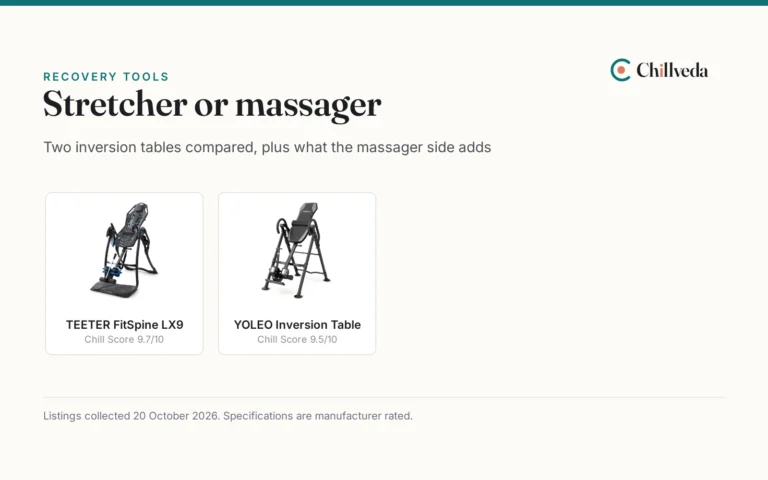
Back stretcher vs back massager is a choice between two ways to work the back: a stretcher like an inversion table tilts you so bodyweight and gravity lengthen the spine, while a massager kneads or vibrates the muscles. Both listings here are inversion tables, so this guide covers the stretcher side with two examples and explains what the massager side would add. Listings were collected 20 October 2026.
This article is informational and is not medical advice. If you have back pain, a spinal condition or a medical condition, speak to a doctor before using inversion equipment. The YOLEO listing advises consulting a licensed physician first, since some medical conditions may not suit inversion. See our Medical Disclaimer.
Chillveda earns a commission when you buy through links on this page, at no extra cost to you. As an Amazon Associate I earn from qualifying purchases. Affiliate disclosure.
Quick picks
-
1
 TEETER FitSpine LX9 Inversion Table Chill Score 9.7/10Check price on Amazon
Inversion table with 20, 40, 60 degree tether, EZ-Reach ankle lock, UL stated, 5-year warranty.
-
2
 YOLEO Gravity Inversion Table for Back Pain Relief Chill Score 9.5/10Check price on Amazon
Inversion table with adjustable angle bar, ratchet ankle lock, memory foam backrest, 1-year warranty.

Inversion table with 20, 40, 60 degree tether, EZ-Reach ankle lock, UL stated, 5-year warranty.
Pros & ConsViewHide
Pros
- EZ-Angle tether with 20, 40, 60 markings
- UL Safety Certification stated
- 5-Year Full Warranty stated
- Acupressure nodes and lumbar bridge stated
Cons
- 74.1 lb, heaviest to move
- Full inversion needs care per disclaimers
- Higher feature set than basic tables
- No 265-lb recommendation needed

Inversion table with adjustable angle bar, ratchet ankle lock, memory foam backrest, 1-year warranty.
Pros & ConsViewHide
Pros
- Adjustable rear cross bar for angle
- Ratchet ankle lock with safety pin
- Memory foam backrest stated
- Foldable for closet or wall storage
Cons
- 265 lb recommendation below the 300 lb capacity
- No certification is stated
- 1 year is the shorter warranty
- No stated degree markings
More to compare
 Back StretcherCheck price on Amazon
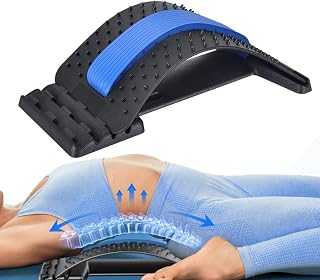 Back Stretcher for Lower Back Pain ReliefCheck price on Amazon
 Spine Decompression Table Back StretcherCheck price on Amazon
 Docemel Back Stretcher for Lower Back Pain ReliefCheck price on Amazon
 Decompression Table Lumba Traction Device Back SpinalCheck price on Amazon
 MINOLL Back Stretcher for Lower Back Pain ReliefCheck price on Amazon
Back stretcher vs back massager: the short answer
A back stretcher uses bodyweight and gravity to lengthen the spine; an inversion table is the classic example. A back massager applies mechanical pressure or vibration to the muscles and never inverts you. Neither listing here is a massager: both are inversion tables, so compare them on angle control, ankle lock, materials and warranty, and shop massagers separately if you want muscle kneading rather than stretching.
Two inversion tables from current listings
How we scored them
| Product | Chill Score | Perf. /35 | Build /25 | Value /25 | Safety /10 | Warranty /5 |
|---|---|---|---|---|---|---|
| TEETER FitSpine LX9 | 9.7 | 32 | 22 | 20 | 4 | 4 |
| YOLEO Inversion Table | 9.5 | 26 | 20 | 21 | 0 | 3 |
Scores run from 9.2 to 9.8: each product’s point total is placed on that range, so more points always means a higher score.
Angle control and ankle locks
The TEETER states an EZ-Angle tether with preset markings at 20, 40 and 60 degrees, plus an EZ-Reach ankle system with an extra-long stainless-steel handle and a secondary gravity-activated lock. The YOLEO states an adjustable rear cross bar for inversion angle adjustment and an adjustable ratchet ankle locking system with a safety lock pin. Both state foldable designs: the TEETER folds for low-profile storage and the YOLEO folds against a wall or into a closet.
Fit, capacity and materials
Both state a 300 lb capacity. The TEETER is rated for users 4 ft 8 in to 6 ft 6 in with a 300 lb capacity, weighs 74.1 pounds, is made of heat-treated steel, and states UL Safety Certification. The YOLEO fits 4 ft 1 in to 6 ft 2 in with a memory foam backrest, and recommends use for people weighing 265 lbs or less despite the 300 lb capacity figure. The TEETER adds acupressure nodes, a lumbar bridge with adjustable arch and a free training app; the YOLEO states an adjustable lumbar support. The TEETER states a 5-Year Full Warranty against the YOLEO’s 1 Year.
What the massager side would add
No massager is listed here. When you shop the massager side, you would compare power source (cordless or wired), heat or vibration modes, and warranty: the counterparts of the angle control, ankle lock and weight capacity you compare on the stretcher side. See our cordless vs wired back massager guide for the massager side, and the back massager vs massage cushion comparison for how massager types differ.
Common questions
Which is better for back pain, a stretcher or a massager?
The listings make no comparative medical claim. A stretcher inverts the body; a massager works the muscles without inversion. Speak to a doctor about which suits your condition.
Do inversion tables need a doctor’s OK?
The YOLEO listing advises consulting a licensed physician before use, since some medical conditions may not suit inversion. The TEETER listing names no such requirement.
What angle do the tables invert to?
The TEETER states preset tether angles at 20, 40 and 60 degrees and lock-out in full inversion. The YOLEO states an adjustable rear cross bar without stated degree markings.
Which is easier to store?
Both state foldable designs. The TEETER states storage in seconds with no disassembly; the YOLEO states it folds against a wall or into a closet.
Which states a longer warranty?
The TEETER states a 5-Year Full Warranty. The YOLEO states 1 Year.
Back to all recovery tools reviews.