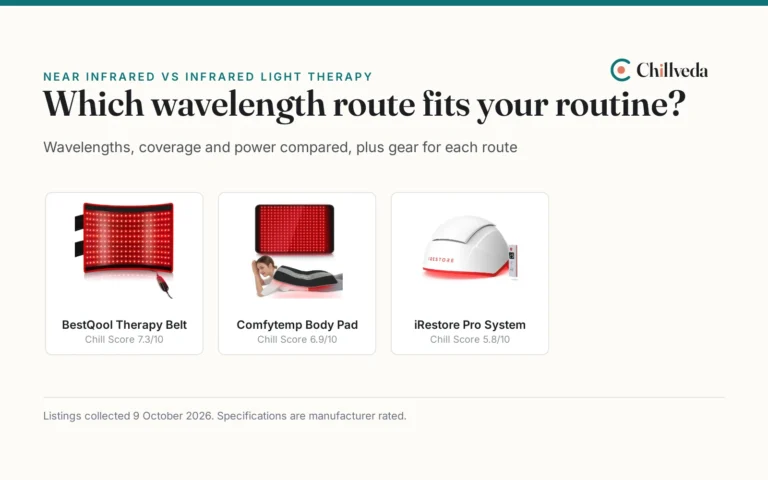
Side by side Choose near infrared light therapy if Choose infrared light therapy if
Near infrared vs infrared light therapy comes down to wavelength specificity and device shape. Near-infrared light therapy targets a specific invisible band around 850nm, often combined with 660nm red light, to reach deeper muscles and joints without heat. Infrared light therapy is a broader category that includes general infrared wraps as well as specialized devices like laser scalp helmets. Choose near-infrared light therapy if you want a dedicated large pad focused on published 850nm deep-tissue wavelengths for muscles and joints. Choose broader infrared light therapy if you want specialized form factors, such as a wearable joint belt or a dedicated scalp helmet.
This comparison covers wavelengths, power ratings, body coverage, and routine upkeep across home devices. Listings were collected 9 October 2026.
This article is informational and is not medical advice. Always use appropriate eye protection around bright light therapy diodes, and avoid looking directly into high-intensity emitters. Consult a healthcare provider before starting light therapy if you are pregnant, take photosensitizing medications, or have an underlying medical condition. See our Medical Disclaimer.
Chillveda earns a commission when you buy through links on this page, at no extra cost to you. As an Amazon Associate I earn from qualifying purchases. Affiliate disclosure.
Quick picks
-
1
 BestQool Red Light Therapy for Body Chill Score 9.5/10Check price on Amazon
A wearable 43W wrap with 220 triple-chip LEDs emitting 660nm red and 850nm near-infrared light across five intensity levels.
-
2
 Comfytemp Red Light Pad for Body, 24'' x 17'' Chill Score 9.4/10Check price on Amazon
A 24 by 17 inch corded body pad delivering up to 48W across 320 LEDs with 660nm red and 850nm near-infrared light.
-
3
 iRestore Professional Laser Red Light Therapy Chill Score 9.3/10Check price on Amazon
A rigid, ventilated helmet equipped with 282 lasers and LEDs designed for hands-free scalp light sessions.

A wearable 43W wrap with 220 triple-chip LEDs emitting 660nm red and 850nm near-infrared light across five intensity levels.
Pros & ConsViewHide
Pros
- Dual 660nm red and 850nm near-infrared wavelengths stated
- 220 LEDs with triple-chip configuration
- 43W power consumption with five intensity levels
- Lightweight at 1.01 pounds and 0.35 inches thick
Cons
- No warranty term stated
- No electrical safety certification stated
- Requires a nearby power outlet for the AC cord
- Listing includes vague comfort claims

A 24 by 17 inch corded body pad delivering up to 48W across 320 LEDs with 660nm red and 850nm near-infrared light.
Pros & ConsViewHide
Pros
- 320 LEDs with 660nm red and 850nm near-infrared light
- Large 24 by 17 inch coverage area
- Up to 48W of power with three adjustable levels
- Four light modes and built-in timer
Cons
- No warranty term stated
- No electrical safety certification stated
- Spec table lists package dimensions rather than product thickness
- Corded design requires sitting near an outlet

A rigid, ventilated helmet equipped with 282 lasers and LEDs designed for hands-free scalp light sessions.
Pros & ConsViewHide
Pros
- 282 lasers and LEDs configured for full scalp coverage
- Hands-free helmet design with ventilated padding
- Preset session schedule of 2 to 3 times per week
- Detailed product dimensions of 10.8 by 9.9 by 6.6 inches
Cons
- Wavelength figures in nanometers are not stated
- Wattage and power consumption are not stated
- No warranty term stated
- Corded by default, requiring an optional battery for cordless use
More to compare
 Red Light Therapy for FaceCheck price on Amazon
 Infrared Light Therapy for Joint and Muscle Pain PortableCheck price on Amazon
 Red Light Therapy and Near Infrared Light Therapy Wand forCheck price on Amazon
 Lifepro Infrared & Red Light Therapy for Body Joints &Check price on Amazon
 Ceramic Infrared Sauna 2 Person Infrared Sauna w/Red LightCheck price on Amazon
 2-3 Person Ceramic Infrared Sauna with Red Light TherapyCheck price on Amazon
Near infrared vs infrared light therapy at a glance
| Feature | Near infrared | Infrared light therapy |
|---|---|---|
| Category scope | Specific optical band within infrared | Broad umbrella covering all infrared bands |
| Primary mechanism | Deep optical penetration without radiant heat | Optical photobiomodulation or thermal therapy |
| Target areas | Deep muscle and joint tissue | Varies widely, from scalp to localized joints |
| Form factors in our listings | Large flexible body pad | Wearable joint belt and rigid scalp helmet |
| Wavelength disclosure in our listings | Both 660nm and 850nm stated | Stated on the belt, not stated on the helmet |
| Power draw in our listings | Up to 48W stated | 43W stated on the belt, not stated on the helmet |
| Best for | Broad muscle and joint coverage | Specialized formats or multi-zone wearable wraps |
How near infrared and infrared wavelengths differ
Wavelength selection defines how light energy interacts with tissue. Near-infrared light occupies the optical band immediately adjacent to visible red light. In photobiomodulation devices, makers commonly combine visible 660nm red light with invisible 850nm near-infrared light. The Comfytemp listing states that visible 660nm red light focuses on surface layers, while 850nm near-infrared light targets deeper muscles and joints. On the infrared light therapy side, the BestQool belt similarly pairs 660nm red light with 850nm near-infrared light across 220 triple-chip LEDs. In contrast, the iRestore helmet listing describes its 282 lasers and LEDs as light therapy, but does not state its operating wavelengths in nanometers. Our guide to red light wavelengths explains how these bands compare.
Physical dimensions and power requirements also vary across designs. The Comfytemp pad draws up to 48W corded, providing 24 by 17 inches of surface area. The BestQool belt lists a 43W power consumption, operating across AC 85-265V wide voltage over a 21.9 by 13.6 inch footprint. The iRestore helmet does not state its wattage, measuring 10.8 by 9.9 by 6.6 inches with corded operation.
| Device | Side | Listed wattage | Electrical input | Coverage dimensions | Listed weight |
|---|---|---|---|---|---|
| Comfytemp Body Pad | Near infrared | Up to 48W | Corded plug-in | 24 x 17 inches | 2.2 pounds (package) |
| BestQool Therapy Belt | Infrared light therapy | 43W | AC 85-265V | 21.9 x 13.6 x 0.35 inches | 1.01 pounds |
| iRestore Pro System | Infrared light therapy | Not stated | Corded plug-in | 10.8 x 9.9 x 6.6 inches | 2.79 pounds |
The Comfytemp example lists up to 48W across a daily routine of 20 minutes. The BestQool example lists 43W on AC 85-265V input. The iRestore listing leaves wattage unstated, which means its power draw cannot be verified from published specs alone.
Form factor, coverage and power
The near-infrared listing in this comparison uses a large flat pad design. The Comfytemp example measures 24 by 17 inches and ships at 2.2 pounds, providing a wide surface for the back, abdomen, hips, or legs. Because it requires a continuous AC plug-in connection, sessions take place near an electrical outlet. See our red light therapy mats roundup for flat pad options.
The infrared light therapy listings demonstrate two distinct form factors. The BestQool belt measures 21.9 by 13.6 by 0.35 inches and weighs 1.01 pounds, designed as a flexible wrap for knees, elbows, or the lower back with wide-voltage AC 85-265V input. For similar wearable options, explore our red light therapy belts guide.
The second infrared therapy option adopts a rigid helmet shape. The iRestore example weighs 2.79 pounds and measures 10.8 by 9.9 by 6.6 inches, engineered exclusively for scalp coverage with 282 lasers and LEDs. It requires a corded wall connection, though the listing mentions an optional battery pack sold separately for cordless use. Our targeted red light devices guide covers other purpose-built tools.
Upkeep
Light therapy pads and wraps sit against the skin or thin clothing, collecting sweat and body oils over repeated sessions. Unplug the device before wiping down the exterior fabric or protective transparent layer with a lightly damp microfiber cloth. Never submerge electrical pads or helmets in water.
Storage practices protect internal circuitry. Flexible pads and belts contain delicate solder joints and LED matrices that can break under sharp creases. Roll or lay them flat when stored. Routine recommendations differ by product: the Comfytemp listing suggests a daily 20 minutes routine, noting that consistent sessions over 3 weeks help establish a regular pattern. The iRestore listing suggests sessions 2 to 3 times per week, citing observation windows of 3 to 6 months.
Gear for each route
These are scored on the Chill Score: performance 35, build 25, value 25, safety certifications 10 where it applies and warranty 5. None states a UL or ETL listing, so all score 0 for safety, and none publishes a formal warranty term.
| Product | Chill Score | Perf. /35 | Build /25 | Value /25 | Safety /10 | Warranty /5 |
|---|---|---|---|---|---|---|
| BestQool Therapy Belt | 9.5 | 30 | 21 | 21 | 0 | 0 |
| Comfytemp Body Pad | 9.4 | 29 | 20 | 20 | 0 | 0 |
| iRestore Pro System | 9.3 | 23 | 19 | 16 | 0 | 0 |
Scores run from 9.2 to 9.8: each product’s point total is placed on that range, so more points always means a higher score.
Choose near infrared light therapy if
- You want a dedicated large pad format for covering broad body areas like the back, hips, or legs.
- You want devices explicitly branded around near-infrared optical penetration without heat.
- You prefer a simple plug-in pad with multiple preset modes and intensity levels.
- You want a daily session routine centered on joint and muscle relaxation at home.
Choose infrared light therapy if
- You want wearable or highly targeted form factors, such as a joint belt or a scalp helmet.
- You want versatility in application, ranging from localized wraps to dedicated hairline systems.
- You prefer a device with wide-voltage compatibility or the option to add a battery pack.
- Your schedule favors targeted sessions a few times per week rather than a daily pad routine.
Common questions
What is near infrared red light therapy?
Near-infrared red light therapy pairs visible red light (such as 660nm) with invisible near-infrared light (such as 850nm). In home devices like the Comfytemp pad, visible red light targets surface layers, while near-infrared wavelengths reach deeper muscles and joints without generating radiant heat.
What does near infrared light therapy do?
Near-infrared light delivers invisible wavelengths, such as the 850nm band stated on the Comfytemp listing, that penetrate deeper into tissue than visible colors. The maker describes it as a tool for muscle and joint relaxation, back comfort, and post-exercise recovery, delivering optical light energy rather than heavy thermal warmth.
What is infrared light therapy good for?
Infrared light therapy serves as an umbrella category for devices utilizing infrared wavelengths. In consumer recovery gear, it spans wearable wraps for joint and lower back placement, as shown by the BestQool belt, as well as specialized devices like the iRestore laser and LED scalp helmet. Its purpose depends on the specific form factor and target area.
How often can you use near infrared light therapy?
Usage frequency depends on the specific device and maker instructions. The Comfytemp near-infrared pad listing recommends a daily session of 20 minutes, noting that consistent application over 3 weeks or more helps establish a regular routine. Other light therapy devices may recommend sessions 2 to 3 times per week depending on their intended focus.
Back to all red light therapy reviews.