Short answer
Is LED or laser light therapy more effective?
Neither technology is universally superior because each serves a distinct clinical role. LED arrays disperse light across broad skin areas, making them practical for hands-free cosmetic routines over the face or neck. Laser units deliver concentrated light into a small contact area, making them suited for targeted spot application.
Side by side Choose LED red light therapy if Choose laser red light therapy if
LED vs laser red light therapy comes down to beam spread, coverage area, and treatment focus. LED devices use light-emitting diodes that disperse light broadly across wide surfaces such as the face, making them the practical pick for general skincare and hands-free cosmetic routines. Laser red light therapy (low-level laser therapy or cold laser) uses coherent, collimated diodes that concentrate energy into small contact spots, making it the practical choice for focused spot treatment on localized points.
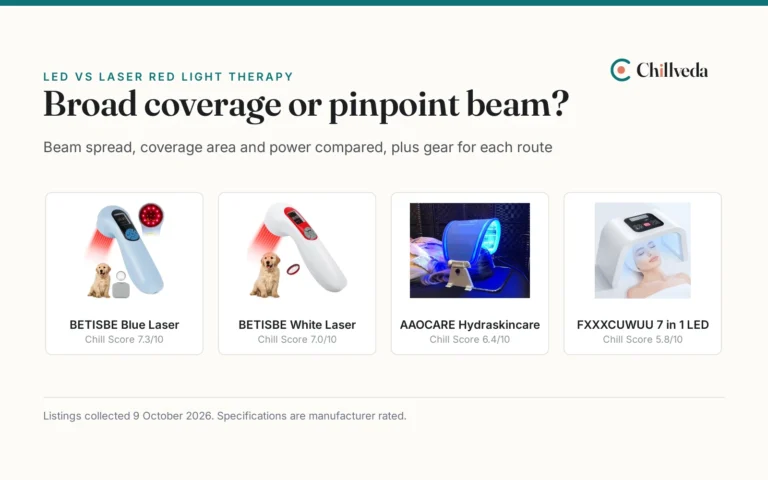
This comparison examines beam behavior, coverage area, electrical power, session requirements, upkeep, and eye safety, using four featured devices to illustrate the differences. Listings were collected 9 October 2026.
This article is informational and is not medical advice. Red and near-infrared light can cause eye strain or retinal damage if viewed directly without eye protection. Never stare into the light sources, use protective eyewear during sessions, and consult a clinician before use if you have photosensitivity, take light-sensitizing medications, or are pregnant. See our Medical Disclaimer.
Chillveda earns a commission when you buy through links on this page, at no extra cost to you. As an Amazon Associate I earn from qualifying purchases. Affiliate disclosure.
Quick picks
-
1
 5000mAh 5 * 808nm & 10 * 650nm LLLT Cold Laser Chill Score 9.5/10Check price on Amazon
A handheld cold laser device combining five 808nm and ten 650nm diodes with a 5000mAh battery and a stated 1 year warranty.
-
2
 5000mAh 5 * 808nm & 10 * 650nm LLLT Cold Laser Chill Score 9.5/10Check price on Amazon
A portable handheld cold laser unit pairing 808nm and 650nm diodes with a 5000mAh battery, but with no warranty term stated.
-
3
 Hydraskincare Red Light Therapy for Face Chill Score 9.4/10Check price on Amazon
A curved tabletop LED facial machine offering 640nm red, 810nm near-infrared, yellow, and blue light across an 18 by 7 inch panel.
-
4
 Led-Light-Therapy, Red Light Therapy for Face 7 Chill Score 9.3/10Check price on Amazon
A detachable 287-light LED beauty canopy featuring seven visible light colors, but without any nanometer wavelength specifications.

A handheld cold laser device combining five 808nm and ten 650nm diodes with a 5000mAh battery and a stated 1 year warranty.
Pros & ConsViewHide
Pros
- Five 808nm and ten 650nm laser diodes stated
- 5000mAh rechargeable lithium-ion battery
- Continuous and pulse modes with 60 minute timer
- 1 year warranty stated in the spec table
Cons
- No safety certification stated
- Small treatment window requires manual repositioning
- Spec table lists target audience as dogs while title includes humans
- The listing does not state irradiance or optical power output

A portable handheld cold laser unit pairing 808nm and 650nm diodes with a 5000mAh battery, but with no warranty term stated.
Pros & ConsViewHide
Pros
- Five 808nm infrared and ten 650nm red laser diodes
- 5000mAh battery for cordless treatment
- Continuous and pulse settings with 3 power gears
- Protective eyewear, magnetic cover, and suitcase included
Cons
- No warranty term stated in the listing
- No safety certification stated
- Narrow contact area covers only small spots at a time
- Spec table lists specific use as hip despite broad title claims

A curved tabletop LED facial machine offering 640nm red, 810nm near-infrared, yellow, and blue light across an 18 by 7 inch panel.
Pros & ConsViewHide
Pros
- Four stated wavelengths including 640nm red and 810nm infrared
- Large 18 by 7 inch panel covers the entire face hands-free
- Colors can be run individually or combined simultaneously
- Curved canopy design allows hands-free relaxation
Cons
- Contradiction between 18 by 7 inch bullet and 21 by 9 inch table
- No wattage or irradiance figures stated
- No warranty term stated
- No safety certification stated

A detachable 287-light LED beauty canopy featuring seven visible light colors, but without any nanometer wavelength specifications.
Pros & ConsViewHide
Pros
- 287 light points stated for broad facial coverage
- Seven color modes including red, green, yellow, and blue
- Detachable arch structure for easier storage
- Lightweight at 4.3 pounds
Cons
- No nanometer wavelength figures stated in the listing
- Muddled usage schedule in listing bullets
- No warranty term stated
- No safety certification stated
More to compare
 TENDLITE® Pro Red & Infrared LED Light Therapy withCheck price on Amazon
 Led Red Light Therapy Mask for Face 7-1 ColorsCheck price on Amazon
 Nourished Bodynskin LED Light Therapy Face & Neck MaskCheck price on Amazon
 LED-Red-Light-Therapy-DeviceCheck price on Amazon
 Shark CryoGlow LED Face MaskCheck price on Amazon
 45W Red LED Light Therapy PanelCheck price on Amazon
LED vs laser red light therapy at a glance
| Feature | LED light therapy | Laser red light therapy |
|---|---|---|
| Light coherence | Non-coherent light | Coherent light |
| Beam profile | Divergent, wide-angle dispersion | Collimated, directional beam |
| Spectral bandwidth | Broader emission band around peak | Narrow monochromatic emission band |
| Coverage style | Broad surface area coverage | Focused spot application |
| Eye safety | Eyewear recommended for bright output | Protective eyewear required for direct beam |
| Featured models format | Tabletop arches (AAOCARE, FXXXCUWUU) | Handheld wands (BETISBE Blue, White) |
| Featured models power | Corded plug-in operation | Rechargeable 5000mAh battery |
Beam spread, coverage area and dimensions
The physical distinction between LED and laser light determines how much body surface each session reaches. LED panels spread light across a wide angle, covering broad surface areas simultaneously. In contrast, laser diodes maintain a tight, collimated beam that concentrates optical power into a small contact point.
Comparing the stated dimensions from the featured listings demonstrates the practical footprint difference between the two formats:
| Device format | Listed dimensions | Footprint and placement |
|---|---|---|
| AAOCARE LED arch | 18 x 7 in panel, 21 x 9 x 3 in overall | Tabletop placement; 18 x 7 in canopy |
| FXXXCUWUU LED arch | 9.76 x 13.66 x 6.57 in | Tabletop placement; 287 light points |
| BETISBE laser wand | 9.84 x 8.23 x 4.21 in package | Handheld contact head; cordless 5000mAh battery |
Floor space and tabletop placement requirements depend on device dimensions. The AAOCARE unit lists dimensions of 21 by 9 by 3 inches, requiring a tabletop footprint of 21 inches by 9 inches. The FXXXCUWUU arch measures 9.76 by 13.66 by 6.57 inches, requiring 9.76 inches by 13.66 inches of surface space. In contrast, the BETISBE laser wands list package dimensions of 9.84 by 8.23 by 4.21 inches and 11.54 by 9.88 by 4.17 inches, storing inside an included case with no dedicated counter footprint.
For electrical specifications, neither the AAOCARE nor the FXXXCUWUU listing states operating wattage or irradiance in milliwatts per square centimeter, leaving their exact power draw unverified on the product pages. The BETISBE laser listings publish a 5000mAh battery capacity with 1 lithium-ion battery, providing cordless operation across 3 power gears and timer settings up to 60 minutes.
Cost, space and power
LED tabletop arches require dedicated surface space and proximity to a standard wall outlet. The AAOCARE unit measures 21 by 9 inches at its base, while the FXXXCUWUU canopy takes up 9.76 by 13.66 inches. Both designs suit users who have a dedicated nightstand or vanity where the arch can remain assembled between sessions. For wearable alternatives that store more easily, see our guide to the best red light therapy masks.
Handheld laser wands prioritize portable spot treatment over broad surface coverage. The BETISBE units weigh 2.01 and 2.03 pounds in the listings and pack into an included carrying suitcase with their charging adapter and safety eyewear. Their cordless 5000mAh battery allows application anywhere without cord constraints. For other compact recovery equipment, explore our guide to targeted red light therapy devices.
Upkeep and eye safety
Upkeep for both device types centers on keeping optical surfaces clear of dust and skin oils. The FXXXCUWUU LED canopy features a detachable arch structure that breaks down for cleaning and storage, while the AAOCARE panel requires simple exterior wiping. Laser wands require careful inspection of the diode window and magnetic cover to prevent residue buildup from blocking the contact area.
Eye protection is a crucial safety distinction. The coherent, concentrated beam produced by laser diodes represents a direct optical hazard, which is why the BETISBE listings include protective eyewear and explicitly instruct users not to expose eyes for long periods. LED canopies produce dispersed ambient light rather than a focused beam, but protective goggles remain advisable given the brightness of 287 light points or multi-wavelength arrays.
Regulatory status is another area where buyers should read listings carefully. Neither listing carries an FDA clearance record from federal regulators. For a detailed breakdown of how regulatory designations apply to wellness equipment, see our guide to red light FDA clearance.
Gear for each route
These are scored on the Chill Score: performance 35, build 25, value 25, safety certifications 10 where it applies and warranty 5. None states a UL or ETL listing, so all score 0 for safety.
| Product | Chill Score | Perf. /35 | Build /25 | Value /25 | Safety /10 | Warranty /5 |
|---|---|---|---|---|---|---|
| BETISBE Blue Laser | 9.5 | 29 | 21 | 20 | 0 | 2 |
| BETISBE White Laser | 9.5 | 29 | 21 | 20 | 0 | 0 |
| AAOCARE Hydraskincare | 9.4 | 27 | 19 | 19 | 0 | 0 |
| FXXXCUWUU 7 in 1 LED | 9.3 | 23 | 18 | 18 | 0 | 0 |
Scores run from 9.2 to 9.8: each product’s point total is placed on that range, so more points always means a higher score.
Choose LED red light therapy if
- You want to cover broad skin surfaces such as the face or neck in a single session.
- Your primary focus is cosmetic skincare or general non-targeted phototherapy.
- You prefer hands-free sessions where you rest under an array rather than holding a wand.
- You want multiple visible colors such as blue or yellow alongside red light.
Choose laser red light therapy if
- You need concentrated spot application on specific joints or localized points.
- You prefer a collimated, coherent beam over wide-angle light dispersion.
- You want the narrow spectral output of dedicated laser diodes.
- You do not mind holding and repositioning the device manually during a session.
Common questions
Is LED or laser light therapy more effective?
Neither technology is universally superior because each serves a distinct clinical role. LED arrays disperse light across broad skin areas, making them practical for hands-free cosmetic routines over the face or neck. Laser units deliver concentrated light into a small contact area, making them suited for targeted spot application.
Can LED light reach as deep as a cold laser?
Optical penetration depth is determined primarily by wavelength rather than light source technology. Near-infrared wavelengths like 808nm and 810nm penetrate deeper into tissue than visible red bands like 640nm or 650nm. However, laser light delivers that energy in a tight, concentrated beam, whereas LED light disperses across a wider angle.
Do you need protective glasses for red light therapy?
Eye protection is recommended for all high-output light sessions and is essential for laser devices. Laser diodes emit concentrated, coherent light that can cause ocular injury if viewed directly, which is why the BETISBE laser packages include protective glasses. Tabletop LED arches also emit bright light that warrants wearing opaque goggles during use.
What wavelengths do LED and laser devices use?
The featured listings provide red and near-infrared bands. The BETISBE laser models publish five 808nm infrared diodes and ten 650nm red diodes. The AAOCARE LED unit lists 640nm red, 810nm near-infrared, 583nm yellow, and 423nm blue light. The FXXXCUWUU listing claims seven color modes but does not publish nanometer wavelength values.
Are at-home red light therapy devices FDA cleared?
Some consumer phototherapy devices obtain FDA clearance, but none of the featured listings in this review state a clearance record. A device marketed without clearance has not submitted third-party safety documentation to the agency. Always check product specifications for concrete regulatory filings rather than relying on general marketing claims.
Back to all red light therapy reviews.