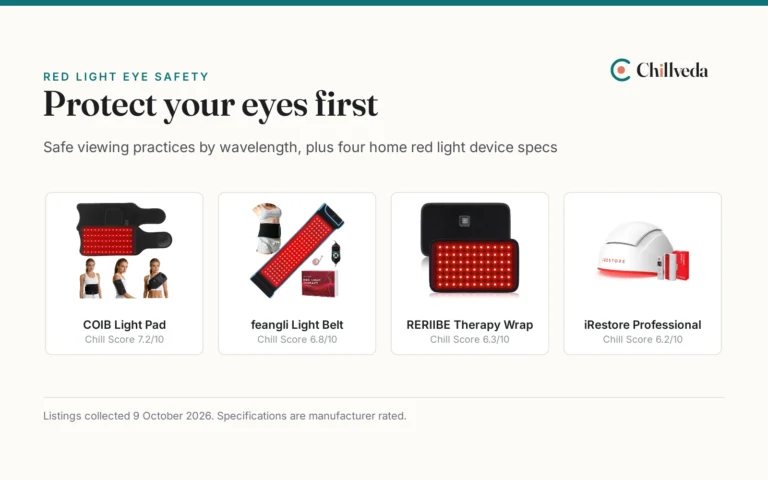
Is red light therapy safe for your eyes? Red light therapy eye safety depends on wavelength, optical intensity, and whether you look directly into the beam. Visible red light provides clear visual brightness, but invisible near-infrared wavelengths deliver optical energy without provoking a strong glare warning. You should never stare directly into phototherapy diodes, and you should wear opaque or wavelength-matched goggles whenever a panel or facial device shines in your field of view.
This guide examines stated wavelength specifications, why invisible infrared energy demands caution, and what manufacturers publish across four home phototherapy devices. Listings were collected 9 October 2026.
This article is informational and is not medical advice. Never stare directly into high-intensity light emitting diodes or laser apertures. Individuals with retinal disorders, eye conditions, or those taking photosensitizing medications should consult an eye care specialist before using phototherapy devices. Discontinue use immediately if you experience eye strain or visual discomfort. See our Medical Disclaimer.
Chillveda earns a commission when you buy through links on this page, at no extra cost to you. As an Amazon Associate I earn from qualifying purchases. Affiliate disclosure.
Quick picks
-
1
 Red Light Therapy Pad, 70 LEDs Adjustable Chill Score 9.5/10Check price on Amazon
A 22.1 by 7.1 inch wearable wrap with 70 dual-wavelength LEDs, six timer settings, and a stated 113 F maximum temperature.
-
2
 Correa de terapia de luz roja con 132 chips 3-en-1 Chill Score 9.4/10Check price on Amazon
A 50 by 8 inch wearable light belt with 132 chips across three wavelengths, five brightness levels, and a 9.84 foot power cord.
-
3
 Red Light Therapy, Portable Red Light Therapy Chill Score 9.3/10Check price on Amazon
An 11.8 by 7.49 inch pad with 60 lamp beads, two adjustable straps, and five push-button intensity modes.
-
4
 iRestore Professional + Rechargeable Battery Pack Chill Score 9.3/10Check price on Amazon
A 3.53 pound hands-free helmet device featuring 282 lasers and LEDs designed for scalp coverage with an included rechargeable battery pack.

A 22.1 by 7.1 inch wearable wrap with 70 dual-wavelength LEDs, six timer settings, and a stated 113 F maximum temperature.
Pros & ConsViewHide
Pros
- Dual wavelengths stated at 660nm and 850nm
- Six auto shut-off timers from 5 to 30 minutes
- Included 30.3 inch extension strap expands fit to 50 inches
- Dual power support for wall adapter or power bank
Cons
- No warranty term is stated
- No safety certifications listed
- Maximum temperature reaches 113 F
- Irradiance figures are not stated

A 50 by 8 inch wearable light belt with 132 chips across three wavelengths, five brightness levels, and a 9.84 foot power cord.
Pros & ConsViewHide
Pros
- Three wavelengths listed: 660nm, 850nm, and 940nm
- Generous 50 by 8 inch wrap coverage
- Long 9.84 foot power cord
- Transparent TPU inner layer for simple wiping
Cons
- No warranty term is stated
- No safety certifications listed
- Corded operation only
- Irradiance and optical power figures are not stated

An 11.8 by 7.49 inch pad with 60 lamp beads, two adjustable straps, and five push-button intensity modes.
Pros & ConsViewHide
Pros
- Dual 660nm visible red and 850nm near-infrared wavelengths
- Compact 11.8 by 7.49 inch pad weighs 10.4 ounces
- Includes both 27.6 inch and 6.1 inch straps
- Five selectable intensity modes on a single button
Cons
- No warranty term is stated
- Listing contradicts itself with 180 LEDs in title versus 60 beads in bullets
- Claims cord-free convenience while requiring a USB power cable
- No safety certifications or timer intervals stated

A 3.53 pound hands-free helmet device featuring 282 lasers and LEDs designed for scalp coverage with an included rechargeable battery pack.
Pros & ConsViewHide
Pros
- 282 lasers and LEDs provide broad scalp coverage
- Hands-free dome design with ventilated padding
- Includes rechargeable battery pack
- Clear dimensions stated at 10.8 by 9.9 by 6.6 inches
Cons
- No warranty term is stated
- Claims FDA clearance in title without a published clearance number
- Heaviest device here at 3.53 pounds
- Wavelengths in nanometers are not stated
More to compare
 670nm Red Light Therapy Glasses for Eye Comfort & VisualCheck price on Amazon
 INIA Red Light Therapy Eye Mask for Precision CareCheck price on Amazon
 Under-Eye Red Light Therapy DeviceCheck price on Amazon
 Under Eye Red Light TherapyCheck price on Amazon
 Red Light Therapy for EyesCheck price on Amazon
 Cordless Red Light for EyesCheck price on Amazon
Understanding red light therapy eye safety by device format, from maker listings
| Device format | Listing model | Stated wavelengths | Eye protection in listing |
|---|---|---|---|
| Flexible light wrap | COIB 70 LED Pad | 660nm and 850nm | Not stated in listing |
| Adjustable light belt | feangli 132-Chip Belt | 660nm, 850nm, 940nm | Not stated in listing |
| Targeted joint wrap | RERIIBE RLTP-60A | 660nm and 850nm | Not stated; notes infrared is invisible |
| Laser and LED cap | iRestore Professional | Not stated | Not stated in listing |
None of these four listings state whether protective eyewear is provided, as wearable wraps and caps are primarily configured for torso, joint, or scalp application rather than direct facial treatment. However, when operating phototherapy equipment near the face, or whenever using high-output panels, eye protection remains an important safety consideration.
Why near-infrared light behaves differently than visible red light
The human eye perceives visible red light, such as 660nm, as bright crimson illumination that signals your eyes to avert or narrow. In contrast, near-infrared wavelengths such as 850nm and 940nm produce little to no perceived brightness. Because visual brightness does not match the actual radiant energy delivered, near-infrared optical radiation enters the eye without the discomfort or glare that normally warns you of intense exposure. When devices combine visible red with near-infrared light, or when near-infrared operates alone, the invisible component delivers optical power to ocular tissues without visual warning. Our red light vs near infrared light guide explores these spectrum differences in detail.
Device makers frequently combine both wavelength bands. The COIB and RERIIBE pads pair 660nm red diodes with 850nm infrared chips, while the feangli belt adds 940nm chips. Because invisible energy creates no glare to warn you, looking into active near-infrared arrays risks optical strain without immediate warning signs.
When do you need goggles for red light therapy
Whether you require protective eyewear depends on beam direction, device proximity, and the area receiving light. When secured flush against the lower back, knee, or abdomen, wearable wraps direct their optical output into skin tissue. In that position, direct beam exposure to the eyes is minimal.
Eye protection becomes necessary whenever diodes are oriented toward your face or placed within your field of view. Scattered light from reflective surfaces can still reach the eyes, and eyelid tissue does not fully block penetrating near-infrared wavelengths. Sitting closer to an emitter increases optical intensity, as outlined in our guide on how far should you sit from a red light panel. In those setups, dedicated eyewear provides important protection.
Red light devices and stated specifications
These are scored on the Chill Score, which weighs performance 35, build 25, value 25, safety certifications 10 where it applies and warranty 5. None of these four listings publish third-party electrical safety certifications or concrete warranty terms, so all four score 0 for safety and 0 for warranty.
| Product | Chill Score | Perf. /35 | Build /25 | Value /25 | Safety /10 | Warranty /5 |
|---|---|---|---|---|---|---|
| COIB Light Pad | 9.5 | 29 | 21 | 21 | 0 | 0 |
| feangli Light Belt | 9.4 | 28 | 20 | 20 | 0 | 0 |
| RERIIBE Therapy Wrap | 9.3 | 26 | 19 | 19 | 0 | 0 |
| iRestore Professional | 9.3 | 24 | 20 | 18 | 0 | 0 |
Scores run from 9.2 to 9.8: each product’s point total is placed on that range, so more points always means a higher score.
For dedicated eye protection choices, see our best red light therapy goggles guide.
Practicing red light therapy eye safety at home
- Never stare directly into active diodes. Even when light appears comfortable, looking straight into focused emitters causes unnecessary glare and visual fatigue. Keep your gaze directed away from active arrays, and use dedicated protective eyewear rather than relying on closed eyelids alone.
- Wear opaque or wavelength-matched goggles. If a device illuminates your face or sits in your peripheral view, wear dedicated protective eyewear rather than regular sunglasses to ensure proper frame coverage and optical filtering.
- Respect stated session timers. Device listings publish differing session guidelines: COIB provides auto shut-off timers between 5 and 30 minutes, feangli recommends 30 minutes daily, RERIIBE suggests 15 to 30 minutes, and iRestore suggests sessions two to three times a week. Always follow the specific duration and schedule stated in your device manual.
- Keep targeted wraps on the body. Wearable pads and belts are shaped for the waist, back, or limbs. Keep them wrapped securely around the intended target area rather than repositioning them near the face or eyes.
- Be cautious with invisible near-infrared modes. Near-infrared light at 850nm and 940nm produces little to no visible brightness, so it does not provoke the same natural aversion or pupillary constriction as bright visible light. As the RERIIBE listing notes, infrared light is invisible to the eyes, meaning optical energy can enter without a glaring visual warning.
Common mistakes
- Assuming closed eyelids block all near-infrared light, when longer wavelengths penetrate thin eyelid tissue.
- Staring directly into diodes to check whether invisible 850nm or 940nm near-infrared chips are working.
- Using regular tinted sunglasses instead of opaque or rated phototherapy goggles during facial sessions.
- Assuming a claim of FDA clearance replaces optical safety precautions or guarantees included eye protection.
Common questions
Do you need goggles for red light therapy?
Protective eyewear is recommended whenever phototherapy diodes illuminate your face or fall within your field of vision. While eyelids attenuate some visible light, near-infrared wavelengths penetrate eyelid skin. Wearing opaque blackout goggles or wavelength-filtered glasses prevents optical strain and protects sensitive ocular structures.
Can red light therapy damage your eyes?
Directly staring into high-intensity LEDs or laser diodes can cause glare, retinal strain, or thermal fatigue over extended exposure. The risk is heightened with near-infrared wavelengths because the lack of perceived brightness fails to trigger a protective squint or blink. Keeping your eyes averted and using appropriate goggles keeps exposure within safe limits.
Why is near-infrared light riskier for eyes than visible red light?
Visible red light at 660nm provides clear visual brightness that prompts natural eye aversion. In contrast, near-infrared wavelengths like 850nm and 940nm produce little to no perceived brightness, so significant optical power can enter the eye without an immediate glare warning. This absence of visual warning makes dedicated eyewear essential when devices face the eyes.
Can you use regular sunglasses for red light therapy?
Regular sunglasses are designed to reduce ambient sunlight glare and filter ultraviolet radiation, not phototherapy wavelengths. Most sunglasses allow concentrated red and near-infrared light to pass directly through the lenses. Dedicated red light goggles use specialized filtering dyes or total blackout cups to block therapeutic wavelengths.
Is red light therapy safe for pets’ eyes?
Makers like feangli and COIB describe their wearable light wraps as pet-friendly, but animals must also be protected from direct ocular exposure. Never wrap a light pad around an animal’s face or point active diodes toward their eyes. Keep pet sessions focused exclusively on the torso, back, or limbs as directed by your veterinarian.
Sources: Amazon product listings for the devices named above, collected 9 October 2026. Related: our red light wavelengths explained guide and best targeted red light devices.
Back to all red light therapy reviews.