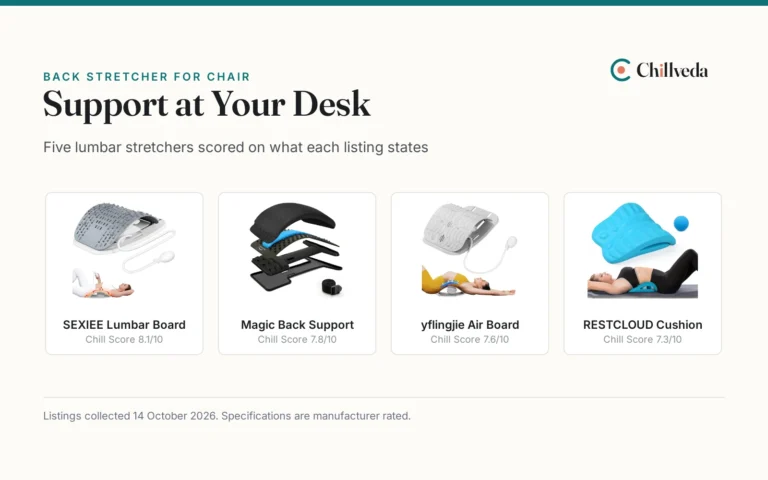
Using a back stretcher for chair seating can help relieve lower back stiffness during long hours at your desk. Placed upright against a chair backrest, these devices support the natural inward curve of the lumbar spine without requiring floor space or dedicated workout time.
This roundup scores five back stretchers for office chairs on Amazon on what each listing publishes. Listings and details were collected 14 October 2026.
This article is informational and is not medical advice. Lumbar stretching places direct pressure on the back. Speak to a doctor first if you have acute spinal injuries, severe osteoporosis, or radiating nerve pain. Avoid the neck, direct spine, and major blood vessels. See our Medical Disclaimer.
Chillveda earns a commission when you buy through links on this page, at no extra cost to you. As an Amazon Associate I earn from qualifying purchases. Affiliate disclosure.
Quick picks
-
1
 Back Stretcher for Lower Back Chill Score 9.6/10Check price on Amazon
A pneumatic lumbar stretching board made from polypropylene and thermoplastic rubber, featuring ten magnets, ninety acupressure nodes, and a manual hand pump for smooth arch adjustments.
-
2
 Multi-Level Back Stretcher Device Chill Score 9.6/10Check price on Amazon
A three-level adjustable back stretcher paired with a memory foam cushion and a washable mesh cover, designed for both seated chair support and horizontal traction.
-
3
 Back Stretcher for Lower Back Pain Relief Chill Score 9.6/10Check price on Amazon
An adjustable lumbar decompression board built with an ABS plastic frame, soft EVA cushioning, and an air compression mechanism to vary stretch intensity.
-
4
 RESTCLOUD Back Stretcher for Back Pain Relief Chill Score 9.5/10Check price on Amazon
A contoured polyurethane foam cushion shaped with a C-curve arch, eight massage nodes, sixteen bars, and a removable central ball for dual-intensity lower back support.
-
5
 Back Stretcher for Lower Back Pain Relief Chill Score 9.4/10Check price on Amazon
A slotted polypropylene back stretcher offering four height settings, eighty-six acupressure points, and a central foam strip with a stated two-hundred-pound weight capacity.
What we picked for home recovery

A pneumatic lumbar stretching board made from polypropylene and thermoplastic rubber, featuring ten magnets, ninety acupressure nodes, and a manual hand pump for smooth arch adjustments.
Pros & ConsViewHide
Pros
- Pneumatic air pump allows continuous arch adjustment
- Features 10 magnets and 90 acupressure nodes
- Wide support board distributes lumbar pressure
- Constructed with durable PP, TPR, and PVC materials
Cons
- No warranty term is stated
- Spec table lists contradictory depth dimensions
- Manual bulb pump must be pumped by hand
- Wider board may feel bulky on narrow office chairs

A three-level adjustable back stretcher paired with a memory foam cushion and a washable mesh cover, designed for both seated chair support and horizontal traction.
Pros & ConsViewHide
Pros
- Includes a memory foam cushion for chair seating
- Offers 3 adjustable height levels for stretching
- Removable ventilated mesh cover is washable
- Lightweight design weighs 1.4 pounds
Cons
- No warranty term is stated
- Spec table mistakenly lists 0.04-inch thickness
- Care instructions contradict between machine and hand wash
- Narrower 4-inch width provides less lateral support

An adjustable lumbar decompression board built with an ABS plastic frame, soft EVA cushioning, and an air compression mechanism to vary stretch intensity.
Pros & ConsViewHide
Pros
- Air compression system adjusts arch height smoothly
- ABS plastic frame with soft EVA foam cushioning
- Lightweight frame weighs only 1.3 pounds
- Requires no mechanical assembly before use
Cons
- No warranty term is stated
- Listing lacks details on acupressure node count
- Single color option listed
- Narrower 8.2-inch width than some wider boards

A contoured polyurethane foam cushion shaped with a C-curve arch, eight massage nodes, sixteen bars, and a removable central ball for dual-intensity lower back support.
Pros & ConsViewHide
Pros
- Solid polyurethane foam construction requires no setup
- Includes 8 massage nodes and 16 spinal alignment bars
- Removable center ball alters support intensity
- C-shaped curve fits the spine passively
Cons
- No warranty term is stated
- Cannot adjust arch height beyond removing center ball
- Heaviest unit in this group at 1.8 pounds
- Foam cover is not removable for washing

A slotted polypropylene back stretcher offering four height settings, eighty-six acupressure points, and a central foam strip with a stated two-hundred-pound weight capacity.
Pros & ConsViewHide
Pros
- Features 4 slotted height adjustment levels
- Surface includes 86 acupressure contact points
- Central foam strip cushions the spine during use
- Listing states a 200-pound maximum weight limit
Cons
- No warranty term is stated
- Listing omits the product weight
- Rigid plastic arch is difficult to adjust while seated
- Marketing claims moxibustion without any heating element
More to compare
 Everlasting Comfort Lumbar Support Board Back Stretcher forCheck price on Amazon
 Inflatable Back Stretcher for Lower Back Pain ReliefCheck price on Amazon
 JUMPOW Back Stretcher for Lower Back Pain ReliefCheck price on Amazon
 MINOLL Back Stretcher for Lower Back Pain ReliefCheck price on Amazon
 North American HealthcareCheck price on Amazon
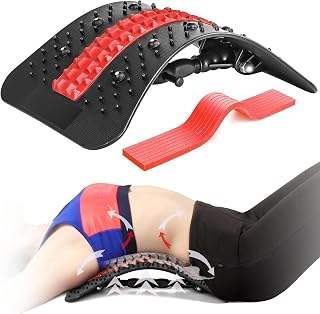 Back StretcherCheck price on Amazon
Choosing a back stretcher for chair use
When selecting a back stretcher for chair support, the mechanism determines how you adjust spinal curve during the workday. The five picks here fall into three design categories:
- Pneumatic air bladders: Models like the SEXIEE and yflingjie use an internal air cushion. An external manual pump lets you increase or decrease lumbar arch height gradually while remaining seated.
- Slotted plastic arches: Models like the Magic Back Support and CNYUANFEN use rigid arched plates that slot into fixed notches. These offer stable mechanical elevation, though changing levels requires stepping away from your chair to flex the plastic plate by hand.
- Contoured solid foam: The RESTCLOUD uses molded polyurethane foam without moving parts. It provides passive lumbar cradling, with intensity modified by inserting or removing its central massage ball.
Narrower boards concentrate support along the lumbar spine, while wider boards spread contact across the chair back. For seated desk routines, air compression provides the most seamless adjustment without interrupting your workflow.
Dimensions, adjustments and materials
| Stretcher | Adjustment type | Materials | Dimensions | Warranty |
|---|---|---|---|---|
| SEXIEE Lumbar Board | Pneumatic pump | PP, TPR, PVC | 14.56 x 9.05 x 1.18 in | Not stated |
| Magic Back Support | 3-level slots | Memory foam, cotton | 15 x 4 in | Not stated |
| yflingjie Air Board | Air compression | ABS plastic, EVA | 14.5 x 8.2 x 2 in | Not stated |
| RESTCLOUD Cushion | Removable ball | Polyurethane foam | 12.6 x 12.2 x 4 in | Not stated |
| CNYUANFEN A1 Board | 4-level slots | PP plastic | 14.96 x 9.95 x 1.81 in | Not stated |
We evaluated five back stretcher listings intended for chair and seated support. None of the five listings publish a concrete warranty term, and none publish electrical or formal safety certifications. Two use pneumatic air systems, two use rigid slotted plastic frames, and one uses solid molded polyurethane foam.
Who should not buy these
Anyone experiencing acute back trauma, spinal fractures, spondylolisthesis, or severe disc herniation should consult a physician before using mechanical back stretchers. A manual back stretcher also will not suit anyone looking for powered vibration or active heat, where an electric heat pad with massager or dedicated back massagers are better choices. If your office chair has a deeply curved ergonomic mesh back, adding a rigid board may disrupt the built-in lumbar contour.
For more options, see our guides to back stretcher vs yoga wheel and foam rollers for back.
Score notes
The Chill Score weighs performance 35, build 25, value 25, safety certifications 10 where it applies, and warranty 5. For non-electric back stretchers, safety certifications do not apply to manual plastic and foam devices, so safety scores zero across all listings. Furthermore, none of the five manufacturers publishes a concrete warranty term, resulting in zero warranty points.
| Product | Chill Score | Perf. /35 | Build /25 | Value /25 | Safety /10 | Warranty /5 |
|---|---|---|---|---|---|---|
| SEXIEE Lumbar Board | 9.6 | 30 | 21 | 21 | n/a | 0 |
| Magic Back Support | 9.6 | 29 | 20 | 21 | n/a | 0 |
| yflingjie Air Board | 9.6 | 28 | 20 | 20 | n/a | 0 |
| RESTCLOUD Cushion | 9.5 | 27 | 20 | 19 | n/a | 0 |
| CNYUANFEN A1 Board | 9.4 | 26 | 18 | 19 | n/a | 0 |
Scores run from 9.2 to 9.8: each product’s point total is placed on that range, so more points always means a higher score. Safety counts only for powered gear or where the listing states safety features; where it does not apply, the score is taken over the remaining 90 points.
SEXIEE leads because its pneumatic hand pump enables gradual arch adjustments while seated at your desk, supported by durable polypropylene construction. Magic Back Support earns second place with its soft memory foam cushion and washable cover, which provides superior chair comfort. The CNYUANFEN A1 scores lowest due to unverified marketing claims, omitted product weight, and stiff slotted tabs.
Check Your Space First
- Chair backrest width: Ensure your office chair seat back is wider than your chosen stretcher. The widest option here is RESTCLOUD at 12.4 inches wide, while Magic Back Support measures 4 inches across.
- Forward seat displacement: Placing a stretcher behind your back reduces available seat depth by 1.18 inches (SEXIEE) to 4 inches (RESTCLOUD), which moves your seating position forward on the chair cushion.
- Desk storage and weight: Unit weights range from 1.3 pounds (yflingjie) to 1.8 pounds (RESTCLOUD), allowing any of these five devices to store easily inside a standard office file drawer.
- Manual operation: None of these devices require electrical outlets, charging cords, or batteries, giving you full flexibility to position them on desk chairs, dining chairs, or vehicle seats.
Common questions
How do you position a back stretcher on an office chair?
Place the device upright against the lower portion of your chair backrest, with the wider base resting on the seat pan. Lean back gently so that the curve aligns with your natural lumbar arch. If your chair has adjustable lumbar support, lower it so the stretcher sits flat against the backrest.
How long should you use a back stretcher on a chair?
Short intervals are recommended when introducing spinal stretching during the workday. Product listings suggest starting with five-minute sessions two to three times daily to let spinal muscles adapt gradually. Avoid sitting against a rigid stretcher continuously throughout the day without breaks.
What is the benefit of a pneumatic back stretcher over a slotted model?
Pneumatic stretchers use an inflatable air bladder controlled by a hand pump, allowing you to fine-tune the arch smoothly while remaining seated. Slotted plastic boards require you to remove the stretcher and physically bend the plastic plate into fixed notches. This makes pneumatic models significantly more convenient for quick desk adjustments.
Can a foam back stretcher work as well as an arched plastic board?
A molded foam stretcher like the RESTCLOUD provides gentle, passive cushioning that conforms to your back rather than forcing a rigid arch. It offers less pronounced mechanical traction than slotted or pneumatic boards, but it avoids the hard pressure points that plastic plates can produce during prolonged desk sitting.
Back to all recovery tools reviews.