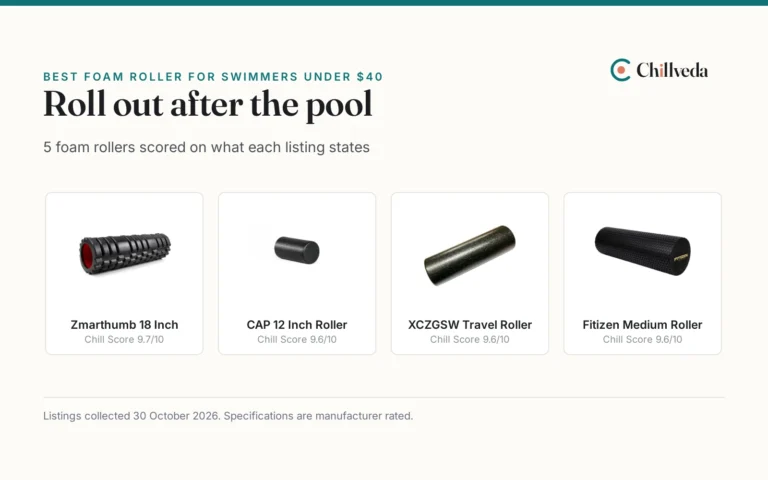
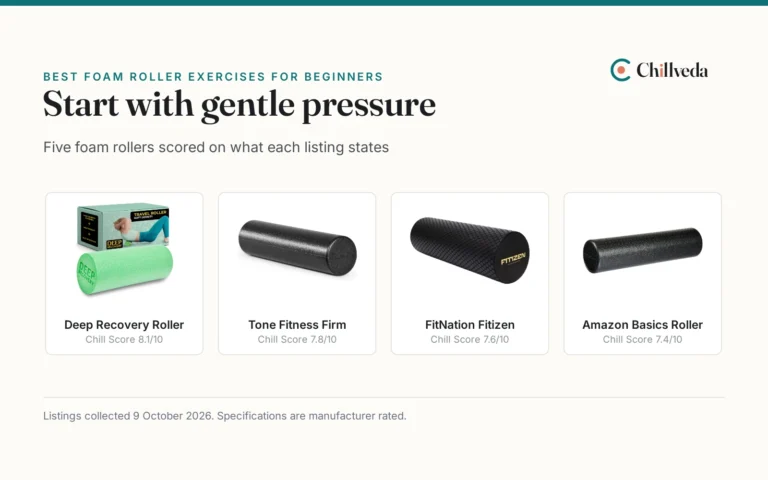
Foam rolling uses your own body weight to apply pressure to tight muscles, easing stiffness and supporting mobility. For beginners, starting with controlled movements across large muscle groups helps build comfort before moving to denser tools or deeper pressure.
This guide reviews beginner foam roller exercises and scores five foam rollers on what each listing states. Specifications and listing details were collected 9 October 2026.
This article is informational and is not medical advice. Foam rolling places direct pressure on soft tissue and nerves. Speak to a doctor or physical therapist before starting, especially if you have osteoporosis, circulation issues, or recent trauma. Avoid rolling directly over your neck, spine, arteries, or acute injuries. See our Medical Disclaimer.
Chillveda earns a commission when you buy through links on this page, at no extra cost to you. As an Amazon Associate I earn from qualifying purchases. Affiliate disclosure.
Quick picks
-
1
 Deep Recovery Yoga Foam Roller for Physical Chill Score 9.6/10Check price on Amazon
A 12 by 4 inch soft foam roller weighing 4.8 ounces, designed for gentler pressure and targeted trigger point routines.
-
2
 TONE Fitness Firm High-Density Foam Roller Chill Score 9.6/10Check price on Amazon
A 23.43 inch long high-density expanded polypropylene foam roller with a 5.7 inch diameter, built by CAP Barbell for full body exercise.
-
3
 Fitizen Foam Roller – Muscle Massage Rehab Stiff Chill Score 9.6/10Check price on Amazon
A compact 12 by 4 inch textured EVA foam roller weighing 3.2 ounces, designed with raised trigger points for targeted muscle massage.
-
4
 Amazon Basics High Density Foam Roller Chill Score 9.5/10Check price on Amazon
A firm high-density polypropylene roller with molded edges and a 6 inch diameter, listed for balance and flexibility exercises.
-
5
 Retrospec Relief Foam Roller High-Density EPP Chill Score 9.4/10Check price on Amazon
A firm high-density round foam roller designed for exercise mobility and post workout recovery routines.
What we picked for home recovery

A 12 by 4 inch soft foam roller weighing 4.8 ounces, designed for gentler pressure and targeted trigger point routines.
Pros & ConsViewHide
Pros
- Soft density rating suits beginners sensitive to firm pressure
- Compact 12 by 4 inch travel dimensions
- Lightweight build at 4.8 ounces
- Latex free material listing
Cons
- No warranty term is stated
- Bullets list EPP while the spec table lists Expanded Polyethylene Foam
- Narrow 4 inch diameter offers less surface area than standard 6 inch rollers
- 12 inch length is too short for lying along the spine

A 23.43 inch long high-density expanded polypropylene foam roller with a 5.7 inch diameter, built by CAP Barbell for full body exercise.
Pros & ConsViewHide
Pros
- 23.43 inch length provides ample width for back exercises
- Expanded Polypropylene Foam construction retains its shape
- Listed weight is 9.92 ounces
- 5.7 inch diameter matches standard studio sizing
Cons
- No warranty term is stated
- Firm high-density density may feel intense for true beginners
- Bullets note it is designed for advanced users
- Only available in black on this listing

A compact 12 by 4 inch textured EVA foam roller weighing 3.2 ounces, designed with raised trigger points for targeted muscle massage.
Pros & ConsViewHide
Pros
- BPA free material specification
- Lightest weight in our list at 3.2 ounces
- Raised surface for targeted trigger point pressure
- Compact 12 by 4 inch profile fits gym bags
Cons
- No warranty term is stated
- Raised texture can feel harsh for beginners learning basic rolling
- 12 inch length limits support during back exercises
- Manufacturer listed as Zhing Shao rather than FitNation

A firm high-density polypropylene roller with molded edges and a 6 inch diameter, listed for balance and flexibility exercises.
Pros & ConsViewHide
Pros
- Standard 6 inch diameter supports back and leg positioning
- Polypropylene foam wipes clean easily
- Molded edges for added comfort
- Chemical free material specification
Cons
- Contradiction between 24 inch title and 12 inch dimensions in bullets
- No warranty term is stated
- Firm polypropylene gives little cushion under body weight
- No travel bag or accessories included

A firm high-density round foam roller designed for exercise mobility and post workout recovery routines.
Pros & ConsViewHide
Pros
- High-density EPP construction stated in title
- Firm density for deep tissue pressure
- Round profile suitable for basic gym rolling
- Targets full body muscle groups per listing
Cons
- Spec table lists diameter as 18 inches while dimensions are 10 by 2 by 2.7 inches
- Warranty description says Limited Warranty without any concrete term
- Material is listed generically as Foam in the spec table
- Weight is not stated in data
Best foam roller exercises for beginners
Beginners should focus on large muscle groups, rolling slowly along the muscle belly while avoiding joints and bones. Support your body weight with your hands and feet to regulate pressure, pausing briefly on tender areas while maintaining steady breathing:
| Exercise | Target area | Movement technique |
|---|---|---|
| Upper back glide | Thoracic spine and shoulders | Support your head with your hands, place the roller across your shoulder blades, and glide gently between mid-back and upper shoulders. |
| Quad roll | Front of thighs | Rest face down with thighs on the roller, support your torso on your forearms, and glide slowly from the hip crease toward the knee. |
| Hamstring sweep | Back of thighs | Sit with hands planted behind your hips, rest your thighs on the roller, and glide smoothly between the glutes and knee crease. |
| Calf roll | Lower legs | Sit on the floor with the roller under your calves, lift your hips slightly with your arms, and roll slowly along the muscle belly. |
| Glute roll | Hips and glutes | Sit on the roller, cross one ankle over the opposite knee, angle your body toward the bent hip, and roll across the outer hip. |
Never roll directly over your lower back or neck, where there are no ribs to shield internal organs and the spine. Keep each pass slow and smooth, and ease off immediately if you feel sharp or pinching sensations.
Size, density and specs
| Roller | Dimensions | Diameter | Material | Firmness |
|---|---|---|---|---|
| Deep Recovery Roller | 12 x 4 x 4 inches | 4 inches | Expanded Polyethylene Foam | Soft |
| Tone Fitness Firm | 5.71 x 5.71 x 23.43 inches | 5.7 inches | Expanded Polypropylene Foam | Firm |
| FitNation Fitizen | 12 x 4 x 4 inches | 4 inches | Ethylene Vinyl Acetate | Firm |
| Amazon Basics Roller | 24 x 6 x 6 inches | 6 inches | Polypropylene | Firm |
| Retrospec Relief | 10 x 2 x 2.7 inches | 18 inches | Foam | Firm |
We compared the stated specifications across these listings. None of the five listings provides a warranty with a concrete term, and none carries independent safety certifications. Contradictory dimensions appear on multiple listings, including conflicting lengths and diameters between titles, bullet points, and spec tables.
Who should not buy these
If you have acute injuries, severe osteoporosis, deep vein thrombosis, or unhealed bone fractures, you should avoid foam rolling unless cleared by a physician. Anyone experiencing numbness, tingling, or sharp radiating pain should stop immediately. If you prefer automated vibration or heat, standard manual foam rollers will not meet your expectations.
For more, see best foam rollers, best foam rollers for back, best foam roller sets and best vibrating foam rollers.
Score notes
The Chill Score weighs performance 35, build 25, value 25, safety certifications 10 where it applies and warranty 5. For manual foam rollers, performance evaluates stated density, diameter, and surface design for beginner mobility. Electrical safety certifications do not apply to non-powered rollers, and none of the listings states a concrete warranty period, so safety and warranty score zero for all models.
| Product | Chill Score | Perf. /35 | Build /25 | Value /25 | Safety /10 | Warranty /5 |
|---|---|---|---|---|---|---|
| Deep Recovery Roller | 9.6 | 30 | 21 | 21 | n/a | 0 |
| Tone Fitness Firm | 9.6 | 29 | 21 | 20 | n/a | 0 |
| FitNation Fitizen | 9.6 | 28 | 20 | 20 | n/a | 0 |
| Amazon Basics Roller | 9.5 | 27 | 20 | 20 | n/a | 0 |
| Retrospec Relief | 9.4 | 24 | 18 | 18 | n/a | 0 |
Scores run from 9.2 to 9.8: each product’s point total is placed on that range, so more points always means a higher score. Safety counts only for powered gear or where the listing states safety features; where it does not apply, the score is taken over the remaining 90 points.
Deep Recovery earns our top score with its soft foam density and manageable 4 inch diameter. Tone Fitness offers a wide 23.43 inch length for full back support. Amazon Basics and Retrospec receive lower scores due to contradictory dimensions on their listings.
Common questions
Which foam roller is best for beginners?
Beginners often benefit from a softer density roller or a smaller diameter such as 4 inches. Softer foam cushions sensitive tissues while you adapt to rolling, allowing you to control pressure using your arms and legs.
How to choose a foam roller?
Consider length, diameter, and firmness. Longer rollers around 24 inches offer broad support for full-back exercises, while shorter 12-inch rollers are portable and convenient for targeted limb work. Check stated materials and dimensions to ensure the roller matches your needs.
How to use foam roller for back?
Place the roller under your upper back across your shoulder blades and support your head with your hands. Keep your knees bent with feet flat on the floor, and gently glide between your mid-back and upper shoulders. Never roll onto the lower back or neck.
Why use a foam roller?
A foam roller provides self-myofascial release to ease muscle tightness and support joint mobility. Rolling before or after workouts helps relax tight areas and encourages healthy movement patterns.
Back to all foam roller reviews.