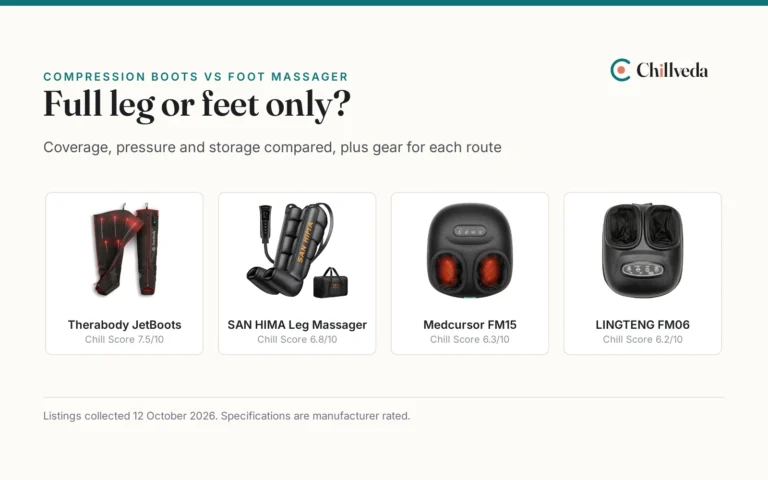
Side by side Choose compression boots if Choose a foot massager if
Picture your evening recovery routine after a long workday or a strenuous training session: you sit down on the living room sofa or settle into an office chair and decide how much of your lower body needs relief. The choice between compression boots vs foot massager comes down to how much surface area you want to treat and how you prefer to relax. Compression boots are tall inflatable sleeves designed for full-leg recovery from toes to thighs while you recline with your legs extended. A foot massager is a rigid floor console that sits under a desk or in front of your favorite chair, delivering mechanical kneading and heat directly to your soles while you sit upright. Athletes managing heavy leg fatigue should choose compression boots, while desk workers and retail staff dealing with plantar discomfort or cold, aching arches should pick a foot massager.
This comparison examines coverage area, massage mechanics, floor space, electrical needs, and upkeep routines across both categories, using concrete listing specifications to help you decide. Listings were collected 12 October 2026.
This article is informational and is not medical advice. Avoid using high pneumatic pressure or aggressive mechanical massage over acute muscle tears, open wounds, deep vein thrombosis, or severe peripheral neuropathy, and do not place motorized massagers directly over bones or major arteries without medical clearance. Consult a physician before beginning treatment if you have cardiovascular conditions, circulatory disorders, or diabetes. See our Medical Disclaimer.
Chillveda earns a commission when you buy through links on this page, at no extra cost to you. As an Amazon Associate I earn from qualifying purchases. Affiliate disclosure.
Quick picks
-
1
 Therabody JetBoots PRO Plus Wireless LED 3-in-1 Chill Score 9.5/10Check price on Amazon
A wireless pneumatic compression boot combining vibration, infrared LED light therapy and up to 5 hours of battery life for full leg recovery.
-
2
 SAN HIMA Air Compression Leg Massager Chill Score 9.4/10Check price on Amazon
A corded sequential air compression leg massager with 5 chambers, 6 modes and an included 1-year warranty for full leg relief.
-
3
 Medcursor Foot Massager Machine with Heat Chill Score 9.3/10Check price on Amazon
A compact corded foot massager providing shiatsu kneading, rolling nodes, gentle heat and air compression for tired feet.
-
4
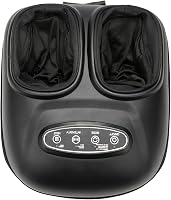 LINGTENG Foot Massager, Heated Foot Massager Chill Score 9.3/10Check price on Amazon
An under-desk electric foot massager combining shiatsu kneading, constant temperature heat, air compression and a removable washable sleeve.

A wireless pneumatic compression boot combining vibration, infrared LED light therapy and up to 5 hours of battery life for full leg recovery.
Pros & ConsViewHide
Pros
- Combines compression, vibration and LED light therapy
- Cordless design with up to 5 hours of battery life
- Eight built-in presets and 60-second flush cycles
- Includes convenient travel bag and fits 27 to 32 inch legs
Cons
- No warranty term is stated
- Heaviest pick in this comparison at 11.33 pounds
- Short size limited to 27 to 32 inch leg lengths
- No safety certifications stated on the listing

A corded sequential air compression leg massager with 5 chambers, 6 modes and an included 1-year warranty for full leg relief.
Pros & ConsViewHide
Pros
- Five air chambers provide sequential full leg coverage
- Six massage modes, six intensity levels and three timers
- TPU-coated nylon build with carry bag included
- One-year manufacturer warranty stated
Cons
- Listing confuses power source between corded electric and battery
- No heating function included on the sleeves
- No safety certifications stated on the listing
- Full-leg sleeves require floor space to extend legs during use

A compact corded foot massager providing shiatsu kneading, rolling nodes, gentle heat and air compression for tired feet.
Pros & ConsViewHide
Pros
- Combines shiatsu kneading, rolling and air compression
- Built-in heating function for cold or tired feet
- Lightweight design weighing 5 pounds
- Two air pressure intensity levels and three massage settings
Cons
- Spec table errantly claims unit is waterproof
- Heating function requires warm-up time before full effect
- No warranty term is stated
- Treats feet only, with no calf or leg coverage
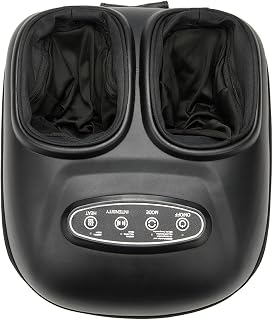
An under-desk electric foot massager combining shiatsu kneading, constant temperature heat, air compression and a removable washable sleeve.
Pros & ConsViewHide
Pros
- Shiatsu kneading with air compression and constant temperature heat
- Removable and washable zippered foot sleeve for hygiene
- Simple one-key electric operation
- Compact footprint fits under standard desks
Cons
- Lacks mechanical rolling nodes found on other foot massagers
- No warranty term is stated
- No safety certifications stated on the listing
- Treats feet only, with no calf or leg coverage
More to compare
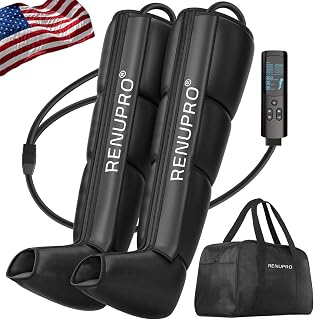 Leg Compression MassagerCheck price on Amazon
 Air Relax Plus AR-3 Professional Compression BootsCheck price on Amazon
 DEKEMASTER Full Leg Compression MassagerCheck price on Amazon
 JZBRAIN Professional Sequential Air Compression Boots forCheck price on Amazon
 FIT KING Air Compression Leg and Foot Boots Massager forCheck price on Amazon
Compression boots vs foot massager at a glance
| Compression boots | Foot massager | |
|---|---|---|
| Treatment area | Full leg (feet, calves and thighs on these examples) | Feet only (arches, soles and heels on these examples) |
| Massage mechanism | Sequential pneumatic air chambers (plus vibration and LED on Therabody) | Shiatsu kneading and air compression (plus rollers on Medcursor) |
| Heat function | Neither listing states heating elements | Both listings include heating functions |
| Operating position | Reclining or seated with legs extended | Seated upright with feet on the floor |
| Power supply | Battery powered (Therabody) or corded electric (SAN HIMA) | Corded electric on both examples |
| Portability and storage | Pack into included travel and carry bags | Rigid standalone consoles kept on the floor |
Coverage and massage mechanics
The primary distinction between these devices is the physical mechanism used to deliver relief. Compression boots rely on pneumatic air bladders that inflate and deflate sequentially. For example, the SAN HIMA example features 5 sequential air chambers extending from foot to thigh, while the Therabody example provides 8 preset compression programs and cycle flushes in as little as 60 seconds. This pneumatic squeezing action compresses large muscle compartments, assisting venous blood return throughout the lower limbs. High-end boots may also integrate complementary modalities; the Therabody unit incorporates vibration and infrared LED light therapy alongside pneumatic pressure.
Foot massagers focus their work exclusively below the ankles. Rather than full-limb sequential compression, they combine mechanical shiatsu kneading mechanisms with localized air compression around the feet. The Medcursor example includes rolling nodes under the arch alongside shiatsu kneading and 2 air pressure intensity levels. The LINGTENG example relies on shiatsu kneading without rollers, combining hand-like kneading with constant temperature heat and wrapped air compression. If you want to explore more dedicated models in each category, check our guides to the best compression boots and the best foot massagers, or look into a shiatsu foot massager with compression.
Space, power and storage footprints
Recovery equipment must fit your room layout and available storage. The two categories handle space differently. Compression boots enclose the legs during use, requiring room to recline with legs extended, but pack away between sessions; the SAN HIMA nylon sleeves fold into an included carry bag, while the 11.33-pound Therabody boots pack into an included travel bag. Standalone foot massagers, like the ABS plastic LINGTENG and polyester-lined Medcursor consoles, remain rigid units designed to stay on the floor under a desk or in front of a chair.
To compare the physical dimensions and weight of each device, we list the maker’s stated measurements below.
| Device | Category | Dimensions (L x W x H) | Weight |
|---|---|---|---|
| Therabody JetBoots | Compression boots | 15.55 x 8.54 x 15.28 in | 11.33 lb |
| SAN HIMA Leg Massager | Compression boots | 16.54 x 9.84 x 7.87 in | 6.17 lb |
| Medcursor FM15 | Foot massager | 14.41 x 13.03 x 6.97 in | 5 lb |
| LINGTENG FM06 | Foot massager | 15.91 x 12.99 x 7.09 in | 6.81 lb |
Power configurations also differ across these picks. The Therabody example operates cordlessly on an internal rechargeable lithium-ion battery delivering up to 5 hours of run time from a 5-hour charge, allowing you to use it without sitting beside a power outlet. The other three models require corded electric power. The SAN HIMA listing presents conflicting information, noting corded electric operation in its main description while referencing a 12V battery in its spec table.
Cleaning and upkeep
Routine hygiene is essential for gear that contacts bare feet and legs. Because foot massagers operate on bare or socked feet within an enclosed cavity, dirt and moisture can accumulate over time. The LINGTENG example addresses this by including a detachable zippered foot sleeve that can be removed and washed. The Medcursor example features polyester interior lining that requires spot cleaning, although its listing mistakenly labels the appliance as waterproof in the spec table; this is an error buyers should disregard to avoid electrical hazards.
Compression boots require external wipe-downs after sweaty training sessions. The SAN HIMA model uses TPU-coated 100% nylon, which can be wiped clean with a damp cloth, while the Therabody model lists a polycarbonate boot structure. For deeper care tips, see our guide on how to use compression boots.
Gear for each route
These are scored on the Chill Score: performance 35, build 25, value 25, safety certifications 10 where it applies and warranty 5. None of these four listings states a UL or ETL safety certification, so all score 0 for safety. SAN HIMA earns warranty points for its stated 1-year coverage, while the other three models state no warranty terms.
| Product | Chill Score | Perf. /35 | Build /25 | Value /25 | Safety /10 | Warranty /5 |
|---|---|---|---|---|---|---|
| Therabody JetBoots | 9.5 | 33 | 22 | 20 | 0 | 0 |
| SAN HIMA Leg Massager | 9.4 | 28 | 19 | 19 | 0 | 2 |
| Medcursor FM15 | 9.3 | 27 | 18 | 19 | 0 | 0 |
| LINGTENG FM06 | 9.3 | 26 | 19 | 18 | 0 | 0 |
Scores run from 9.2 to 9.8: each product’s point total is placed on that range, so more points always means a higher score.
Choose compression boots if
- You need recovery that covers your calves, knees, and thighs rather than just your feet.
- You train for endurance sports, running, or cycling and experience widespread leg soreness.
- You want to recover while reclining with your legs extended.
- You travel frequently and want portable gear that packs into an included bag.
Choose a foot massager if
- Your discomfort is concentrated in the arches, heels, or soles of your feet.
- You spend long hours standing or walking and want kneading pressure targeted on your feet.
- You want soothing heat therapy during your recovery session.
- You want a compact unit that stays under your desk for convenient daily use while sitting upright.
Check Your Space First
- Outlet proximity: The Medcursor, LINGTENG, and SAN HIMA examples require a corded electric connection, so plan a seating spot near a wall outlet unless you choose a cordless option like the 5-hour battery-powered Therabody model.
- Floor clearance for boots: Full-leg sleeves require room to extend your legs; for example, the Therabody Short model is designed for leg lengths of 27 to 32 inches, so verify you have adequate space in front of your chair or bed.
- Under-desk clearance: Standalone foot massagers need adequate vertical and horizontal clearance; the LINGTENG unit stands 7.09 inches high and measures 15.91 by 12.99 inches, while the Medcursor unit stands 6.97 inches tall and measures 14.41 by 13.03 inches.
- Storage weight: If lifting devices onto shelves or into closets, note that the Therabody boots weigh 11.33 pounds (11.3 pounds in the spec table), while the standalone foot massagers weigh 5 pounds for Medcursor and 6.81 pounds for LINGTENG.
Common questions
What are compression boots?
Compression boots are wearable inflatable sleeves that enclose the feet, calves, and thighs. They use internal air chambers that inflate and deflate sequentially, applying rhythmic pneumatic compression along the legs. The mechanical squeezing action is designed for post-workout leg recovery and easing muscle fatigue.
Can a foot massager replace compression boots?
A foot massager cannot replace compression boots because it only treats the feet. Foot massagers use mechanical kneading mechanisms, air compression, and heating elements to target the soles, arches, or heels. If you need recovery that extends into your calves and thighs, you require the full-leg coverage of compression boots.
How often can you use compression boots?
Usage frequency depends on your recovery routine and the maker’s guidelines for your specific device. Many users run a session after intense exercise or prolonged periods on their feet. Preset programs or built-in timer settings, like the three timer options on the SAN HIMA example, allow you to select session lengths that match your recovery needs.
Do I need compression boots if I only have foot pain?
If your discomfort is limited to tired soles, aching arches, or tight heels, a dedicated foot massager is generally the more effective and affordable choice. Foot massagers provide motorized shiatsu kneading and heat therapy that compression sleeves do not offer. Compression boots are designed primarily for athletes and individuals needing full-leg muscular recovery.
How do you clean compression boots?
Cleaning requirements depend on the materials used by the manufacturer. Sleeves made from TPU-coated nylon, such as the SAN HIMA example, or polycarbonate boots like the Therabody example, should be wiped clean externally with a damp cloth. Never submerge electrical massagers or air boots in water, and allow components to dry fully before placing them in a storage bag.
Back to all recovery tools reviews.