Short answer
Which is better for lower back tightness, a roller or a ball?
A massage ball is generally safer and more effective for lower back tightness because it can target the gluteus medius and piriformis muscles, which often contribute to lumbar tension. Placing a foam roller directly under the lumbar spine can hyperextend the lower back and strain surrounding joints. Using a ball against a wall allows you to relieve tight hips without compressing spinal discs.
When deciding between a foam roller vs massage ball, the choice depends on whether you need broad coverage or pinpoint pressure. A foam roller uses a wide cylindrical surface to distribute body weight across large muscle groups such as the quadriceps, hamstrings, and upper back. A massage ball focuses your body weight onto a small, curved point that reaches deep into localized tissue restrictions in the glutes, shoulders, and feet. Most recovery routines work best when using both tools for their distinct strengths.
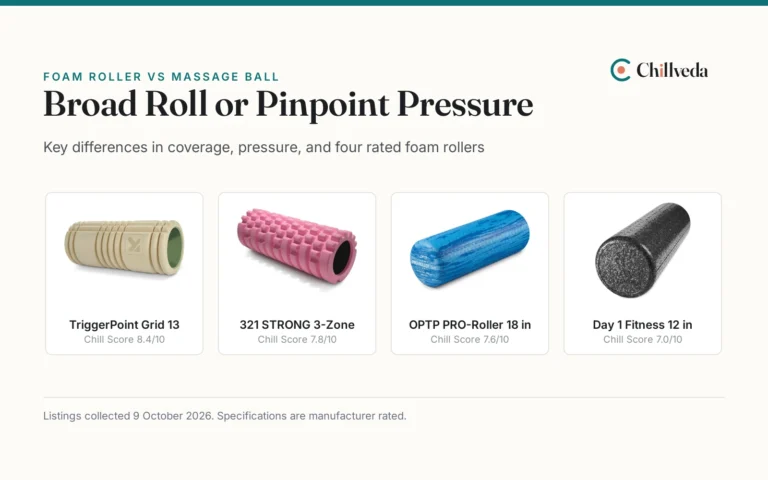
This guide breaks down how surface area, density, and tool geometry influence tissue release, when to choose each tool, and how our four rated foam rollers perform across stated specifications. Listings were collected 9 October 2026.
This article is informational and is not medical advice. Deep tissue rolling and point pressure place mechanical stress on soft tissues and joints. Do not roll directly over the cervical spine, neck, bony prominences, major arteries, or acute injuries without consulting a healthcare professional. Stop immediately if you experience sharp pain, numbness, or tingling. See our Medical Disclaimer.
Chillveda earns a commission when you buy through links on this page, at no extra cost to you. As an Amazon Associate I earn from qualifying purchases. Affiliate disclosure.
Quick picks
-
1
 TRIGGERPOINT Performance Therapy Grid Patented Chill Score 9.7/10Check price on Amazon
A 13 inch firm hollow core roller with a multi-density EVA foam grid, 30 percent bio-based materials, and a 1 year warranty.
-
2
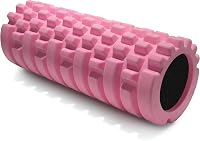 321 STRONG Patented 3-Zone Massage Roller Chill Score 9.6/10Check price on Amazon
A 12.5 inch medium density roller with three distinct textured zones mimicking palms, fingers, and thumbs over a solid EPP core.
-
3
 OPTP PRO-Roller Soft Density Foam Roller – Round Chill Score 9.6/10Check price on Amazon
An 18 inch soft density EVA foam roller suited for gentle mobility work, supine spine support, and balance routines.
-
4
 Day 1 Fitness High Density Muscle Foam Rollers Chill Score 9.5/10Check price on Amazon
A 12 inch solid high-density EPP foam roller providing firm, unyielding surface contact for deep muscle pressure.

A 13 inch firm hollow core roller with a multi-density EVA foam grid, 30 percent bio-based materials, and a 1 year warranty.
Pros & ConsViewHide
Pros
- Stated 1 year manufacturer warranty
- Multi-density grid surface designed for tissue aeration
- Firm hollow core with stated 500-point weight limit
- Made with 30% renewable bio-based materials
Cons
- Spec table contradicts title by listing target body part as hands
- 13 inch length is narrow for broad torso or chest stretches
- Firm hollow core may feel too aggressive for beginners
- Carries no third-party safety certification

A 12.5 inch medium density roller with three distinct textured zones mimicking palms, fingers, and thumbs over a solid EPP core.
Pros & ConsViewHide
Pros
- Three textured zones allow variable massage intensity
- Closed-cell EVA foam exterior over lightweight EPP core
- Listing states materials are free of BPA, PVC, lead, and phthalates
- Includes companion digital guide in product documents
Cons
- No warranty term is stated
- Spec table claims cellulite removal without clinical verification
- Listing asserts specific percentage recovery claims
- 12.5 inch length limits simultaneous two-leg rolling
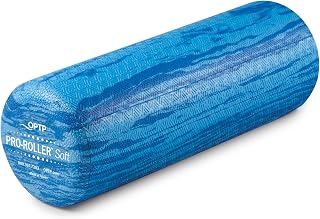
An 18 inch soft density EVA foam roller suited for gentle mobility work, supine spine support, and balance routines.
Pros & ConsViewHide
Pros
- Longer 18 inch length provides broader torso and back coverage
- Soft density offers gentler pressure for sensitive areas
- Durable closed-cell heat-molded EVA foam
- Lightweight at 7.81 ounces and easy to wipe clean
Cons
- No warranty term is stated
- Spec table lists model as PSFR36 instead of PSFR18B
- Soft density lacks the depth needed for stubborn trigger points
- Larger 6 inch diameter raises the body higher off the floor

A 12 inch solid high-density EPP foam roller providing firm, unyielding surface contact for deep muscle pressure.
Pros & ConsViewHide
Pros
- High-density solid EPP construction resists bending or deformation
- Compact 12 inch length fits easily inside athletic bags
- Firm density delivers intense pressure for dense tissue
- Listing notes a 30 Day Amazon Guarantee
Cons
- Spec table claims tacky vinyl surface despite polypropylene build
- Listing claims treatment of plantar fasciitis and tennis elbow
- No manufacturer warranty beyond standard 30-day return terms
- Smooth firm surface can feel unforgiving on bony prominences
More to compare
 321 STRONG Patented 3-Zone Massage RollerCheck price on Amazon
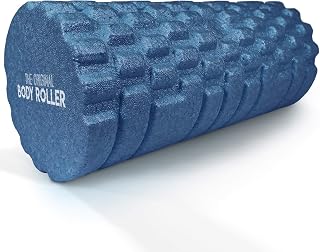 The Original Body RollerCheck price on Amazon
 Amazon Basics High Density Foam Roller for Exercise andCheck price on Amazon
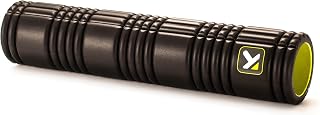 TriggerPoint Grid 2.0 Foam Roller for Deep Tissue Massage andCheck price on Amazon
 TONE Fitness Firm High-Density Foam Roller for ExerciseCheck price on Amazon
 Fitizen Foam RollerCheck price on Amazon
Foam roller vs massage ball: key differences
| Feature | Foam roller | Massage ball |
|---|---|---|
| Contact area | Broad cylinder distributing body weight | Small spherical focal point |
| Primary target | Large muscle groups (quadriceps, hamstrings, calves) | Localized knots (glutes, upper back, feet) |
| Pressure profile | Diffuse compression across muscle length | Concentrated, deep focal compression |
| Spine alignment | Supports length of spine in supine mobility work | Spans between scapula and spine without bone contact |
| Portability | Cylinders from 12 to 18 inches long | Compact spheres fitting easily into athletic bags |
| Standing wall use | Difficult to stabilize against vertical surfaces | Secure placement against a wall for controlled pressure |
The fundamental distinction between these recovery tools is surface area. A foam roller spreads your body weight across a cylinder measuring 5.25 to 6 inches in diameter and 12 to 18 inches in length. This broad surface makes it easy to glide along long muscle bands, flushing large muscle groups during a warm-up or cool-down. In contrast, a massage ball concentrates your weight onto a compact sphere, delivering deep pressure into isolated trigger points that broad cylinders bridge over.
Leverage also differs substantially between the two shapes. Rollers require floor space and dynamic core support to control how much body weight presses into the cylinder. Massage balls work effectively on the floor, but they also allow precise wall work, letting you modulate pressure by leaning your torso against a vertical wall without straining your wrists or neck. For an analysis of powered options, our massage gun vs foam roller breakdown examines motorized percussion compared to manual pressure.
When a foam roller works best
Foam rollers excel whenever you need to address broad expanses of tissue or incorporate spinal mobility exercises into your session. Key scenarios include:
- Large muscle warm-ups and cool-downs: Rolling the quadriceps, hamstrings, and calves helps increase blood circulation and prepare muscle fibers for movement without creating excessive focal soreness.
- Thoracic spine extension: Positioning a roller perpendicular to your mid-back allows you to gently extend your thoracic spine while keeping your hips on the floor, restoring mobility restricted by prolonged sitting.
- Supine postural opening: An 18-inch roller aligned vertically along the spine supports the head, torso, and sacrum simultaneously, enabling gentle chest and shoulder opening routines.
- Beginner tissue desensitization: Because rollers spread body weight widely, they provide a gentler entry point for users unaccustomed to self-myofascial release.
To browse options across firm, soft, and textured designs, explore our curated best foam rollers roundup.
When a massage ball works best
A massage ball is the better choice whenever tight tissue is sheltered by surrounding bone or nestled deep beneath superficial muscle layers. Common applications include:
- Glute and piriformis release: Sitting on a ball directs focal pressure directly into the gluteal complex, reaching trigger points that flat rollers roll right past.
- Rhomboids and upper back: Trapping a ball between your shoulder blade and spine allows targeted pressure on knotty tissue while keeping bone contact minimal.
- Pectoral and anterior shoulder relief: Standing and leaning into a ball against a wall allows pinpoint work on tight chest muscles without compressing the shoulder joint.
- Plantar fascia release: Rolling the sole of the foot over a ball while seated applies controlled arch pressure that a wide roller cannot replicate.
If your priority is targeted trigger point relief rather than broad muscle rolling, read our best massage balls guide.
Combining rollers and balls in one routine
Because foam rollers and massage balls serve complementary functions, many athletes use both tools sequentially. A practical workflow begins with broad foam rolling to identify general areas of tightness and warm the tissue. Once broad rolling highlights a specific tender spot, switching to a massage ball enables focused compression to release that adhesion.
Specialized shapes also bridge the gap between these tools. For example, a peanut massage ball for back care uses two joined spheres to massage the spinal erector muscles while leaving a center channel clear to protect the vertebrae.
Foam rollers compared
These are scored on the Chill Score, which weighs performance 35, build 25, value 25, safety certifications 10 where it applies and warranty 5. These manual rollers carry no electrical components or third-party safety listings, so all four score 0 for safety.
| Product | Chill Score | Perf. /35 | Build /25 | Value /25 | Safety /10 | Warranty /5 |
|---|---|---|---|---|---|---|
| TriggerPoint Grid 13 | 9.7 | 30 | 22 | 21 | n/a | 2 |
| 321 STRONG 3-Zone | 9.6 | 29 | 20 | 21 | n/a | 0 |
| OPTP PRO-Roller 18 in | 9.6 | 28 | 20 | 20 | n/a | 0 |
| Day 1 Fitness 12 in | 9.5 | 26 | 18 | 19 | n/a | 1 |
Scores run from 9.2 to 9.8: each product’s point total is placed on that range, so more points always means a higher score. Safety counts only for powered gear or where the listing states safety features; where it does not apply, the score is taken over the remaining 90 points.
For more options across different lengths and densities, see our complete guide to the best foam rollers.
How to choose roller firmness and size
- Soft density: Softer foam, such as heat-molded EVA, yields slightly under body weight. It is ideal for physical therapy, Pilates, older adults, and supine spinal alignment where hard surfaces cause discomfort.
- Medium density with surface zones: Medium density strikes a balance between comfort and penetration. Textured surfaces with raised ridges or knobs simulate therapist hands to vary pressure without the unforgiving feel of solid plastic.
- Firm high density: Solid expanded polypropylene rollers resist compression completely. They deliver maximum pressure for dense muscle tissue and experienced athletes, but they require greater pain tolerance.
- Length selection: Compact rollers measuring 12 to 13 inches are lightweight and pack easily into gym bags. Longer 18-inch rollers provide stability across the upper back and support supine rehabilitation exercises.
Common mistakes to avoid
- Rolling directly across bone: Never roll over the cervical vertebrae, kneecaps, or hip joints. Pressure should remain centered on the fleshy belly of the muscle.
- Holding breath under pressure: Tensing up and holding your breath causes muscle guarding, which defeats the purpose of myofascial release. Slow your breathing and ease up on pressure until muscles relax.
- Spending too long on a single spot: Grinding a tender trigger point continuously can bruise tissue. Limit continuous pressure on a single knot, then move to adjacent areas.
- Rolling too quickly: Rushing across the roller bounces over muscle tissue instead of allowing fibers to adapt. Roll deliberately and pause briefly on areas of restriction.
Common questions
Which is better for lower back tightness, a roller or a ball?
A massage ball is generally safer and more effective for lower back tightness because it can target the gluteus medius and piriformis muscles, which often contribute to lumbar tension. Placing a foam roller directly under the lumbar spine can hyperextend the lower back and strain surrounding joints. Using a ball against a wall allows you to relieve tight hips without compressing spinal discs.
Can a massage ball replace a foam roller entirely?
A massage ball cannot completely replace a foam roller because it lacks the surface area needed for broad muscle groups. Rolling large areas like the quadriceps or hamstrings on a small ball is time-consuming and can cause excessive localized bruising. A roller is far more practical for general warm-ups and sweeping tension from large leg muscles.
Should beginners choose a foam roller or a massage ball first?
Most beginners should start with a foam roller because its broad contact patch distributes body weight evenly, reducing discomfort. A massage ball creates intense focal pressure that can trigger muscle guarding in unaccustomed users. Once you understand how your body responds to pressure, adding a massage ball allows you to tackle stubborn knots.
Does a textured foam roller work better than a smooth roller?
Textured rollers feature ridges or knobs designed to vary surface pressure and aerate tissue during movement. They offer targeted sensation closer to a massage ball while maintaining the stability of a cylinder. However, smooth rollers remain preferable for supine spine routines and users who find surface projections uncomfortable.
Can you use a foam roller and massage ball every day?
Yes, daily use is generally safe when performed with light to moderate pressure as part of a mobility or recovery routine. If you perform intense, deep tissue work that leaves muscles tender, allow those specific areas a day of rest before rolling them again. Always listen to your body and avoid rolling over inflamed or bruised skin.
Sources: Amazon product listings for the recovery tools named above, collected 9 October 2026. Related: see our massage gun vs foam roller comparison and our guide to the peanut massage ball for back tension.
Back to all recovery tools reviews.