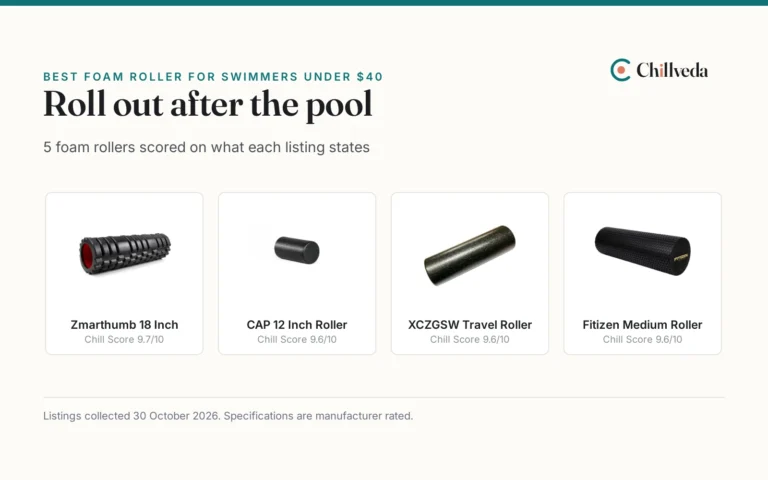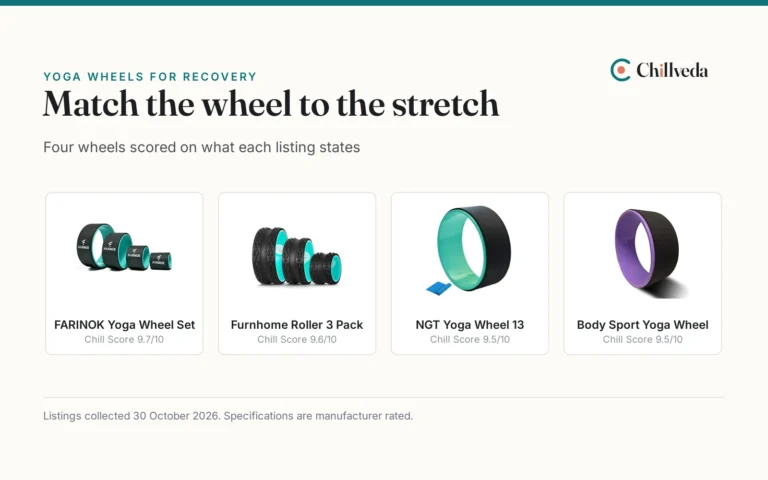
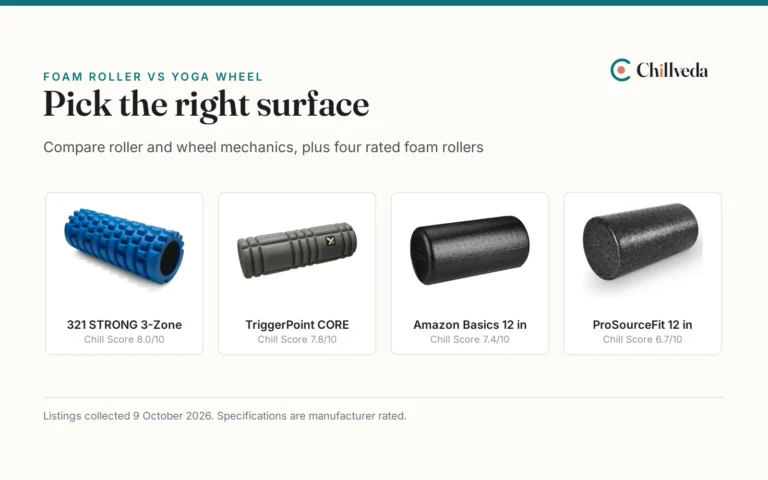
Choosing between a foam roller vs yoga wheel comes down to whether you want broad muscle recovery or deep spinal extension. A foam roller offers a wide, stable cylinder designed to massage large muscle groups such as the quadriceps, hamstrings, glutes, and lats. A yoga wheel features a narrower, rigid circular ring built specifically to open the chest, stretch the shoulders, and support deep backward spinal extension. For general post-exercise recovery, a foam roller is more versatile, while a yoga wheel serves targeted backbends and mobility routines.
This guide explains the structural differences between a foam roller and a yoga wheel, how their surface contact areas change muscle pressure, and four rated foam rollers for recovery. Listings were collected 9 October 2026.
This article is informational and is not medical advice. Rolling over the neck, direct spine, major arteries, or acute injuries can cause harm. Consult a healthcare provider before starting a recovery routine if you have chronic pain, osteoporosis, or spinal conditions. Stop rolling immediately if you feel sharp pain or numbness. See our Medical Disclaimer.
Chillveda earns a commission when you buy through links on this page, at no extra cost to you. As an Amazon Associate I earn from qualifying purchases. Affiliate disclosure.
Quick picks
-
1
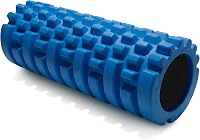 321 STRONG Patented 3-Zone Massage Roller Chill Score 9.6/10Check price on Amazon
A medium density EVA foam roller with three patented surface zones and a 13 inch length.
-
2
 TriggerPoint CORE Foam Massage Roller with Softer Chill Score 9.6/10Check price on Amazon
A solid core EVA foam roller with softer compression, a multi-density grid pattern, and a 4 inch diameter.
-
3
 Amazon Basics High Density Foam Chill Score 9.5/10Check price on Amazon
A firm high-density polypropylene roller measuring 12 by 6 inches, backed by a stated 30-day guarantee.
-
4
 ProsourceFit High Density Foam Rollers 12 Chill Score 9.4/10Check price on Amazon
A firm 12 by 6 inch foam roller with a stated 300 lb weight capacity and smooth exterior.
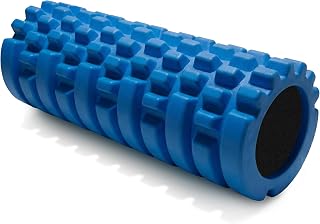
A medium density EVA foam roller with three patented surface zones and a 13 inch length.
Pros & ConsViewHide
Pros
- Three massage zones mimic fingers, thumbs and palms
- Closed cell EVA foam is BPA and PVC free
- Seven US patents cover the surface projections
- Lightweight core weighs 0.1 kg
Cons
- No warranty term is stated
- Spec table lists 5.25 in diameter but 13 x 6 x 6 in dimensions
- Medium firmness may feel intense for beginners
- No safety certifications listed

A solid core EVA foam roller with softer compression, a multi-density grid pattern, and a 4 inch diameter.
Pros & ConsViewHide
Pros
- Solid core EVA foam construction resists breakdown
- Multi-density grid pattern provides targeted pressure
- Softer compression suits users sensitive to firm rollers
- Compact 4 inch diameter is easy to maneuver
Cons
- No warranty term is stated
- Narrower 4 inch diameter offers less floor clearance
- Soft compression may lack depth for dense muscle tissue
- No safety certifications listed

A firm high-density polypropylene roller measuring 12 by 6 inches, backed by a stated 30-day guarantee.
Pros & ConsViewHide
Pros
- Stated 30 Day Amazon Guarantee
- Firm polypropylene maintains shape during exercise
- Molded edges provide comfort along the borders
- Consistent 12 by 6 inch dimensions and 6 inch diameter
Cons
- Short 30 day warranty coverage
- Smooth surface lacks textured trigger point zones
- Firm material may be too rigid for sensitive backs
- No safety certifications listed

A firm 12 by 6 inch foam roller with a stated 300 lb weight capacity and smooth exterior.
Pros & ConsViewHide
Pros
- Stated 300 LB maximum weight capacity
- Standard 12 by 6 inch size fits travel and home storage
- Water resistant surface wipes clean easily
- First listed in 2016 with long market history
Cons
- No warranty term is stated
- Spec table lists density as low despite title claiming high density
- Spec table contradicts material as EPE foam versus EPP in bullets
- Listing gives flawed weight figure of 0.27 g
More to compare
 Amazon Basics High Density Foam Roller for Exercise andCheck price on Amazon
 Day 1 Fitness High Density Muscle Foam RollersCheck price on Amazon
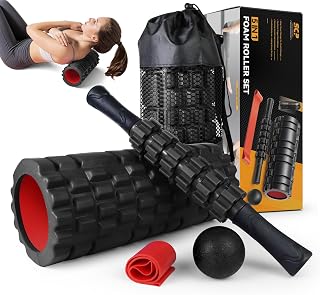 SUBCULTUREPICK 5 in1 Foam Roller SetCheck price on Amazon
 5 in 1 Foam Roller Set High Density Patented Foam Roller forCheck price on Amazon
 Gaiam Restore Compact Textured Foam Roller for Muscle RepairCheck price on Amazon
 Oceanfoam Ripple RollerCheck price on Amazon
Comparing a foam roller vs yoga wheel by design and use
| Design feature | Foam roller | Yoga wheel |
|---|---|---|
| Primary structure | Wide solid or hollow cylinder | Narrow circular hollow ring |
| Contact area | Broad surface across muscle width | Narrow concentrated track |
| Target body areas | Full body: legs, hips, back, and lats | Thoracic spine, chest, shoulders, and hips |
| Primary application | Self-myofascial release and recovery | Spinal extension, backbends, and balance |
| Floor stability | High stability on flat cylindrical base | Dynamic balance required on narrow wheel |
| Pressure distribution | Spreads across broad cylindrical contact | Concentrates along a narrow track |
The mechanical difference between these tools is straightforward. A foam roller provides a wide, stable base that spreads your body weight across a broad contact zone, making it suitable for rolling out large muscle groups across the legs, hips, and upper back. A yoga wheel narrows that contact to a slim track, concentrating pressure along the thoracic spine while allowing the shoulders and ribcage to drop back into extension.
Why contact surface changes massage depth
A foam roller distributes body weight across its cylindrical width. When rolling broad muscles such as the quads, hamstrings, or calves, the wide contact area prevents excessive pressure at a single point. This broad distribution makes a cylinder manageable for full body soft tissue recovery and allows the user to modulate pressure by supporting weight on hands or feet.
A yoga wheel concentrates body weight along a narrow circular curve. Because the wheel does not span the width of the torso, it sits directly between the shoulder blades along the thoracic spine. This narrow contact allows the shoulders to drop backward on either side, creating passive chest expansion and deep spinal extension that a wide cylinder cannot match.
Where roller diameter and curvature matter
Roller diameter affects floor clearance and body positioning during rolling. A 6 inch diameter roller, such as the ProSource or Amazon Basics models, elevates the body higher off the floor, which helps maintain clearance when rolling calves and hamstrings. A 4 inch roller, such as the TriggerPoint CORE, keeps the user closer to the floor with less spinal extension angle, though softer foam density is what primarily reduces pressure intensity.
A yoga wheel features a circular arc that supports the spine during backward extension. Rolling on a rigid circular ring requires core engagement to maintain balance, as the wheel can tip sideways if body weight shifts off center. For back recovery, choose a wider cylinder if you want stable support, or a circular wheel if your priority is spinal extension and chest opening.
Foam rollers worth considering
These are scored on the Chill Score, which weighs performance 35, build 25, value 25, safety certifications 10 where it applies and warranty 5. Foam rollers carry no safety certifications on their listings, so all four score 0 for safety.
| Product | Chill Score | Perf. /35 | Build /25 | Value /25 | Safety /10 | Warranty /5 |
|---|---|---|---|---|---|---|
| 321 STRONG 3-Zone | 9.6 | 30 | 20 | 21 | n/a | 0 |
| TriggerPoint CORE | 9.6 | 29 | 21 | 20 | n/a | 0 |
| Amazon Basics 12 in | 9.5 | 27 | 19 | 20 | n/a | 1 |
| ProSourceFit 12 in | 9.4 | 26 | 16 | 19 | n/a | 0 |
Scores run from 9.2 to 9.8: each product’s point total is placed on that range, so more points always means a higher score. Safety counts only for powered gear or where the listing states safety features; where it does not apply, the score is taken over the remaining 90 points.
For more choices and surface variations, see our best foam rollers roundup.
Using a foam roller or wheel in practice
- Start with a flat surface. Roll on an exercise mat or firm floor to maintain stable contact and prevent slipping.
- Regulate pressure with your limbs. Use hands and feet to bear body weight when rolling sensitive areas, rather than dropping full weight onto the cylinder.
- Keep movement deliberate. Roll slowly along muscle length, pausing over tense areas rather than bouncing quickly across joints.
- Engage your core on a wheel. Because a yoga wheel is narrow, maintain steady abdominal tension to prevent the ring from shifting sideways during spinal stretches.
- Avoid direct bone and joint contact. Roll soft muscle tissue rather than bony prominences or the cervical spine.
Common mistakes
- Rolling directly across the lower back, which hyperextends the lumbar spine without ribcage support.
- Using a narrow yoga wheel for broad leg muscles like quads and hamstrings where it easily tips.
- Rushing through fast rolls instead of applying steady, controlled compression.
- Choosing an overly dense roller when recovering from acute soreness or muscle strain.
Common questions
What is a foam roller good for?
A foam roller is designed for self-myofascial release across major muscle groups throughout the body. Rolling creates mechanical compression that eases muscle tightness, supports post-workout flexibility, and aids general mobility. It is commonly used on the calves, hamstrings, quadriceps, glutes, and upper back.
Can a yoga wheel replace a foam roller?
A yoga wheel cannot fully replace a foam roller for general athletic recovery. While a yoga wheel excels at thoracic spine extension, chest opening, and deep backbends, its narrow frame makes it unstable for rolling the legs or hips. A foam roller provides the broad surface needed for full body soft tissue massage.
How do you use a foam roller for legs?
To roll the legs, sit or lie on an exercise mat with the roller positioned under your calf, hamstring, or quadriceps. Support part of your body weight on your hands or opposite foot to control the pressure level. Roll slowly between joints, pausing briefly on tight muscular knots rather than rolling over the knees.
Is a yoga wheel safe for back pain?
A yoga wheel can support spinal stretching when used with control, but it places the back into deep extension. Individuals with lower back pain, disc issues, or spinal instability should avoid aggressive backbends without clinician guidance. For gentle thoracic mobilization, a wider foam roller or massage ball often provides more stable support.
Which tool is better for beginners?
A foam roller is generally better for beginners due to its wide base of support and versatility across the entire body. It allows new users to adjust pressure easily and roll without balancing on a narrow circular ring. Beginners should consider softer foam densities or moderate diameter rollers while learning basic rolling movements.
Sources: Amazon product listings for the recovery tools and rollers named above, collected 9 October 2026. Related: our best foam rollers for back and best yoga wheels.
Back to all recovery tool reviews.