Short answer
What is the difference between graduated and uniform compression boots?
Graduated compression boots apply a directional pressure gradient, typically inflating chambers sequentially from the feet upward toward the thighs to assist venous return. Uniform compression boots apply equal pressure across all chambers simultaneously or cycle chambers without a distal-to-proximal gradient. For post-workout recovery, graduated sequential modes are commonly chosen for directional flushing, while uniform modes provide even compression across the entire leg.
Sitting on the living room rug after an evening run, untangling air hoses near the nearest wall outlet, the distinction between graduated compression boots vs uniform compression boots comes down to how air pressure is distributed along your legs. Graduated compression boots apply a directional pressure gradient, typically inflating chambers sequentially from the feet upward toward the thighs to guide fluid return toward the core. Uniform compression boots, in contrast, apply an even level of pressure across all chambers without a distal-to-proximal pressure gradient. For athletic recovery, graduated sequential compression provides active directional flushing, whereas uniform compression delivers balanced, full-leg compression.
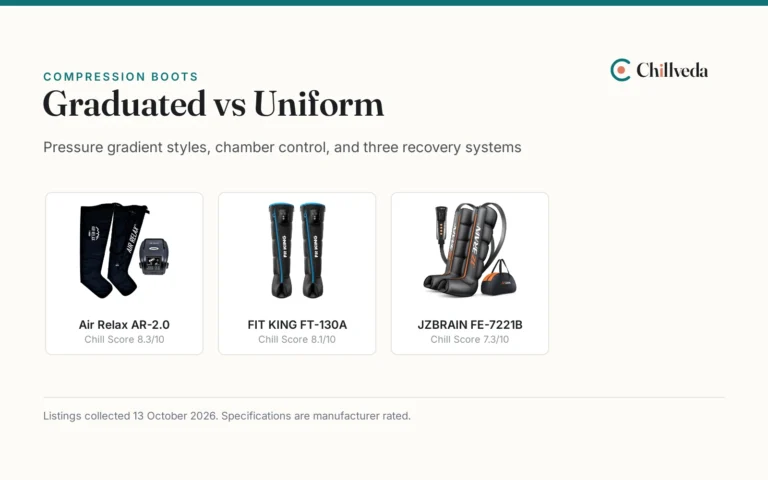
This guide examines how pressure gradient styles work across chamber designs, how sequential and uniform modes differ on maker spec sheets, and how three compression boot systems compare based on manufacturer data. Listings were collected 13 October 2026.
This article is informational and is not medical advice. Compression therapy exerts mechanical pressure on limbs and blood vessels. Do not use compression boots if you have deep vein thrombosis, active blood clots, open wounds, acute soft tissue injuries, or severe peripheral vascular disease without consulting a physician first. Stop immediately if you experience numbness, sharp pain, or circulatory distress. See our Medical Disclaimer.
Chillveda earns a commission when you buy through links on this page, at no extra cost to you. As an Amazon Associate I earn from qualifying purchases. Affiliate disclosure.
Quick picks
-
1
 Air Relax AR-2 Professional Compression Boots Chill Score 9.7/10Check price on Amazon
A 4-chamber corded leg recovery system offering three therapy modes, biocompatible construction, and stated FDA and CE MDD medical device clearances.
-
2
 FIT KING Cordless Air Compression Boots Recovery Chill Score 9.6/10Check price on Amazon
An all-in-one cordless compression system featuring 5 overlapping chambers, 11 pressure levels from 50 to 150 mmHg, and dual rechargeable lithium batteries.
-
3
 Compression Boots, Full Leg Compression Massager Chill Score 9.5/10Check price on Amazon
A corded sequential leg compression system with 5 independent air chambers, 6 intensity settings up to 130 mmHg, and stated FSA and HSA eligibility.
A 4-chamber corded leg recovery system offering three therapy modes, biocompatible construction, and stated FDA and CE MDD medical device clearances.
Pros & ConsViewHide
Pros
- Stated FDA and CE MDD medical device clearance
- Three therapy modes including peristaltic and uniform cycles
- Biocompatible, non-toxic, and lead-free garment material
- One year manufacturer warranty with lifetime support
Cons
- Four chambers rather than five
- Corded pump requires proximity to a power outlet
- Fixed 15 minute session timer without adjustments
- No pressure calibration or chamber isolation data stated

An all-in-one cordless compression system featuring 5 overlapping chambers, 11 pressure levels from 50 to 150 mmHg, and dual rechargeable lithium batteries.
Pros & ConsViewHide
Pros
- Cordless design with dual 2600 mAh rechargeable batteries
- Five overlapping chambers with pressure sensor adjustment
- Eleven adjustable pressure levels from 50 to 150 mmHg
- Two year manufacturer warranty term
Cons
- No safety or medical certifications stated in the listing
- Heaviest system here at 9.26 pounds
- Requires 3 hours charging time for 3 hours dual boot runtime
- ABS plastic construction rather than fabric outer casing

A corded sequential leg compression system with 5 independent air chambers, 6 intensity settings up to 130 mmHg, and stated FSA and HSA eligibility.
Pros & ConsViewHide
Pros
- Five independent chambers for sequential dynamic compression
- Six intensity settings from 80 to 130 mmHg
- FSA and HSA store eligibility stated
- Pump inflates in 30 seconds with 50 to 55 dB noise level
Cons
- Spec table lists contradictory 0.79 inch package dimensions
- No safety or medical certifications stated in the listing
- Corded electric design requires external hose connections
- One year manufacturer warranty term
More to compare
 Leg Compression MassagerCheck price on Amazon
 JZBRAIN Compression BootsCheck price on Amazon
 Compression BootsCheck price on Amazon
 JZBRAIN Professional Sequential Air Compression Boots forCheck price on Amazon
 Air Relax AR-2 Professional Compression BootsCheck price on Amazon
Graduated compression boots vs uniform compression boots compared
| Compression style | Chamber operation | Pressure distribution | Example mode from data |
|---|---|---|---|
| Sequential graduated | Inflates distal to proximal (foot to thigh) in stages | Directional gradient guiding fluid upward | Air Relax Mode A (peristaltic), JZBRAIN sequential |
| Cyclical uniform | Pressurizes chambers together or cycles full sleeve | Even holding pressure across calves and thighs | Air Relax Mode B (cyclical uniform) |
| Continuous static | Maintains uninterrupted holding pressure | Constant pressure across all active chambers | Air Relax Mode C (continuous therapy) |
| Segmented overlap | Overlapping air bladders eliminate gaps | Continuous pressure line along the limb | FIT KING 5-overlapping boots |
The operational difference between these two systems lies in timing and pressure distribution. Graduated sequential compression inflates lower chambers at the foot and ankle first, holding or releasing before inflating the calf and thigh chambers. This directional wave mimics natural muscular pumping to encourage venous blood flow and lymphatic fluid movement. Uniform compression, by contrast, applies equal pressure across all active chambers without creating a distal-to-proximal gradient. While uniform compression provides consistent circumferential squeezing, sequential graduated systems are engineered specifically to guide fluid progressively toward the upper leg.
How directional pressure gradients guide circulation
The primary mechanical objective of pneumatic recovery boots is supporting venous return. Blood and interstitial fluid naturally pool in the lower extremities due to gravity, especially after prolonged standing or intense training. Our guide on what is a leg compression machine explains how pneumatic chambers compress soft tissue to assist natural vascular clearance.
In a graduated system, compression begins at the foot and progresses up the limb, or maintains higher pressure distally than proximally. By staging the pressure wave, graduated boots establish a clear directional path toward the upper leg. Uniform compression, while effective for general tissue compression, does not create this upward pressure differential. For those comparing home recovery tools, our compression boots vs compression socks guide explores how active pneumatic gradients differ from passive elastic garments.
Chamber count and overlap affect pressure delivery
Listings in this category typically feature four or five chambers per boot. While four-chamber designs provide distinct zones for the foot, calf, knee, and thigh, five-chamber sleeves divide the limb into smaller segments. Overlapping chambers, such as the 5-chamber design found on the FIT KING FT-130A, ensure continuous surface contact without dead zones between compartments.
Control architecture also varies significantly between corded and cordless models. Systems like the JZBRAIN FE-7221B rely on a central console with multi-tube air hoses that connect to both boots, operating at sound levels between 50 and 55 dB. Cordless units integrate individual pumps and micro-controllers directly onto each sleeve. Powered by dual 12V lithium batteries rated at 2600 mAh, each sleeve delivers 3 hours of continuous use when both legs operate, or up to 6 hours for a single leg, following a 3 hour charge.
Compression boots worth considering
These are scored on the Chill Score, which weighs performance 35, build 25, value 25, safety certifications 10 where it applies and warranty 5. The Air Relax AR-2.0 earns safety points for its stated medical device clearances, while uncertified consumer models score 0 for safety.
| Product | Chill Score | Perf. /35 | Build /25 | Value /25 | Safety /10 | Warranty /5 |
|---|---|---|---|---|---|---|
| Air Relax AR-2.0 | 9.7 | 30 | 21 | 20 | 8 | 4 |
| FIT KING FT-130A | 9.6 | 33 | 21 | 22 | 0 | 5 |
| JZBRAIN FE-7221B | 9.5 | 29 | 19 | 21 | 0 | 4 |
Scores run from 9.2 to 9.8: each product’s point total is placed on that range, so more points always means a higher score.
For more options across different price points and features, see our best compression boots roundup.
Setting compression pressure in practice
- Start at low pressure settings. High pressure is not necessarily more effective. Begin at the lowest available intensity, such as 50 mmHg on the FIT KING or 80 mmHg on the JZBRAIN, before adjusting upward.
- Follow manufacturer session timers. Listed session times vary across models, ranging from a fixed 15 minute cycle on the Air Relax to 15, 20, and 25 minute timers on the JZBRAIN, and 15 to 60 minute intervals on the FIT KING. Our overview on how to use compression boots details safe session lengths.
- Verify leg fit before inflating. Ensure your inseam and thigh circumferences match the garment. JZBRAIN specifies an inseam range of 33 to 37 inches and thigh support up to 28 inches.
- Ensure unhindered hose routing. For corded units, lay air hoses flat without sharp kinks or twists to maintain steady pump airflow.
- Stop if you feel sharp pain or tingling. Compression should feel like a firm, rhythmic squeeze. If you experience numbness or joint pain, vent the chambers immediately and remove the sleeves.
Common mistakes
- Selecting the highest pressure level immediately rather than allowing tissues to adapt gradually.
- Expecting uniform pressure modes to provide the directional flushing of a sequential graduated cycle.
- Assuming all compression boots carry medical device clearances when many consumer models publish no regulatory listings.
- Wearing boots loosely, which forces the pump to expend cycle time filling empty air volume rather than compressing tissue.
Common questions
What is the difference between graduated and uniform compression boots?
Graduated compression boots apply a directional pressure gradient, typically inflating chambers sequentially from the feet upward toward the thighs to assist venous return. Uniform compression boots apply equal pressure across all chambers simultaneously or cycle chambers without a distal-to-proximal gradient. For post-workout recovery, graduated sequential modes are commonly chosen for directional flushing, while uniform modes provide even compression across the entire leg.
Is higher compression pressure always better for leg recovery?
No, higher pressure does not equate to faster muscle recovery. Depending on the model, systems offer distinct intensity settings, such as 80 to 130 mmHg on the JZBRAIN or 50 to 150 mmHg on the FIT KING, while others use preset pump output. Starting at lower available intensities allows tissues to adapt without discomfort or bruising.
Can compression boots offer both graduated and uniform modes?
Yes, some multi-mode systems include both styles in a single console. For example, the Air Relax AR-2.0 provides Mode A for peristaltic sequential compression, Mode B for cyclical uniform compression, and Mode C for continuous therapy. Having multiple modes allows users to choose between directional peristaltic flushing and uniform cyclical compression depending on their session goal.
How many air chambers should compression boots have?
Most leg recovery systems feature four or five independently controlled air chambers per boot. Five chambers provide finer pressure segmentation across the foot, lower calf, upper calf, knee, and thigh. Overlapping chamber designs also help eliminate dead zones between adjacent compartments.
How long should a typical compression boot session last?
Session durations depend on the device’s programmed timer options, with listings here offering intervals from 15 minutes up to 60 minutes. Many recovery sessions run between 15 and 25 minutes before the automatic shut-off engages. Always consult your equipment user manual and a healthcare provider regarding appropriate session frequency.
Sources: Amazon product listings for the compression boots named above, collected 13 October 2026.
Related: our how to use compression boots and compression boots vs compression socks.
Back to all compression boots reviews.