Short answer
What is the difference between multi wavelength and dual wavelength red light panels?
A dual wavelength panel focuses light into two primary bands: 660 nm red and 850 nm near-infrared. A multi wavelength panel distributes energy across additional bands, such as 630 nm, 940 nm, or 1060 nm, offering varied absorption characteristics. In marketplace listings, however, terminology is often mixed, with some makers labeling dual-chip LEDs or standard dual wavelengths as multi-wavelength technology.
Side by side Choose a dual wavelength panel if Choose a multi wavelength panel if
Setting up a recovery corner in your bedroom or home gym usually starts with finding a clear patch of wall near a standard 120V wall outlet. Before mounting hardware or positioning a floor stand for an evening recovery routine, choosing between a multi wavelength vs dual wavelength red light panel determines the exact light spectrum delivered to your body. Dual-wavelength panels focus optical output into two primary bands (typically 660 nm red and 850 nm near-infrared), while multi-wavelength panels distribute light across additional bands. However, product listings often blur these definitions: some panels marketed under multi-wavelength labels specify only two wavelengths, while listings tagged under dual-wavelength searches use dual-chip LEDs to house four or six distinct bands. If you want the most thoroughly studied wavelengths with straightforward specifications, choose a dual-wavelength panel; if you want broader spectral distribution across multiple wavelengths, choose a multi-wavelength panel.
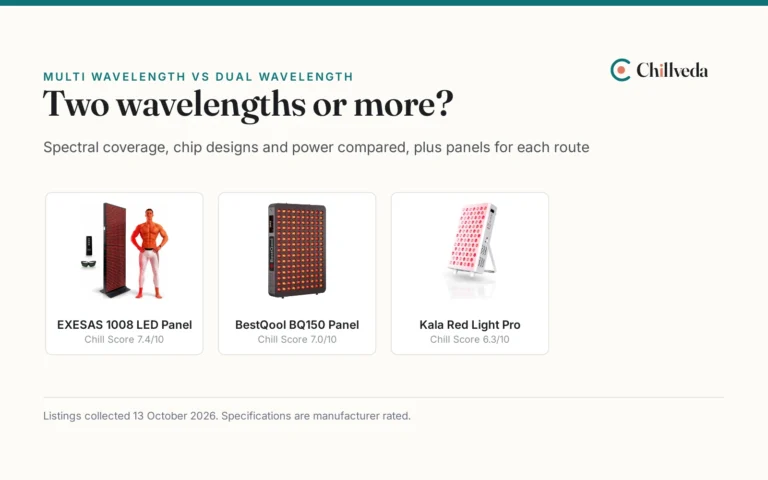
This comparison covers spectral coverage, LED chip design, wattage, power draw, and physical space needs, using concrete examples from current market listings. Listings were collected 13 October 2026.
This article is informational and is not medical advice. Red and near-infrared LEDs produce bright, concentrated light that can cause eye discomfort or strain; never look directly into illuminated diodes and wear opaque protective eyewear during sessions. Consult a doctor before use if you take photosensitizing medications, have a light-sensitive eye condition, or are pregnant. See our Medical Disclaimer and our red light therapy eye safety guide.
Chillveda earns a commission when you buy through links on this page, at no extra cost to you. As an Amazon Associate I earn from qualifying purchases. Affiliate disclosure.
Quick picks
-
1
 EXESAS Professional Grade Full-Body Red Light Chill Score 9.5/10Check price on Amazon
A 73-inch full-body red light therapy panel with 1,008 dual-chip LEDs across six wavelengths, Meanwell drivers, a vertical stand, and a 2-year warranty.
-
2
 BestQool Red Light Therapy Panel Chill Score 9.5/10Check price on Amazon
A 250W red light therapy panel packing 150 dual-chip LEDs across four wavelengths with a stated irradiance of 96.2 mW/cm².
-
3
 Kala Red Light Pro Panel Chill Score 9.3/10Check price on Amazon
A half-body red light panel with a built-in stand, digital timer display, and 5W bulbs emitting 660 nm and 850 nm wavelengths.

A 73-inch full-body red light therapy panel with 1,008 dual-chip LEDs across six wavelengths, Meanwell drivers, a vertical stand, and a 2-year warranty.
Pros & ConsViewHide
Pros
- 1,008 dual-chip LEDs with 30-degree beam angle
- Six wavelengths stated from 630 nm to 1060 nm
- Vertical floor stand, hanging kit, and remote control included
- 2-year manufacturer warranty stated
Cons
- Spec table lists 5 watts total wattage, conflicting with 1,008 5W LEDs
- 73-inch height requires dedicated vertical floor space
- No irradiance figure in mW/cm² is published in the listing
- No third-party safety certification stated

A 250W red light therapy panel packing 150 dual-chip LEDs across four wavelengths with a stated irradiance of 96.2 mW/cm².
Pros & ConsViewHide
Pros
- Stated 250W power draw and 96.2 mW/cm² irradiance
- Four wavelengths combining 630, 660, 850, and 940 nm
- 150 dual-chip LEDs with a wide 60-degree beam angle
- Modular design allows connecting additional panels later
Cons
- No concrete warranty term stated in the listing
- Weighs 12.2 pounds, heavier than smaller half-body panels
- No third-party safety certification stated
- Listing claims 10 minutes equals 20 on standard devices without independent verification

A half-body red light panel with a built-in stand, digital timer display, and 5W bulbs emitting 660 nm and 850 nm wavelengths.
Pros & ConsViewHide
Pros
- Built-in stand and digital display with timer settings
- Dual 660 nm red and 850 nm near-infrared wavelengths
- 50,000-hour stated bulb lifespan
- Compact package weight of 9.9 pounds
Cons
- Title advertises multi-wavelength technology while bullets specify only two wavelengths
- No total panel wattage or irradiance figure in mW/cm² stated
- No warranty term stated in the listing
- Listing makes health claims that we do not repeat
More to compare
 BestQool Red Light Therapy PanelCheck price on Amazon
 BONTANNY Red Light TherapyCheck price on Amazon
 Red Light Therapy Ankle WrapCheck price on Amazon
Multi wavelength vs dual wavelength red light panel at a glance
| Dual wavelength listings | Multi wavelength side | |
|---|---|---|
| Wavelength configuration | Focuses on two primary wavelengths (660 nm and 850 nm), though the BestQool and EXESAS listings add peripheral bands | Marketed as multi-wavelength technology, though the Kala example specifies only 660 nm and 850 nm |
| LED construction | Dual-chip LEDs on the BestQool and EXESAS listings | 5W individual bulbs stated on the Kala example |
| Power consumption | 250 W stated on the BestQool example; 5 W listed on the EXESAS spec table | Total panel wattage not stated on the Kala example |
| Optical irradiance | 96.2 mW/cm² stated on the BestQool listing; unstated in mW/cm² on EXESAS | Unstated in numerical mW/cm² on the Kala listing |
| Manufacturer warranty | 2-year warranty stated on EXESAS; no concrete term on BestQool | No warranty term stated on the Kala listing |
| Form factor examples | Tabletop modular unit (BestQool) or 73-inch vertical floor stand (EXESAS) | Packaged at 18.74 by 13.58 by 5.79 inches with built-in stand (Kala) |
Spectral coverage and electrical installation
Red light therapy panels deliver optical energy through light-emitting diodes. The foundational research in photobiomodulation centers on two primary bands: 660 nm in the visible red spectrum and 850 nm in the near-infrared spectrum. Visible red light at 660 nm absorbs primarily in superficial dermal layers, while near-infrared light at 850 nm penetrates into deeper tissue layers. Our red light wavelengths guide explores the differences between these core bands.
Multi-wavelength panels distribute optical energy across additional bands. In the listings compared here, extra visible wavelengths like 630 nm complement the 660 nm red band, while supplemental near-infrared wavelengths like 940 nm and 1060 nm provide different absorption characteristics alongside 850 nm.
| Wavelength | Optical spectrum | Listing examples |
|---|---|---|
| 630 nm | Visible red | BestQool BQ150, EXESAS 1008 LED |
| 660 nm | Visible red | Kala Pro, BestQool BQ150, EXESAS 1008 LED |
| 850 nm | Near-infrared | Kala Pro, BestQool BQ150, EXESAS 1008 LED |
| 940 nm | Near-infrared | BestQool BQ150, EXESAS 1008 LED |
| 1060 nm | Near-infrared | EXESAS 1008 LED |
Operating on a standard 120 volts household supply, electrical current is determined by the formula amps = W / 120. For the BestQool BQ150 example, the manufacturer states a power draw of 250 W, which operates comfortably within standard household circuit limits during daily sessions of 10 or 20 minutes. With session timers typically set for 10, 15, or 20 minutes, overall electricity consumption remains modest.
By contrast, the 73-inch EXESAS listing illustrates why published specifications require careful reading. The spec table lists wattage as 5 watts alongside 1,008 LEDs described with 5 watts output each in the bullets. The 5 watts figure in the spec table copies a single LED rating rather than total panel draw, leaving its electrical load unverified. When planning room placement for a 73-inch panel on a 120 volts outlet, ensure the floor area around the integrated cooling fans remains open and unobstructed.
Chip design, irradiance and mounting
Therapy panels use either single-chip or dual-chip LED construction. Dual-chip LEDs place two light-emitting semiconductor dice beneath a single primary lens. In dual-wavelength configurations, this design can pair one red and one near-infrared chip under the same lens for blended beam coverage. In panels with broader spectral configurations, makers combine different wavelength pairings under each lens across the panel face.
Optical irradiance measures the power density delivered to the surface. The BestQool listing publishes a manufacturer-rated irradiance of 96.2 mW/cm² at the surface with a 60-degree beam angle. By comparison, the Kala listing claims superior output over competitors but provides no numerical mW/cm² figure, while the EXESAS listing also leaves irradiance unstated. For details on evaluating these numbers, see our guide on how to read irradiance numbers and recommendations on how far to sit from a red light panel.
Mounting options also vary by individual product design rather than wavelength category. The Kala example includes a built-in stand, the BestQool example supports desktop placement and modular linking, and the 73-inch EXESAS panel uses a vertical floor stand with wheels alongside hanging hardware. See our comparison on hanging red light panel vs panel with stand and our roundup of full body red light panels for installation formats.
Gear for each route
These are scored on the Chill Score: performance 35, build 25, value 25, safety certifications 10 where it applies and warranty 5. None states a UL or ETL listing, so all score 0 for safety.
| Product | Chill Score | Perf. /35 | Build /25 | Value /25 | Safety /10 | Warranty /5 |
|---|---|---|---|---|---|---|
| EXESAS 1008 LED Panel | 9.5 | 30 | 21 | 20 | 0 | 3 |
| BestQool BQ150 Panel | 9.5 | 29 | 20 | 21 | 0 | 0 |
| Kala Red Light Pro | 9.3 | 26 | 19 | 19 | 0 | 0 |
Scores run from 9.2 to 9.8: each product’s point total is placed on that range, so more points always means a higher score.
Choose a dual wavelength panel if
- You want to concentrate optical energy into the two primary, thoroughly studied wavelengths: 660 nm red and 850 nm near-infrared.
- You prefer verified panel metrics like the BestQool example’s stated 250 W power draw and 96.2 mW/cm² irradiance.
- You want a compact or modular panel rather than a 73-inch vertical floor unit.
- You want to avoid paying a premium for multi-wavelength labels that may specify only standard dual bands upon closer inspection.
Choose a multi wavelength panel if
- You want optical energy distributed across multiple bands spanning from 630 nm to 1060 nm as stated on the EXESAS example.
- You have the ceiling clearance and floor space for a 73-inch full-body panel with an integrated vertical stand.
- You want a manufacturer-backed 2-year warranty term like that stated on the EXESAS listing.
- You want dual-chip LED hardware that combines multiple wavelength chips across a large panel array.
Check Your Space First
- Floor clearance: The EXESAS full-body panel measures 21 inches long by 2.6 inches wide by 73 inches tall; ensure your room has adequate ceiling height and a stable floor area for its vertical base stand.
- Wall and desk footprint: The BestQool BQ150 measures 14.3 by 2.6 by 21.3 inches and weighs 12.2 pounds, requiring a sturdy desk, table, or mobile stand capable of holding that weight.
- Packaging and storage: The Kala example ships in a box measuring 18.74 by 13.58 by 5.79 inches and weighing 9.9 pounds with an integrated stand, making it easy to store in a closet between sessions.
- Electrical supply: All three panels use standard corded electric 120V household connections; verify your outlet has surrounding clearance so cooling fans and air vents remain unblocked.
Common questions
What is the difference between multi wavelength and dual wavelength red light panels?
A dual wavelength panel focuses light into two primary bands: 660 nm red and 850 nm near-infrared. A multi wavelength panel distributes energy across additional bands, such as 630 nm, 940 nm, or 1060 nm, offering varied absorption characteristics. In marketplace listings, however, terminology is often mixed, with some makers labeling dual-chip LEDs or standard dual wavelengths as multi-wavelength technology.
Are more wavelengths always better in a red light therapy panel?
Not necessarily. The vast majority of published photobiomodulation research centers on 660 nm and 850 nm, where cellular response is thoroughly documented. While adding wavelengths like 630 nm or 940 nm provides broader spectral spread, total energy output matters just as much. A panel with two strong, high-irradiance wavelengths can be more effective than a low-powered panel spreading limited wattage across six wavelengths.
Does a dual-chip LED mean the panel is dual wavelength?
No. A dual-chip LED refers to the physical packaging of two light-emitting semiconductor chips within a single diode lens. A maker can use dual-chip LEDs to house two identical wavelengths, a standard pair of 660 nm and 850 nm, or different combinations in a multi-wavelength array. For example, the EXESAS panel uses dual-chip LEDs across six wavelengths spanning from 630 nm to 1060 nm.
How much electricity does a red light panel use at home?
Home red light panels consume modest electricity during typical 10 or 20 minute sessions. For example, a panel rated at 250 watts like the BestQool BQ150 draws power on a standard 120 volts line for brief 10 to 20 minute durations. Because sessions are short, the ongoing electrical addition to a monthly utility bill remains very low.
Do I need protective goggles when using these panels?
Yes. Both visible red light and invisible near-infrared light emit high optical power that can cause significant glare, eye strain, or retinal discomfort. Always use dedicated protective glasses designed for photobiomodulation wavelengths during your session and never stare directly into the LEDs.
Back to all red light therapy reviews.