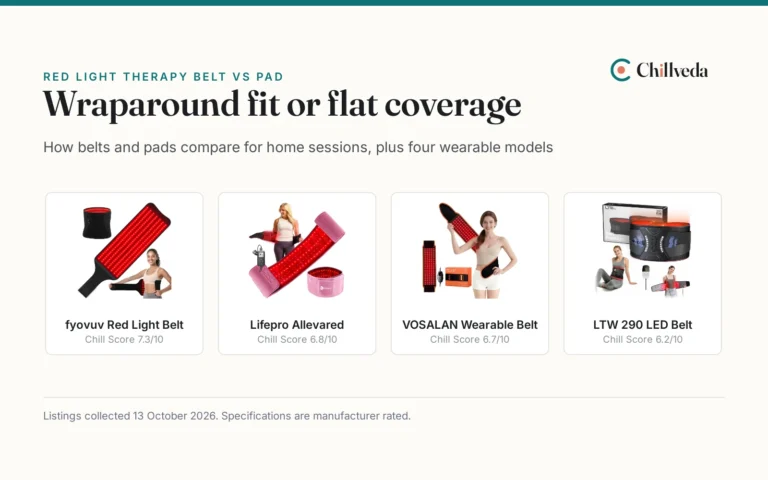
When you set up an evening recovery session on your sofa or bedside chair near a standard wall outlet, choosing between a red light therapy belt vs pad comes down to how you plan to position the light. A red light therapy belt is designed with adjustable straps and flexible backing to wrap snugly around curved areas like the lower back, waist, or joints while you relax. A red light therapy pad typically provides a broader, flat rectangular surface designed to rest against the back of a chair or lie flat on a stable surface. If you need targeted, hands-free placement that stays secured to your body while you recline or sit, choose a belt; if you want broader, unstrapped coverage to drape over wider torso areas or rest against, a flat pad is generally the better fit.
This guide explains the structural differences between flexible belts and flat pads, how stated diode counts and wavelengths compare across maker listings, and four wearable models to evaluate for home use. Listings were collected 13 October 2026.
This article is informational and is not medical advice. Red light and near-infrared devices emit concentrated light that can cause eye strain or discomfort, so avoid staring directly into active LEDs and use appropriate eye protection. Consult a medical professional before starting sessions if you have underlying medical conditions, light sensitivity, or take photosensitizing medications. See our Medical Disclaimer.
Chillveda earns a commission when you buy through links on this page, at no extra cost to you. As an Amazon Associate I earn from qualifying purchases. Affiliate disclosure.
Quick picks
-
1
 Red Light Therapy for Body Chill Score 9.5/10Check price on Amazon
A flexible red light wrap with 210 dual-chip LEDs, a 21.45 by 11 inch panel, four modes, and a 20-minute timer.
-
2
 Lifepro Allevared Red Light Therapy Belt Chill Score 9.4/10Check price on Amazon
A 49.5 inch wearable red light wrap with 660 nm and 850 nm LEDs, pulsed settings, and remote-controlled brightness.
-
3
 Upgraded Red Light Therapy for Body Chill Score 9.4/10Check price on Amazon
A wearable red light wrap with 105 three-in-one LED beads, seven timer modes, and dual-voltage power cords.
-
4
 LTW Upgraded 290 LEDs Red Light Belt Chill Score 9.3/10Check price on Amazon
A 49.5 by 9.5 inch red light belt with 290 tri-chip LEDs, four vibration levels, and four pulsing settings.

A flexible red light wrap with 210 dual-chip LEDs, a 21.45 by 11 inch panel, four modes, and a 20-minute timer.
Pros & ConsViewHide
Pros
- 210 dual-chip LEDs delivering 660 nm red and 850 nm near-infrared wavelengths
- Broad 21.45 by 11 inch LED panel on a 51.18 by 11 inch wrap
- Four operating modes including a 10 Hz pulsing setting
- Stated 5.9 ft power cable and automatic 20-minute timer
Cons
- No warranty term is stated
- Listing carries no stated safety certification
- Weighs 1.41 pounds, heavier than compact wraps
- Title lists 21.45 by 11 inches while full belt measures 51.18 by 11 inches

A 49.5 inch wearable red light wrap with 660 nm and 850 nm LEDs, pulsed settings, and remote-controlled brightness.
Pros & ConsViewHide
Pros
- Stated 660 nm red and 850 nm near-infrared wavelengths
- Adjustable brightness, timer, and pulse light settings
- Dual power support via USB port or 5V-1A wall adapter
- Remote control included with listed user manual PDF
Cons
- No warranty term is stated
- Listing carries no stated safety certification
- Weight contradiction: bullets list 1.2 lbs while spec table lists 2.98 pounds
- Title claims dual or triple chip LED design without specifying which is installed

A wearable red light wrap with 105 three-in-one LED beads, seven timer modes, and dual-voltage power cords.
Pros & ConsViewHide
Pros
- 105 beads combining two 660 nm and one 850 nm chip per bead
- Five intensity levels with steady and 10 Hz to 40 Hz pulsing modes
- Seven timed session options ranging from 5 to 30 minutes
- Supplied with both USB cord and 100 to 240V wall adapter
Cons
- No warranty term is stated
- Listing carries no stated safety certification
- Spec table lists dimensions as 1 by 1 by 1 inches
- Listing states a 60-day return policy rather than a manufacturer warranty

A 49.5 by 9.5 inch red light belt with 290 tri-chip LEDs, four vibration levels, and four pulsing settings.
Pros & ConsViewHide
Pros
- 290 high-density tri-chip LEDs for wide light coverage
- Combines light therapy with 4 vibration and 4 pulse levels
- Five adjustable light intensity settings and 30-minute auto shut-off
- Supportive back panel with adjustable side straps
Cons
- No warranty term is stated
- Listing carries no stated safety certification
- Wavelengths in nanometers are not stated anywhere in the listing
- Spec table lists package dimensions of 16.1 by 9.72 by 3.62 inches instead of product dimensions
More to compare
 Red Light Therapy Belt for Body BackCheck price on Amazon
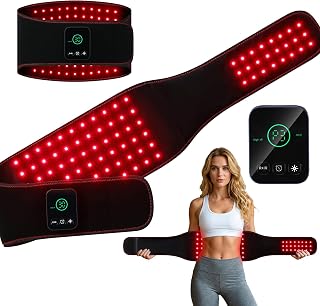 Red Light Therapy Belt for Body Back/AbdomenCheck price on Amazon
 iRESTORE Red Light Therapy Belt for Back Pain and ShoulderCheck price on Amazon
 INIA Red Light Therapy Panel & Belt 2-in-1Check price on Amazon
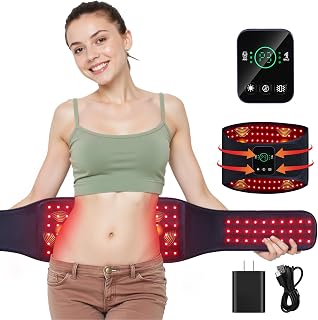 Cordless Red Light Therapy Belt for Body Back & Abdomen withCheck price on Amazon
 Red Light Therapy BeltCheck price on Amazon
Red light therapy belt vs pad: key differences
| Feature | Red light therapy belt | Red light therapy pad |
|---|---|---|
| Primary design | Flexible wrap with adjustable hook-and-loop straps | Flat rectangular mat surface without wrapping straps |
| Body positioning | Secured directly around waist, back, shoulders, or joints | Draped over the body or placed flat against seating |
| Retention method | Fastened with straps for hands-free positioning | Relies on gravity or resting against furniture to stay in place |
| Target application | Focused contoured coverage on curved body zones | Broader rectangular coverage across back or torso |
| Portability | Compact roll-up design suited for travel or sitting | Larger flat footprint suited for stationary home areas |
The primary distinction between these two formats is how they secure to your body. Belts feature elastic or fabric wings that wrap around a limb or torso, holding the light diodes directly against your skin without needing to hold them in place. Pads are designed without fasteners, functioning like an illuminated mat that rests against the body or furniture.
How wavelengths and diode density compare
Most wearable red light listings, including three of the four models examined here, specify combinations of 660 nm visible red light and 850 nm near-infrared light. The 660 nm wavelength produces a bright red glow on the skin surface, while 850 nm light is invisible to the human eye. Listings often remind users that near-infrared LEDs may appear unlit even when functioning normally. Our red light wavelengths guide explains how these two spectral bands behave.
Diode counts vary across wearable designs, ranging from 105 to 290 LED beads among the models collected here. Some makers use multi-chip packages, placing two red chips and one near-infrared chip within a single casing to pack higher emitter counts into a narrower footprint. For details on how dual-spectrum devices function, see our red light vs near infrared light comparison.
Fit, power cords, and placement in your routine
Where you plug in your device determines how easily it integrates into your daily routine. Power options listed in these specifications include a 5V-1A charging adapter and USB connection on the Lifepro, and a 100-240V wall adapter alongside a standard USB cord on the VOSALAN. The fyovuv lists a 5.9 ft cable, providing slack to sit comfortably near a wall outlet, while USB-compatible wraps can also connect to external power packs.
Because these emitters sit directly against the body, protecting your eyes remains critical whenever the wrap is positioned near the upper chest, shoulders, or neck. Read our red light therapy eye safety guide before your first session.
Wearable red light wraps worth considering
These are scored on the Chill Score, which weighs performance 35, build 25, value 25, safety certifications 10 where it applies and warranty 5. None of these four listings state a recognized electrical safety certification or a concrete warranty duration, so all four score 0 for safety and warranty.
| Product | Chill Score | Perf. /35 | Build /25 | Value /25 | Safety /10 | Warranty /5 |
|---|---|---|---|---|---|---|
| fyovuv Red Light Belt | 9.5 | 30 | 21 | 21 | 0 | 0 |
| Lifepro Allevared | 9.4 | 29 | 19 | 20 | 0 | 0 |
| VOSALAN Wearable Belt | 9.4 | 29 | 18 | 20 | 0 | 0 |
| LTW 290 LED Belt | 9.3 | 26 | 18 | 19 | 0 | 0 |
Scores run from 9.2 to 9.8: each product’s point total is placed on that range, so more points always means a higher score.
For more choices, see our best red light therapy belts roundup.
Using your belt or pad in practice
- Remove jewelry before securing the wrap. Hard metal items can scratch the protective surface or press uncomfortably into the skin during a session.
- Start with shorter timer intervals. The models here provide automatic shut-off timers between 20 and 30 minutes, with session selections as short as 5 minutes on some models. Begin with shorter timed sessions to see how your skin responds.
- Check power adapter connections. When using dual-cord wraps, ensure the inline remote or plug is seated firmly before connecting to power.
- Do not fold the active diode panel sharply. While flexible wraps are built to curve around waists and joints, bending them tightly can strain internal wiring.
Common mistakes
- Assuming unlit diodes are defective when they are emitting invisible 850 nm near-infrared light.
- Confusing package dimensions in the listing spec table with the active illuminated surface area.
- Placing a flat pad on an uneven surface where internal LED boards can bend past their intended tolerance.
- Expecting hands-free walking mobility from a flat pad that lacks fastening straps or when connected to a fixed wall outlet.
Common questions
Can you use a red light therapy belt as a flat pad?
Yes, many red light belts can be unfastened and laid flat across a couch or chair back to rest against. However, belts are narrower than dedicated flat pads, and the extended fastening straps remain attached even when laid open.
Why do some LEDs on the belt look unlit during a session?
Near-infrared light at 850 nm falls outside the visible spectrum for human eyes. Belts combining 660 nm red and 850 nm near-infrared diodes will show glowing red chips alongside diodes that appear off, even though both are powered.
How long should a typical session last on a belt or pad?
The listings collected here feature built-in automatic timers between 20 and 30 minutes, with session selections from 5 to 30 minutes on adjustable models. Always follow the manufacturer manual included with your specific device.
Can you run a red light therapy belt off a portable power bank?
Several models include a standard USB cable compatible with 5V-1A power sources or external battery packs. Check your device listing to confirm whether an external battery is supported alongside the supplied wall adapter.
What is the difference between 660nm and 850nm wavelengths?
The 660 nm wavelength is visible red light that is absorbed primarily in the upper skin layers. The 850 nm wavelength is near-infrared light that penetrates deeper into tissue without producing visible illumination.
Sources: Amazon product listings for the red light belts named above, collected 13 October 2026. Related: our red light vs near infrared light guide and red light therapy eye safety overview.
Back to all red light therapy reviews.