Short answer
Can a red light therapy blanket replace a red light panel?
A blanket can replace a panel if you prefer direct contact and flexible placement on a sofa or bed. However, if you want hands-free distance exposure that illuminates broad areas without touching your skin or requiring cleaning after sessions, a panel remains the better choice.
When winding down in your bedroom or recovery space after a long day, plugging an optical wellness device into a standard wall outlet raises an immediate decision between contact wraps and standing light. When comparing a red light therapy blanket vs red light panel, the primary difference is direct skin contact versus distance exposure. A red light therapy blanket wraps flexible LED fabric directly against your back, hips, or legs for contouring warmth, while a red light panel projects light across open space from a distance without touching your skin. Blankets excel for flexible, contouring contact in home relaxation spaces, whereas panels project light across open space without requiring skin contact or post-session wipe-downs.
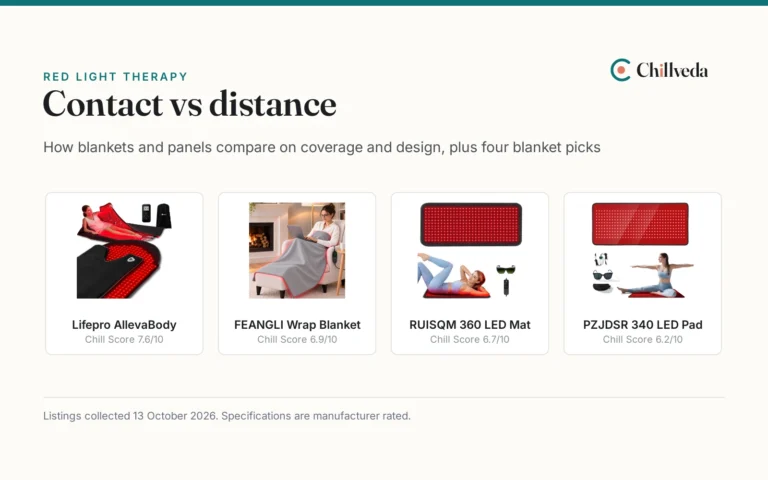
This guide examines how blankets and panels compare on coverage, setup, and maintenance, followed by four red light blankets compared on stated maker specifications. Listings were collected 13 October 2026.
This article is informational and is not medical advice. Red light and near-infrared devices emit concentrated optical radiation. Never look directly into illuminated LEDs, and always use appropriate eye protection during sessions. Consult a physician before use if you are pregnant, have photosensitive conditions, or take medications that increase sensitivity to light. See our Medical Disclaimer.
Chillveda earns a commission when you buy through links on this page, at no extra cost to you. As an Amazon Associate I earn from qualifying purchases. Affiliate disclosure.
Quick picks
-
1
 Lifepro Allevabody Red Light Therapy Wrap Chill Score 9.6/10Check price on Amazon
A 2320-chip dual-wavelength wrap made from neoprene with dual remotes and a lifetime warranty upon registration.
-
2
 FEANGLI Red Light Therapy Blanket for Body Chill Score 9.4/10Check price on Amazon
A 57 by 29.5 inch wearable blanket with 720 LEDs, medical-grade TPU inner film, and zipper cape design.
-
3
 Red Light Therapy Mat for Body Chill Score 9.4/10Check price on Amazon
A 180-watt light therapy pad with 360 red LEDs, 720 infrared chips, and a 5 to 30 minute smart timer.
-
4
 Red Light Therapy Mat for Full Body Chill Score 9.3/10Check price on Amazon
A compact leather light pad with 340 LEDs, rated up to 65 watts, with 5 power levels and 4 modes.

A 2320-chip dual-wavelength wrap made from neoprene with dual remotes and a lifetime warranty upon registration.
Pros & ConsViewHide
Pros
- 2320 dual-wavelength LED chips (660nm and 850nm)
- Lifetime warranty when registered within 14 days
- Dual independent remotes with 1 to 1000Hz pulse options
- Durable neoprene build includes dedicated carry bag
Cons
- Dimensions conflict: bullets state 62x24 in while spec table lists 74.8x24 in
- Title claims triple chip while bullets state 2-in-1 chips
- Heaviest pick here at 11.9 pounds
- No independent electrical safety certification stated

A 57 by 29.5 inch wearable blanket with 720 LEDs, medical-grade TPU inner film, and zipper cape design.
Pros & ConsViewHide
Pros
- Expansive 57 by 29.5 inch coverage area
- 720 LEDs with 3-in-1 chips (660nm and dual 850nm)
- Medical-grade TPU inner film is waterproof and wipe-clean
- Zipper design allows wearing as a shoulder cape or laying flat
Cons
- No concrete warranty duration or term stated
- Listing omits operating wattage
- Package weight is 4.95 pounds without individual mat weight listed
- No independent electrical safety certification stated

A 180-watt light therapy pad with 360 red LEDs, 720 infrared chips, and a 5 to 30 minute smart timer.
Pros & ConsViewHide
Pros
- Listing specifies 180 watts operating power
- Combination of 360 red (660nm) and 720 infrared (850nm) chips
- 5 brightness levels and pulse settings at 10Hz and 40Hz
- Lightweight at 3.15 pounds in package for easier repositioning
Cons
- Listing states only a 60-day refund period with no warranty term
- Smaller 31.5 by 11.8 inch surface offers limited coverage
- Contradiction between bullet LED count and spec table bead totals
- No independent electrical safety certification stated

A compact leather light pad with 340 LEDs, rated up to 65 watts, with 5 power levels and 4 modes.
Pros & ConsViewHide
Pros
- Listing specifies up to 65 watts operating power
- Waterproof, sweat-resistant leather surface wipes clean easily
- Features 340 2-in-1 LEDs with 660nm and 850nm wavelengths
- Lightweight package at 2.43 pounds facilitates storage
Cons
- No warranty term stated on the listing
- Title contains typographical error listing length as 29.6 feet
- Spec table omits product dimensions, giving only package size
- Irradiance claims are unverified manufacturer ratings
More to compare
 hooga Red Light Therapy Blanket PodCheck price on Amazon
 Infrared Sauna Blanket for Relaxation & Self-CareCheck price on Amazon
 Happy Sol Far Infrared Sauna Blanket for HomeCheck price on Amazon
Red light therapy blanket vs red light panel, from maker listings
| Device type | Contact style | Mounting and storage | Typical maintenance |
|---|---|---|---|
| Flexible red light blanket | Direct body contact, flexible contour | Rolls or folds for storage | Wipe down contact liner after use |
| Freestanding red light panel | Distance exposure, no skin contact | Door mount, floor stand, or tabletop | Dry dusting of exterior housing |
The core distinction comes down to mechanical design and how light reaches your body. A blanket places rows of light-emitting diodes directly against your skin or thin clothing, using flexible neoprene, fabric, or TPU film. A panel encloses diodes behind glass or plastic inside a rigid metal housing designed to hang from a door or rest on a floor stand. Our hanging red light panel vs panel with stand guide covers those mounting arrangements in depth.
Why direct contact feels different from distance light
A blanket rests directly against your body, so you feel immediate warmth from trapped body heat and active electronics, with some listings like FEANGLI also offering adjustable built-in heat levels. Because the flexible material wraps closely around curved joints, waistlines, or shoulders, it contours to uneven anatomy. Our guide on what to wear for red light therapy details how thin natural fabrics work under contact devices.
Both blankets and panels commonly pair 660nm red light with 850nm near-infrared light. The difference lies in how that light reaches you: a panel projects light across open air to cover whichever body areas face the beam, while a blanket wraps flexible LEDs directly around specific contours. For details on how those optical bands function, read our red light wavelengths explained guide.
Where distance changes light delivery
Irradiance numbers describe optical power density per unit area, and distance changes that reading drastically. When a blanket rests against the body, the diodes sit directly at the surface, eliminating the beam divergence that occurs as light travels through open space. Distance panels project light across an open gap, meaning optical intensity per square centimeter decreases as you position yourself further from the LEDs. Our guide on how far should you sit from a red light panel explains how session distance dictates your exposure time, while how to read a red light irradiance number unpacks manufacturer claims.
Electrical specifications also vary significantly between models. Among the blankets compared here, RUISQM lists an operating power of 180 watts, while PZJDSR lists up to 65 watts, with the other listings omitting wattage entirely. While distance panels often incorporate cooling fans and heavier power supplies to drive rigid arrays, contact wraps use lower-profile power adapters tailored to flexible mats.
Red light therapy blankets worth checking
These are scored on the Chill Score, which weighs performance 35, build 25, value 25, safety certifications 10 where it applies and warranty 5. None of these blankets state an independent electrical safety certification, so all four score 0 for safety.
| Product | Chill Score | Perf. /35 | Build /25 | Value /25 | Safety /10 | Warranty /5 |
|---|---|---|---|---|---|---|
| Lifepro AllevaBody | 9.6 | 30 | 21 | 20 | 0 | 4 |
| FEANGLI Wrap Blanket | 9.4 | 29 | 20 | 20 | 0 | 0 |
| RUISQM 360 LED Mat | 9.4 | 28 | 19 | 20 | 0 | 0 |
| PZJDSR 340 LED Pad | 9.3 | 26 | 18 | 19 | 0 | 0 |
Scores run from 9.2 to 9.8: each product’s point total is placed on that range, so more points always means a higher score.
For panel options designed for distance sessions, see our best full body red light panels guide.
Choosing between blankets and panels in practice
- Assess your available space. A panel requires clear floor space or an unobstructed door frame, while a blanket rolls into a closet or drawer when finished.
- Consider your preferred posture. Blankets are particularly convenient while lying in bed, lounging on a sofa, or sitting with a wrap draped over your shoulders. Panels generally work best when set up in front of a chair or standing area, though some models mount horizontally over a bed or massage table.
- Factor in post-session maintenance. Contact wraps absorb perspiration and require wiping down TPU or leather surfaces after each use. Panels never touch the body and stay clean.
- Protect your eyes. While panels shine light across the room toward your face, blankets can be positioned away from the eyes, though protective goggles remain essential if near-infrared light is active nearby. See our red light therapy eye safety guide.
Common mistakes
- Comparing contact blanket irradiance figures with distance panel ratings without accounting for the measurement gap.
- Expecting a red light blanket to produce heavy sweating like a dedicated far-infrared sauna blanket.
- Neglecting post-session cleaning on contact liners, allowing sweat and skin oils to accumulate.
- Looking directly into illuminated LED chips without using protective eyewear.
Common questions
Can a red light therapy blanket replace a red light panel?
A blanket can replace a panel if you prefer direct contact and flexible placement on a sofa or bed. However, if you want hands-free distance exposure that illuminates broad areas without touching your skin or requiring cleaning after sessions, a panel remains the better choice.
Do you need eye protection with a red light therapy blanket?
If the blanket is positioned near your face, chest, or anywhere within your field of view, protective goggles are necessary because 850nm near-infrared light is invisible but concentrated. If the blanket is wrapped around your lower back or legs and the diodes do not face your eyes, goggles may not be strictly required, though keeping them on hand is always prudent.
How do you clean a red light therapy blanket after use?
Most listings recommend wiping the waterproof TPU or leather inner lining with a damp cloth and mild soap. Never submerge electrical blankets or controllers in water, and allow the material to air dry completely before folding.
Is a red light therapy blanket the same as an infrared sauna blanket?
No. Red light therapy blankets focus on 660nm red and 850nm near-infrared light for photobiomodulation, providing gentle warmth or mild thermal settings. In contrast, infrared sauna blankets use high-wattage far-infrared heating elements engineered specifically to raise core body temperature and induce heavy sweating.
Can you use a red light therapy blanket while sitting up?
Yes, wraps featuring integrated zippers or flexible construction can be draped over the shoulders like a cape or placed behind your back in an armchair. Ensure the power cord reaches your wall outlet without tension while you remain seated.
Sources: Amazon product listings for the red light therapy blankets named above, collected 13 October 2026. Related: our hanging red light panel vs panel with stand guide and red light therapy panel vs mask comparison.
Back to all red light therapy reviews.