Short answer
Can a red light therapy pad replace a panel?
A pad can replace a panel if your main goal is treating a single joint, lower back area, or muscle group with direct skin contact. However, a pad cannot match a panel’s ability to cover your entire torso or full body in a single session. Many home users choose a pad for portable, targeted use and keep a panel for standing full-body routines.
When you set up a recovery routine in your living room or beside your bed in the evening, choosing between a red light therapy pad vs panel comes down to how you plan to treat your body. A flexible pad wraps directly against your skin with elastic straps to deliver targeted light to your lower back, knees, or shoulders while you sit comfortably on the couch. A standing or hanging panel casts light over a wider area from a short distance, requiring dedicated floor or door space but letting you treat your entire torso without strapping anything on. For targeted joint sessions and easy storage between routines, a flexible pad is the more convenient pick, while a panel suits broad coverage routines if you have the dedicated space.
This guide examines the practical differences between wearable pads and rigid panels, how direct skin contact compares with standing treatment, and flexible pads for home use. Listings were collected 14 October 2026.
This article is informational and is not medical advice. Red light and near-infrared devices emit concentrated optical radiation. Protect your eyes with appropriate eyewear, avoid staring directly into the LEDs, and consult a physician before using light devices if you are pregnant, have photosensitive conditions, or take medications that increase light sensitivity. See our Medical Disclaimer.
Chillveda earns a commission when you buy through links on this page, at no extra cost to you. As an Amazon Associate I earn from qualifying purchases. Affiliate disclosure.
Quick picks
-
1
 ALLOLO Red Light Therapy for Body Chill Score 9.5/10Check price on Amazon
A 32.7 by 15.7 inch flexible pad featuring 405 triple-chip LEDs, four modes including 10Hz pulse, and a 12 month warranty.
-
2
 Red Light Therapy Pad for Body Chill Score 9.5/10Check price on Amazon
A 13 by 7.3 inch wrap with 90 triple-chip LEDs offering 460nm blue, red, and infrared light across 27 settings with a UL-certified adapter.
-
3
 Red Light Therapy for Body Chill Score 9.4/10Check price on Amazon
A 17 by 8 inch wearable pad with 128 tri-chip LEDs, five intensity levels, pulse options, and portable power bank compatibility.
-
4
 Red Light Therapy for Body Chill Score 9.3/10Check price on Amazon
A targeted light therapy wrap featuring 72 dual-chip LEDs sealed behind protective TPU film with five modes and overheat protection.

A 32.7 by 15.7 inch flexible pad featuring 405 triple-chip LEDs, four modes including 10Hz pulse, and a 12 month warranty.
Pros & ConsViewHide
Pros
- Large 32.7 by 15.7 inch coverage area
- 405 LED beads with 3 chips each
- Includes 10Hz pulse mode and 30 minute timer
- Stated 12 month warranty with extension
Cons
- No safety certification stated
- Heaviest package here at 3.95 pounds
- Listing includes sunglasses rather than certified goggles
- Warranty requires registration to extend to 12 months

A 13 by 7.3 inch wrap with 90 triple-chip LEDs offering 460nm blue, red, and infrared light across 27 settings with a UL-certified adapter.
Pros & ConsViewHide
Pros
- Includes UL-certified charging adapter
- Three wavelengths: 460nm blue, 660nm red, 850nm NIR
- Offers 10Hz and 40Hz pulse options
- Two elastic straps included, 17.7 and 31.5 inches
Cons
- No warranty term is stated
- Spec table contradicts title on blue light and coverage
- Compact 13 by 7.3 inch pad size
- 90 LED beads provide smaller coverage area

A 17 by 8 inch wearable pad with 128 tri-chip LEDs, five intensity levels, pulse options, and portable power bank compatibility.
Pros & ConsViewHide
Pros
- 128 tri-chip LEDs with 384 total chips
- 17 by 8 inch pad fits back, knee or shoulder
- Compatible with portable USB power banks
- Five intensity levels with 10Hz and 40Hz pulse modes
Cons
- No warranty term is stated
- No safety certification stated
- Power bank is not included in the package
- Weight stated only for package at 1.06 pounds

A targeted light therapy wrap featuring 72 dual-chip LEDs sealed behind protective TPU film with five modes and overheat protection.
Pros & ConsViewHide
Pros
- Protective TPU film seals LEDs against moisture and oils
- Built-in overheat protection and auto shut-off
- USB powered and compatible with portable power banks
- Five modes and five adjustable energy levels
Cons
- Pad dimensions are not stated in the listing
- Lowest LED bead count here at 72 beads
- No warranty term is stated
- No safety certification stated
More to compare
 24" × 12" Red Light Therapy Pad for Body Pain ReliefCheck price on Amazon
 Red Light Therapy Pad with 72 LEDsCheck price on Amazon
 Comfytemp Red Light Therapy Pad for BodyCheck price on Amazon
 UTK Red Light Therapy PadCheck price on Amazon
 Red Light Therapy Pad for Body 406 LEDs 660nm & 850nmCheck price on Amazon
 Red Light Therapy PadCheck price on Amazon
Red light therapy pad vs panel: how they compare
| Feature | Red light therapy pad | Red light therapy panel |
|---|---|---|
| Contact type | Direct skin contact held by elastic straps | Non-contact, standing or seated at a distance |
| Treatment area | Targeted areas (waist, shoulder, knee, or back) | Broad half-body or full-body coverage |
| Storage and setup | Rolls or folds into an organizer bag for easy storage | Requires wall mounting, door hanging, or floor stand |
| Portability | Compact flexible wraps, select models compatible with power banks | Stationary units requiring dedicated household placement |
| Target wavelengths | Commonly 660nm red and 850nm near-infrared, select models adding 460nm blue | Commonly 660nm red and 850nm near-infrared arrays |
| Wired connection | Wall adapter or portable USB connection | Wall outlet power cord |
The physical differences dictate how each device fits into your daily routine. A pad uses a flexible mat embedded with LED diodes that rests directly against your body. Because the light source touches your skin, very little light scatters into the room, making it easy to use while relaxing. A panel uses a rigid metal or hard plastic housing with high-output LEDs behind lenses. Panels illuminate a larger silhouette, but they require you to remain stationary in front of the device throughout the session.
Why direct contact changes treatment and coverage
Light intensity diminishes as distance increases between the panel and your skin. When using a standing panel, sitting farther back reduces the light energy reaching your skin, while standing closer increases it. Our guide on how far to sit from a red light panel details how positioning affects your session.
A flexible pad bypasses the distance equation entirely by maintaining continuous contact. Because the diodes rest against the skin, energy reaches tissue without traveling through open air. The trade-off is surface area. A pad can treat your lower back, a knee joint, or a shoulder, but covering your entire body requires moving the pad to multiple locations or choosing a panel instead. For broader perspective on output ratings, our article on how to read a red light irradiance number explains maker measurements.
Setup and power: hanging a panel vs wearing a wrap
Before choosing either style, evaluate your physical space and daily setup. A standing panel requires dedicated floor clearance, door hanging brackets, or a sturdy mount near a wall outlet. In contrast, flexible pads require no permanent installation and roll up into compact bundles that fit inside a drawer or travel bag.
Pads also offer simpler physical storage and handling. The largest pad here measures 32.7 by 15.7 inches and packs into an included organizer, with a package weight of 3.95 pounds. More compact models, such as the 17 by 8 inch wrap or the 13 by 7.3 inch pad, keep packaged weight around 1 pound, and select models support portable USB power banks for cord-free mobility. This makes a wearable wrap far easier to stow away after a session than a rigid panel.
Flexible red light pads worth considering
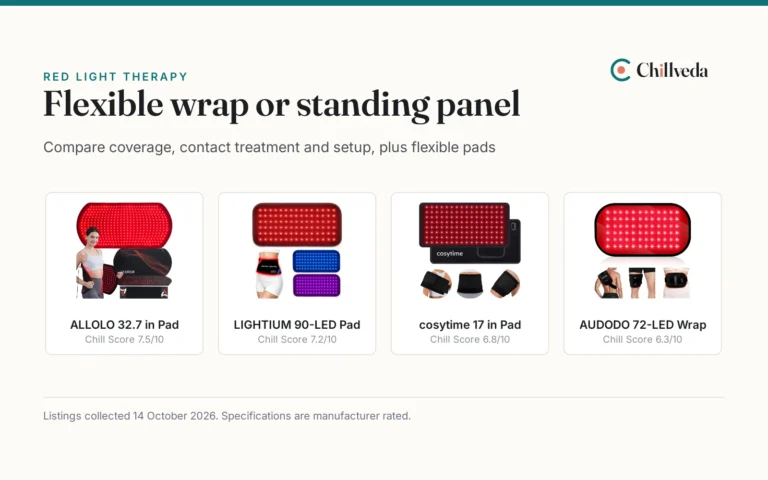
If you prefer targeted contact treatment and easy storage over a stationary panel, flexible wraps are the practical choice. Below are flexible pads compared by their published specifications.
These are scored on the Chill Score, which weighs performance 35, build 25, value 25, safety certifications 10 where it applies and warranty 5. Only listings with documented terms or third-party electrical certifications earn safety or warranty points.
| Product | Chill Score | Perf. /35 | Build /25 | Value /25 | Safety /10 | Warranty /5 |
|---|---|---|---|---|---|---|
| ALLOLO 32.7 in Pad | 9.5 | 32 | 21 | 21 | 0 | 1 |
| LIGHTIUM 90-LED Pad | 9.5 | 29 | 20 | 20 | 3 | 0 |
| cosytime 17 in Pad | 9.4 | 28 | 20 | 20 | 0 | 0 |
| AUDODO 72-LED Wrap | 9.3 | 26 | 19 | 19 | 0 | 0 |
Scores run from 9.2 to 9.8: each product’s point total is placed on that range, so more points always means a higher score.
For standing units with broader coverage, see our best full body red light therapy panels roundup.
Choosing between a pad and a panel in practice
- Match the device to your primary target. If you want to address an isolated knee, shoulder, or lumbar area, a wearable pad wraps directly around the joint. If you want broad torso exposure, a panel treats that area in one session.
- Check your storage and room layout. Panels require wall hooks, door hanging hardware, or floor clearance. Pads fold into compact organizers that store in a nightstand drawer.
- Look for timer controls. Stated pad timers often range from 5 to 30 minutes, or feature a fixed 20-minute auto shut-off to keep sessions within planned durations.
- Consider travel and mobility. Models compatible with portable USB power banks let you move around your home hands-free rather than sitting anchored to a wall socket.
- Verify safety features. Look for protective barriers like smooth TPU films that resist sweat and oils, along with automatic overheat protection.
Common mistakes
- Expecting a compact pad to deliver full-body coverage in a single session.
- Assuming unlisted safety certifications exist without explicit documentation on the listing.
- Looking directly into bright LEDs without wearing protective eyewear when using pads near the neck or face.
- Overlooking cord length and outlet placement when setting up a stationary session.
Common questions
Can a red light therapy pad replace a panel?
A pad can replace a panel if your main goal is treating a single joint, lower back area, or muscle group with direct skin contact. However, a pad cannot match a panel’s ability to cover your entire torso or full body in a single session. Many home users choose a pad for portable, targeted use and keep a panel for standing full-body routines.
Do you need eye protection when using a red light pad?
You do not always need blackout goggles if the pad is wrapped securely around your lower back, knee, or thigh under clothing where light cannot reach your eyes. However, if you use the pad near your neck, chest, or face, you should wear protective eyewear. Never look directly into illuminated LEDs during a session.
How close should a red light panel be compared to a pad?
A pad is designed for direct skin contact held in place by elastic straps, whereas a panel delivers light from a short distance without touching the body. Makers typically specify standing or seated positioning to ensure adequate light exposure while avoiding direct contact. Always follow the distance guidelines provided in your panel user guide.
Can you use a red light therapy pad with a portable power bank?
Select pads are designed with USB power cords that support portable power banks, allowing hands-free mobility around your home. Other models rely strictly on an included wall outlet adapter. Check the listing specifications before buying, as portable power banks are typically sold separately.
How often should you use a red light therapy pad or panel?
Manufacturers typically offer timer settings ranging from 5 to 30 minutes, or feature a fixed 20-minute automatic shutoff. Starting with shorter sessions of 5 to 10 minutes allows you to observe how your skin responds to the light. Always check the instruction manual for your model and consult your clinician.
Sources: Amazon product listings for the light therapy pads and panels named above, collected 14 October 2026. Related: see our guides on how far to sit from a red light panel and red light wavelengths explained.
Back to all red light therapy reviews.