Short answer
Does a corner sauna save more space than a rectangular sauna?
A corner sauna occupies the corner area where two walls meet, leaving the center of the room open. A rectangular sauna of similar capacity occupies a comparable total footprint but extends along a flat wall, which can project further into walkways. In rooms with tight central clearance, placing the cabin in an unused corner helps maintain open traffic flow.
Side by side Choose a corner sauna if Choose a rectangular sauna if
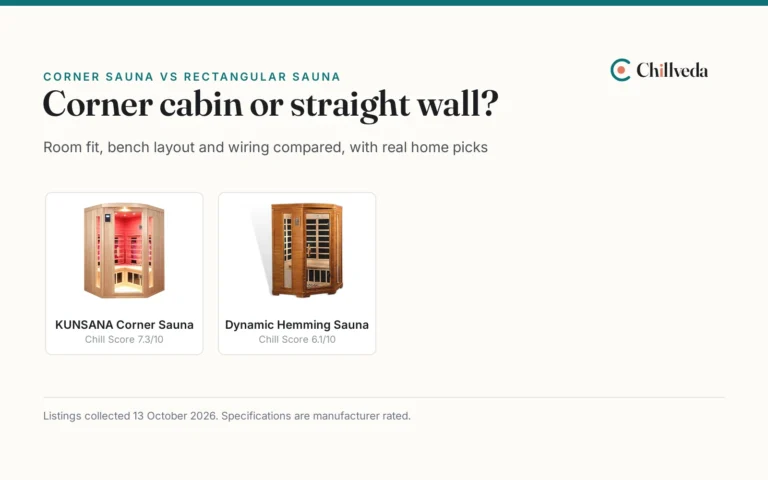
When planning a home wellness retreat in a spare bedroom, insulated garage, or basement gym, choosing where the cabin sits is the first major decision: corner sauna vs rectangular sauna. A corner sauna tucks neatly into the unused perpendicular intersection of two walls to preserve floor area, while a rectangular sauna sits flush against a straight wall to offer a more traditional bench layout. If your room is tight on walking space, choose a corner sauna; if you have open wall space and prefer a straight bench, choose a rectangular cabin.
This head-to-head comparison examines room fit, bench dimensions, electrical wiring, and daily usability, drawing on verified figures from two home saunas. Listings were collected 13 October 2026.
This article is informational and is not medical advice. Saunas produce intense heat that stresses the cardiovascular system and causes fluid loss. Never use a sauna under the influence of alcohol, step out immediately if you feel lightheaded, verify proper electrical wiring, and consult a physician first if you are pregnant or have cardiovascular conditions. See our Medical Disclaimer.
Chillveda earns a commission when you buy through links on this page, at no extra cost to you. As an Amazon Associate I earn from qualifying purchases. Affiliate disclosure.
Quick picks
-
1
 Infrared Saunas 2-3 Person Chill Score 9.5/10Check price on Amazon
A 2 to 3 person hemlock corner sauna rated at 1750 W with a 2-year warranty and a 149 F set point.
-
2
 Dynamic Hemming 2 Person Infrared Corner Sauna Chill Score 9.3/10Check price on Amazon
A 2 person hemlock corner sauna listed at 345 pounds that plugs into a standard 120V house outlet.

A 2 to 3 person hemlock corner sauna rated at 1750 W with a 2-year warranty and a 149 F set point.
Pros & ConsViewHide
Pros
- Rated at 1750 W with a 10 minute warm-up claim
- 2-year limited warranty covering wood, heating and electronics
- Stated seat load capacity up to 600 lbs
- Includes chromotherapy lights, reading lamp and 2 bluetooth speakers
Cons
- No UL or ETL safety certification stated
- Listing contradicts itself by citing both carbon plates and ceramic tubes
- Total product weight is not stated
- 1750 W power rating requires substantial electrical capacity on home circuits

A 2 person hemlock corner sauna listed at 345 pounds that plugs into a standard 120V house outlet.
Pros & ConsViewHide
Pros
- Plugs into a standard 120V household outlet
- Double paneled Canadian hemlock wood construction
- Stated low EMF between 6-10 MG at 6 to 8 inches
- Includes chromotherapy lighting and Bluetooth speakers
Cons
- No warranty term is stated
- Operating wattage and maximum temperature are not stated
- Exterior dimensions differ between bullet points and spec table
- Delivery is curbside only by semi-truck
More to compare
 Corner Home Sauna for 3-4 PersonCheck price on Amazon
 OUTEXER 2-3 Person Corner Sauna Far Infrared 120V 20ACheck price on Amazon
 OUTEXER Sauna Corner Saunas for 4-5 Person 240V IndoorCheck price on Amazon
 OUTEXER Sauna Corner Saunas for 2-3 Person 120V IndoorCheck price on Amazon
 Low EMF Infrared Saunas for 2-3 PersonCheck price on Amazon
 2 Person Corner Sauna 0-5mG Ultra Low EMF Sauna w/ Front DoorCheck price on Amazon
Corner sauna vs rectangular sauna at a glance
| Feature | Corner sauna | Rectangular sauna |
|---|---|---|
| Room placement | Nests into a perpendicular corner | Sits flat against a straight wall or open space |
| Footprint shape | Pentagonal shape | Rectangular box shape |
| Bench configuration | Angled or L-shaped seating facing inward | Straight bench along one wall |
| Door placement | Diagonal center door facing into the room | Door on the front wall |
| Floor space impact | Preserves central floor space in compact rooms | Extends along a straight wall into the room |
| Wall requirements | Requires two clear perpendicular walls | Requires a single clear wall or open space |
Power draw and electrical needs
Power draw and electrical needs depend on heater wattage and cabin volume rather than exterior cabinet shape. Both corner and rectangular cabins come in 120V plug-in formats for compact sizes and dedicated hardwired lines for larger cabins. For example, the KUNSANA listing specifies a 1750 W rating, which demands dedicated capacity on a household line. Meanwhile, the Dynamic Hemming example states it fits a regular 120V house plug but leaves its wattage unstated. An unstated wattage leaves real electrical draw unclear on the listing, rather than indicating lower power consumption. For broader guidance on calculating operating demands, review our guide to home sauna running cost.
Room fit and floor space
A corner sauna is built specifically to fit where two perpendicular walls meet. Because the front door cuts diagonally across the corner, it trims off the protruding front edge that a rectangular box would present, helping preserve central walkway space. This geometry makes corner models popular in multipurpose rooms like master bedrooms or home workout areas. However, placement is rigid: installation requires an unobstructed corner without windows, heat registers, or closet doors along either adjoining wall. For more on planning your footprint, see our breakdown on sauna size for 2 people.
A rectangular sauna sits flush against any flat wall. While it consumes more continuous wall length and extends straight outward into the room, it offers far more installation flexibility. You can place a rectangular sauna along any open wall section, reposition it later, or even set it up freestanding if space permits. The trade-off is that its protruding front corners can restrict movement in narrower spaces.
Bench layout and interior comfort
Interior bench design differs between these two cabin styles. In a corner sauna, benches wrap along the adjoining walls in an angled or L-shaped layout. This arrangement places two bathers facing toward the center of the cabin, making conversation easy while maintaining direct exposure to the wall-mounted heating panels.
A rectangular sauna typically features a single straight bench across the back wall. In compact cabins, both occupants sit side by side facing the front door. In larger rectangular models that span wider dimensions, a straight bench can provide enough length to recline, whereas corner cabins remain dedicated to seated sessions regardless of size. For more details on choosing cabin configurations, consult our guide on how to choose a home sauna.
Featured models
These are scored on the Chill Score: performance 35, build 25, value 25, safety certifications 10 where it applies and warranty 5. Neither listing publishes a UL or ETL electrical certification, so both receive 0 for safety. If you are comparing dedicated corner cabins, see our roundup of corner saunas.
| Product | Chill Score | Perf. /35 | Build /25 | Value /25 | Safety /10 | Warranty /5 |
|---|---|---|---|---|---|---|
| KUNSANA Corner Sauna | 9.5 | 29 | 20 | 20 | 0 | 4 |
| Dynamic Hemming Sauna | 9.3 | 23 | 19 | 19 | 0 | 0 |
Scores run from 9.2 to 9.8: each product’s point total is placed on that range, so more points always means a higher score.
Choose a corner sauna if
- You have an empty perpendicular room corner and want to keep central walking paths clear.
- You prefer an angled entry door that faces outward into the room.
- You want bathers to face each other across an angled seating layout.
- Both adjoining walls are free of low windows, vents, and doors.
Choose a rectangular sauna if
- You have a single open wall section available for cabin placement.
- You prefer side-by-side seating along a straight bench.
- You want the flexibility to reposition the cabin against different flat walls in the future.
- You plan on a larger multi-person cabin where you can recline along a long bench.
Check Your Space First
- Room dimensions: The Dynamic Hemming lists exterior dimensions of 49 by 48 by 76 inches (with 48 by 47 by 76 inches in its spec table), while the KUNSANA lists 76.7 inches high by 47.63 inches wide and 47.63 inches deep. Confirm you have at least 77 inches of vertical ceiling clearance and 48 inches of unobstructed wall length on both sides of the corner.
- Floor loading: The Dynamic Hemming listing states an empty weight of 345 pounds, and the KUNSANA states its seating supports up to 600 pounds. Verify that your subfloor can handle a heavy load in that corner.
- Power supply: The Dynamic Hemming states it fits a regular 120V house plug, while the KUNSANA lists a power draw of 1750 W. Ensure you have a dedicated 120V outlet on a circuit that does not share heavy appliance loads.
- Freight access: The Dynamic Hemming listing specifies curbside delivery only by semi-truck, requiring an accessible roadway and a valid contact phone number for appointment scheduling.
Common questions
Does a corner sauna save more space than a rectangular sauna?
A corner sauna occupies the corner area where two walls meet, leaving the center of the room open. A rectangular sauna of similar capacity occupies a comparable total footprint but extends along a flat wall, which can project further into walkways. In rooms with tight central clearance, placing the cabin in an unused corner helps maintain open traffic flow.
Can you lie down in a corner sauna?
Most compact 2 person corner saunas feature angled benches designed strictly for seated use. The length of each bench segment is not long enough for an adult to stretch out flat. If reclining is a priority, you need a larger rectangular cabin with a straight bench wide enough for full-body lounging.
Can a corner sauna be placed against a flat wall?
Corner saunas are constructed with an angled pentagonal footprint engineered specifically for a corner. Placing a corner sauna against a flat wall leaves open voids behind the angled rear panels and creates an awkward visual profile. For a flat wall installation, a rectangular sauna is designed for that layout.
Do corner and rectangular saunas heat up differently?
Heating performance depends on heater wattage and cabin interior volume rather than cabinet shape. For instance, the KUNSANA corner model lists a power rating of 1750 W with a 10 minute warm-up claim to reach its temperature range of 77 to 149 degrees Fahrenheit. A rectangular cabin with comparable wattage and cubic volume warms up at a similar pace.
What electrical outlet is needed for these saunas?
Many compact indoor cabins operate on standard household electrical service. The Dynamic Hemming example states it fits into a regular 120V house plug, while the KUNSANA model lists a power rating of 1750 W. Verifying dedicated circuit capacity with an electrician ensures the outlet can safely handle sustained heating sessions.
Back to all sauna reviews.