


The sticker price of a home sauna is the number everyone looks at. The electricity bill is the number almost nobody publishes, and it is the one that decides whether the sauna you buy gets used four times a week or four times a year.
This guide works out what each type of home sauna actually costs to run, using published wattage figures and the current national electricity rate. The arithmetic is simple enough that you can redo it with your own rate in about a minute, and we show you how.
This article is informational and is not medical advice. Heat exposure places real stress on the cardiovascular system. Please read our Medical Disclaimer before using any sauna, and speak to a clinician first if you have a heart condition, are pregnant, or take medication that affects blood pressure or thermoregulation.
The only formula you need
Electricity is billed by the kilowatt hour. A kilowatt hour is one thousand watts drawn for one hour. So:
Cost per session = (rated watts ÷ 1000) × hours running × your rate per kWh
As of June 2026, the average US residential electricity rate was 18.34 cents per kilowatt hour, according to the Energy Information Administration. We use that figure throughout this guide.
Your own rate probably differs, and not by a little. Residential rates range from roughly 11 cents in parts of the South to well over 40 cents in Hawaii. Look at the line on your utility bill that shows cents per kWh, or check the EIA state table linked at the bottom, and substitute your number.
What each type of sauna costs
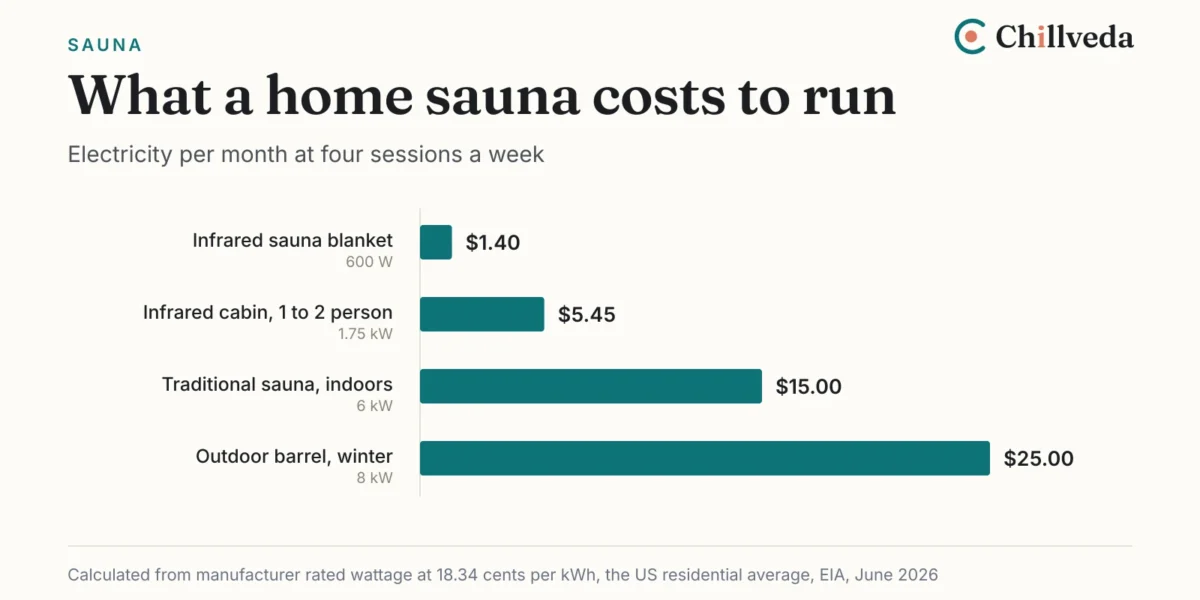
The figures below assume four sessions a week, which works out to about 17 sessions a month. Wattage figures are the ratings published by manufacturers. Duty cycle matters as much as rated wattage: a heater rated at 6 kW does not draw 6 kW continuously once the room is up to temperature, it cycles on and off to hold it.
Infrared sauna blanket
A typical blanket is rated around 600 watts and runs continuously for the length of the session. A 45 minute session uses about 0.45 kWh.
Roughly 8 cents a session, about $1.40 a month.
That is less than running a hair dryer for the same length of time. If electricity cost is the deciding factor in your purchase, a blanket ends the discussion. Browse our infrared sauna blanket coverage for what else separates them.
One or two person infrared cabin
Most cabins in this size are rated between 1.5 and 1.8 kW. Infrared heats the body rather than the air, so warm up is short and the heaters run close to continuously through the session. Call it one hour at 1.75 kW, or 1.75 kWh.
Roughly 32 cents a session, about $5.45 a month.
Traditional electric sauna, four to six person, indoors
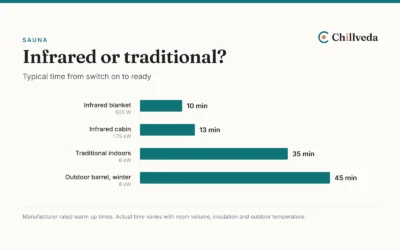
This is where the numbers start to matter. A 6 kW heater draws its full rating during warm up, which typically takes 30 to 40 minutes, then cycles at perhaps 40 percent to hold temperature through the session.
Warm up at 0.6 hours of full draw is 3.6 kWh. A 30 minute session at 40 percent duty adds about 1.2 kWh. Total is around 4.8 kWh.
Roughly 88 cents a session, about $15 a month.
Outdoor barrel or cabin sauna in winter
Outdoor units fight the weather. An 8 kW heater in a barrel sauna during a cold month needs a longer warm up and cycles harder to hold temperature. A realistic figure is around 8 kWh for a warm up plus a 30 minute session.
Roughly $1.47 a session, about $25 a month.
In summer the same unit will cost noticeably less. If you live somewhere with real winters, budget for the winter number, not the average. Our outdoor sauna cabin coverage goes into insulation and wood species, both of which move this figure.
The costs that are not on the meter
Running cost is not the whole bill, and the extras land almost entirely on the larger units.
Electrical work
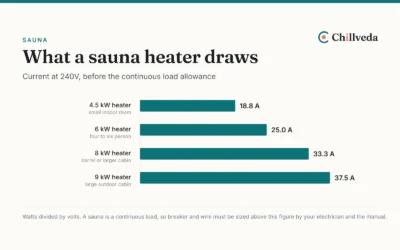
A sauna blanket and most small infrared cabins plug into a standard 120V outlet. Anything with a heater above about 1.8 kW generally needs a dedicated circuit, and traditional heaters at 6 kW and up need 240V service, which usually means hiring a licensed electrician to run a new circuit from your panel. This is frequently the largest single cost after the sauna itself, and it is entirely absent from most product listings.
Ground fault protection is required for outdoor installations. Do not treat this as optional. See our guide to sauna electrical requirements before you commit to a unit.
Freight and placement
Barrel and cabin saunas ship by freight, not parcel. Ask whether liftgate service is included and whether the carrier will bring the crate anywhere other than the end of your driveway. A unit that needs four people and a dolly to move 60 feet is a different proposition from a box a courier leaves at your door.
Maintenance
Traditional saunas need sauna stones replaced periodically as they crack, which is inexpensive but not never. Heaters are the component most likely to fail, so check what the warranty covers and for how long, and whether the manufacturer sells replacement elements at all.
Who should skip a home sauna
We would rather you spent nothing than spent badly.
If you rent, a 240V installation is usually out of the question and a barrel sauna is not coming with you. A blanket or a portable unit is the sensible ceiling.
If your electricity rate is above about 30 cents per kWh, which covers much of the Northeast, California, and Hawaii, run the arithmetic above with your own rate before buying anything with a 6 kW heater. The monthly figure roughly doubles.
If you have not used a sauna regularly somewhere else first, start with a gym or a spa membership for a month. Plenty of expensive cabins are used enthusiastically for three weeks and then become storage.
And if you are buying because a product page promised detoxification, calorie burning, or a metabolic effect, buy for the reason people actually keep using saunas, which is that they find the heat pleasant and relaxing. We do not repeat health claims we cannot support, and our How We Review page explains why.
Safety, briefly
Overheating and dehydration are the common problems. Drink water, keep sessions moderate, and leave immediately if you feel dizzy or unwell. Never use a sauna after drinking alcohol. Do not leave children unattended near one. Look for a UL or ETL listing on any unit that plugs into mains power, and have a licensed electrician do any hard wiring.
Run the numbers yourself
Take the rated wattage from the manufacturer’s specification sheet, divide by 1000, multiply by the hours you expect it to run, and multiply by the rate on your utility bill. Then multiply by how many sessions a month you honestly expect, not how many you hope for.
If that number is comfortable, the sauna is affordable. If it is not, a blanket at 8 cents a session does most of what people actually want from home heat.
Source: US Energy Information Administration, Electric Power Monthly, Table 5.6.A, average retail price of electricity to residential customers, June 2026: 18.34 cents per kWh. View the current table.



Write Your Review
No reviews yet. Be the first to share your experience!