Short answer
Can a back stretcher or yoga wheel replace an inversion table?
Both devices offer gentle spine decompression at home, but they work through different mechanics. A back stretcher uses your body weight over an arch or a manual crank bench, while an inversion table suspends you upside down to use gravity. Inversion tables provide full-body traction through gravitational pull, whereas back stretchers focus traction or curvature on the lumbar region without hanging by the ankles.
When you unroll a mat on the living room floor after a long day at a desk, choosing between a back stretcher vs yoga wheel comes down to whether you want static arch support or dynamic rolling mobility. An arch back stretcher cradles your lumbar spine in a stationary position at an adjustable angle, while a traction bench uses mechanical pull on a floor frame, allowing your back muscles to relax passively without active effort. In contrast, a yoga wheel requires active balance, core tension, and continuous rolling motion across the upper spine to open the chest. For targeted lower back curve support, an arch stretcher is the more focused choice, while a yoga wheel suits dynamic thoracic extension and active mobility routines.
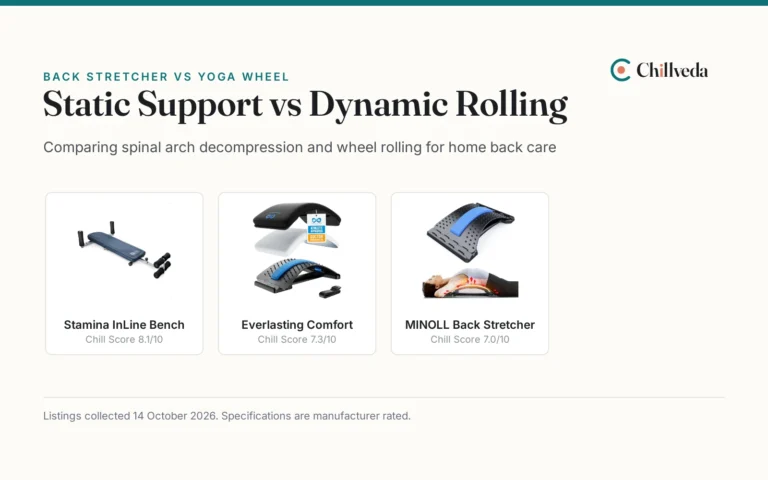
This guide sets out how arch stretchers, traction benches, and yoga wheels differ in mechanics, how placement along the spine alters the stretch, and three back stretchers worth considering for home decompression. Listings were collected 14 October 2026.
This article is informational and is not medical advice. Spinal stretching and traction place mechanical force on vertebrae, discs, and connective tissue. Avoid direct pressure on the neck, spine, arteries, or acute injuries, and consult a clinician before using traction devices if you have osteoporosis, severe scoliosis, or a herniated disc. Stop immediately if you feel numbness, tingling, or sharp pain. See our Medical Disclaimer.
Chillveda earns a commission when you buy through links on this page, at no extra cost to you. As an Amazon Associate I earn from qualifying purchases. Affiliate disclosure.
Quick picks
-
1
 Stamina Products InLine Back Stretch Bench System Chill Score 9.6/10Check price on Amazon
A 72-inch alloy steel traction bench with a manual cranking lever, ankle locks, and a 250-pound maximum user weight rating.
-
2
 Everlasting Comfort Lumbar Support Board Back Chill Score 9.5/10Check price on Amazon
An adjustable lumbar arch with 88 acupressure nodes, three angle settings, a chair strap, and a 350-pound weight limit.
-
3
 MINOLL Back Stretcher for Lower Back Pain Relief Chill Score 9.5/10Check price on Amazon
A lightweight multi-level lumbar board with 102 acupressure contacts, three angle slots, and a 400-pound stated capacity.

A 72-inch alloy steel traction bench with a manual cranking lever, ankle locks, and a 250-pound maximum user weight rating.
Pros & ConsViewHide
Pros
- Steel frame with 250 lbs capacity
- Manual cranking lever for axial decompression
- Adjustable arm supports with 3 width options
- Stated warranty covers 1 year frame, 90 days parts
Cons
- Large assembled footprint, 72 by 25 inches
- Does not fold for storage
- Heaviest pick here at 20.3 pounds
- Lower weight capacity than plastic arches

An adjustable lumbar arch with 88 acupressure nodes, three angle settings, a chair strap, and a 350-pound weight limit.
Pros & ConsViewHide
Pros
- Three angle settings, 15, 30, and 45 degrees
- Includes chair strap for office or car seating
- Removable, machine washable 3D mesh cover
- Stated weight limit of 350 lbs
Cons
- No warranty term is stated
- Spec table lists heat and speed control not on device
- Spec table lists manual winding power source in error
- Lower stated capacity than MINOLL arch

A lightweight multi-level lumbar board with 102 acupressure contacts, three angle slots, and a 400-pound stated capacity.
Pros & ConsViewHide
Pros
- Highest weight capacity here, 400 pounds
- 102 acupressure contact points
- Lightest option at 13.76 ounces
- NBR foam cushioning strip included
Cons
- No warranty term is stated
- Material contradiction between bullets and table
- Age range listed as youth despite adult department
- No chair strap or fabric cover included
More to compare
 MINOLL Back Stretcher for Lower Back Pain ReliefCheck price on Amazon
 YESINDEED Back Stretcher PillowCheck price on Amazon
 Back StretcherCheck price on Amazon
 YAJIACLONE Back Stretcher for Lower BackCheck price on Amazon
 Back Stretcher for Lower Back Pain ReliefCheck price on Amazon
 Docemel Back Stretcher for Lower Back Pain ReliefCheck price on Amazon
Back stretcher vs yoga wheel comparison, from maker specifications
| Category | Device design | Intended action | Stated adjustability |
|---|---|---|---|
| Back stretcher arch | Curved plastic board with acupressure nodes | Passive lumbar arch support and extension | Adjustable angle settings |
| Traction stretch bench | Alloy steel frame with cranking lever | Mechanical axial spine decompression | Length and arm width adjustments |
| Yoga wheel | Circular ring with foam exterior | Dynamic rolling and spinal extension | Fixed diameter |
The pattern is clear across maker listings. An arch back stretcher provides stationary lumbar support at an adjustable angle while resting on the floor, and models equipped with a strap can also be mounted to an office chair. A traction bench uses mechanical leverage to lengthen the spine along a horizontal track. In contrast, a yoga wheel relies on rolling motion and requires continuous balance, engaging the core as you move across the cylinder. None of these tools require electrical power, but they serve different routines.
Why passive arch stretchers focus on stationary decompression
An arch back stretcher relies on gravity and body weight over an adjustable curved frame to support lumbar extension. While lying over the board, your spinal extensor muscles can release passively because the plastic frame maintains the curve without requiring active muscular engagement. Our back stretcher vs inversion table guide explains how floor-based stretching compares to full inversion.
A yoga wheel introduces movement and instability. Lying over a narrow circular cylinder forces your abdominal muscles and hip stabilizers to work continuously so the wheel does not tip sideways. That makes the yoga wheel effective for active thoracic mobility and backbends, but less suitable when you need passive rest for fatigued lumbar muscles.
Where spinal curvature and body placement differ
Placement along the spine changes how each tool performs. An arch stretcher is contoured specifically for the lumbar lordosis, which is the natural inward curve of the lower back. Placing a rigid lumbar board under the neck or upper spine is uncomfortable because the curvature does not conform to other spinal segments. In contrast, a yoga wheel is commonly used along the thoracic spine, the mid and upper back between the shoulder blades. Rolling along the thoracic region opens tight chest muscles and promotes extension in rounded shoulders, though yoga practitioners also use wheels for hip and balance poses.
Do not force your spine into steep curves prematurely. Start on the gentlest arch setting or supported wheel positions, keep your knees bent to reduce lower back strain while on the floor, and avoid rolling directly over the cervical vertebrae.
Back stretchers worth considering
These are scored on the Chill Score, which weighs performance 35, build 25, value 25, safety certifications 10 where it applies and warranty 5. Manual stretchers carry no published safety certifications, so all three score 0 for safety.
| Product | Chill Score | Perf. /35 | Build /25 | Value /25 | Safety /10 | Warranty /5 |
|---|---|---|---|---|---|---|
| Stamina InLine Bench | 9.6 | 30 | 21 | 20 | n/a | 2 |
| Everlasting Comfort | 9.5 | 27 | 19 | 20 | n/a | 0 |
| MINOLL Back Stretcher | 9.5 | 26 | 18 | 20 | n/a | 0 |
Scores run from 9.2 to 9.8: each product’s point total is placed on that range, so more points always means a higher score. Safety counts only for powered gear or where the listing states safety features; where it does not apply, the score is taken over the remaining 90 points.
For more choices and rolling options, see our best yoga wheels and best foam rollers for back guides.
Using a back stretcher or yoga wheel in practice
- Start at the lowest arch or gentlest roll. Multi-level stretchers offer graduated angles. The Everlasting Comfort listing states three settings (15°, 30°, and 45°), while the MINOLL lists 15, 28, and 42 degrees. Begin on the lowest angle before attempting steeper arches.
- Keep early sessions brief. Session guidance varies: the MINOLL listing recommends relaxing for 5 to 10 minutes each time, twice a day, while other models do not specify a duration. When using a yoga wheel, keep initial rolling passes brief to evaluate how your back responds.
- Keep knees bent on the floor. Bending your knees with feet flat on the mat relieves excess pelvic tilt and lower back tension while lying across an arch stretcher.
- Check user weight limits. The listings state clear weight ratings: Stamina lists a maximum user weight of 250 lbs, Everlasting Comfort lists 350 lbs, and MINOLL lists 400 pounds. Never exceed the maker’s stated limit.
- Secure moving parts. On mechanical units like the Stamina bench, ensure the ankle locks and length adjustment knob are locked in place before operating the cranking lever.
Common mistakes
- Jumping straight to the highest arch setting instead of allowing lumbar muscles to adapt to the lowest angle first.
- Arching the lower back over a narrow wheel without maintaining core support, which can pinch lumbar facet joints.
- Rushing off the device. Rolling to your side and using your arms to sit up avoids sudden lumbar strain after decompression.
- Expecting passive stretching to replace medical care for structural conditions, herniated discs, or acute injuries.
Common questions
Can a back stretcher or yoga wheel replace an inversion table?
Both devices offer gentle spine decompression at home, but they work through different mechanics. A back stretcher uses your body weight over an arch or a manual crank bench, while an inversion table suspends you upside down to use gravity. Inversion tables provide full-body traction through gravitational pull, whereas back stretchers focus traction or curvature on the lumbar region without hanging by the ankles.
Is a back stretcher better for lower back pain than a yoga wheel?
An arch back stretcher is shaped to support the lumbar curve while resting on the floor, and certain models include straps for chair use. A yoga wheel requires active balancing and is generally better suited for opening the chest and mobilizing the thoracic spine. If you need stationary lower back support without dynamic movement, a lumbar arch is typically the more direct choice.
How does a yoga wheel compare to a standard foam roller?
A yoga wheel has a rigid circular core that maintains its shape under body weight, creating a deeper curve for extension exercises. A foam roller has a broader, softer cylinder that disperses pressure across larger muscle groups. To understand how roller materials and shapes compare, read our foam roller vs yoga wheel guide.
How often should you use a lumbar back stretcher?
Session frequency varies by device, and many listings do not publish a recommended duration. The MINOLL listing suggests lying on the arch for 5 to 10 minutes each time, twice a day, while other models leave session length to individual comfort or clinician guidance. Beginners should start on the lowest angle setting for short periods to see how their back responds.
Can you use a back stretcher while sitting in a chair?
Yes, certain lumbar boards are designed for dual use on the floor and in seated positions. The Everlasting Comfort model includes an adjustable chair strap specifically for office chairs and car seats. Seated use provides upright lumbar posture support without requiring you to lie flat on the floor.
Sources: Amazon product listings for the back stretchers and decompression equipment named above, collected 14 October 2026.
Back to all recovery tools reviews.