Short answer
What is the difference between a red light therapy cap and a helmet?
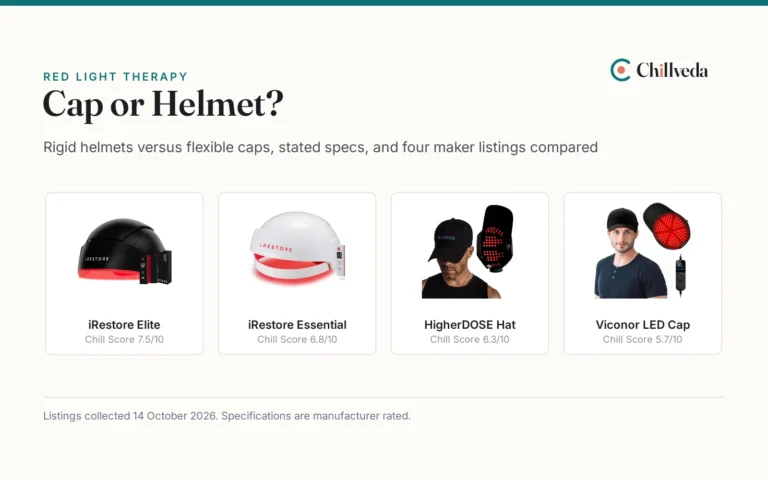
The primary difference is structural design and fit. A helmet uses a rigid molded shell with interior padding that maintains fixed spacing above the scalp, while a cap uses flexible textile materials that conform directly to the head. Helmets provide structured ventilation, whereas caps are lighter and fold flat for travel.
Finding a quiet moment at your bathroom vanity or favorite armchair for a daily scalp session often comes down to choosing between a flexible fabric cap and a structured rigid dome. When comparing a red light therapy cap vs helmet, the short answer is that a rigid helmet provides a molded protective shell that maintains consistent standoff distance and airflow above the scalp, while a red light therapy cap offers a lighter, flexible construction that conforms directly to the head and packs easily for travel. If you prefer a structured dome with fixed interior spacing, choose a helmet; if you want minimal weight and a low-profile fit, choose a cap.
This guide examines the concrete differences between cap and helmet designs, what maker specifications reveal about diode counts and wavelengths, and how four popular at-home models compare based on published specifications. Listings were collected 14 October 2026.
This article is informational and is not medical advice. Red light and near-infrared devices emit concentrated light energy; do not look directly into the emitters, and wear appropriate eye protection if light reaches your eyes. Consult a doctor before starting light therapy for hair or scalp conditions. See our Medical Disclaimer.
Chillveda earns a commission when you buy through links on this page, at no extra cost to you. As an Amazon Associate I earn from qualifying purchases. Affiliate disclosure.
Quick picks
-
1
 iRestore Elite + Rechargeable Battery Pack Chill Score 9.5/10Check price on Amazon
A rigid red light therapy helmet featuring 500 lasers and LEDs, triple wavelength technology, and an included rechargeable battery pack.
-
2
 iRestore Essential - Laser Red Light Therapy Chill Score 9.4/10Check price on Amazon
A rigid home-use red light helmet with hands-free operation and a 1.74 pound product weight.
-
3
 HigherDOSE Red Light Therapy Hat for Hair Growth Chill Score 9.3/10Check price on Amazon
A cordless, flexible red light therapy cap weighing 1 pound with an included rechargeable lithium-ion battery.
-
4
 LED lights Hair Growth Cap, Black Chill Score 9.2/10Check price on Amazon
A dome-shaped scalp therapy device listing 24-hour customer support and a 1.39 pound package weight.

A rigid red light therapy helmet featuring 500 lasers and LEDs, triple wavelength technology, and an included rechargeable battery pack.
Pros & ConsViewHide
Pros
- 500 lasers and LEDs with 2500 mW total power
- Triple wavelength technology stated
- Includes rechargeable battery pack for cordless sessions
- 12 minute daily session time
Cons
- No warranty term stated in the listing
- Heaviest package here at 4.39 pounds
- No safety certifications stated
- Rigid helmet shell does not fold for travel

A rigid home-use red light helmet with hands-free operation and a 1.74 pound product weight.
Pros & ConsViewHide
Pros
- Rigid helmet design weighs 1.74 pounds
- Hands-free home operation
- Listed as developed in GMP-certified facilities
- Clear product dimensions: 10.8 x 10 x 7 inches
Cons
- No diode count or wavelengths stated in the listing
- No warranty term stated in the listing
- Requires 1 Product Specific battery
- No safety certification stated

A cordless, flexible red light therapy cap weighing 1 pound with an included rechargeable lithium-ion battery.
Pros & ConsViewHide
Pros
- Lightest option here at 1 pound
- Cordless design with rechargeable lithium-ion battery
- Flexible wearable cap fits easily into routines
- Unisex design with model number REDHAT-V1
Cons
- No diode count, wavelengths, or power stated
- No warranty term stated in the listing
- No safety certifications stated
- Fabric cap format offers less rigid structural ventilation

A dome-shaped scalp therapy device listing 24-hour customer support and a 1.39 pound package weight.
Pros & ConsViewHide
Pros
- Lightweight package at 1.39 pounds
- Package dimensions: 10.63 x 7.68 x 4.41 inches
- 24 hour customer service support stated
- Dome shape designed for daily scalp coverage
Cons
- Listing title says LED while bullet points claim laser
- Requires a 9V battery according to spec table
- No warranty term or safety certification stated
- No diode count, wavelength, or power numbers provided
More to compare
 GroWell Red Light Therapy Hair Growth CapCheck price on Amazon
 Hair Regrowth Red Light Therapy Laser CapCheck price on Amazon
 CAYAMA Red Light Therapy for Hair Growth CapCheck price on Amazon
 Red Light Therapy for Hair CapCheck price on Amazon
 Laser Hair Growth CapCheck price on Amazon
 LLLT Laser Hair Growth CapCheck price on Amazon
Red light therapy cap vs helmet: stated specs by type
| Device format | Listing model | Stated structure | Stated power and diodes | Stated weight |
|---|---|---|---|---|
| Rigid helmet | iRestore Elite | Rigid shell, interior padding, ventilation | 500 lasers and LEDs, 2500 mW, triple wavelength | 4.39 lb package |
| Rigid helmet | iRestore Essential | Rigid shell, 10.8 x 10 x 7 in | Not stated | 1.74 lb product |
| Flexible cap | HigherDOSE Hat (REDHAT-V1) | Soft wearable hat, 12 x 8 x 5.5 in | Not stated | 1 lb product |
| Cap / dome | Viconor LED Cap | Dome-shaped cap, 10.63 x 7.68 x 4.41 in | Not stated | 1.39 lb package |
The contrast between formats is immediately apparent in the physical specifications. Rigid helmets are structured units weighing 1.74 pounds for the iRestore Essential up to a 4.39 pound package for the iRestore Elite, whereas the HigherDOSE hat lists a product weight of 1 pound. The iRestore Elite is the only listing here that specifies diode numbers (500 lasers and LEDs), power output (2500 mW), and triple wavelength technology. The other three listings leave power and wavelength specifications unstated.
Rigid helmets versus flexible caps: build and fit
Rigid helmets use a molded exterior shell with interior padding and ventilation openings, with the Elite listing specifying medical-grade padding. This structure maintains a fixed distance between the light source and your scalp, which keeps hair from pressing directly against the emitters and allows heat dissipation during use. The trade-off is bulk: helmet packages range up to 4.39 pounds and require dedicated shelf space rather than slipping into a drawer.
Flexible caps like the HigherDOSE hat take the opposite approach. Built like a standard cap with product dimensions of 12 x 8 x 5.5 inches and weighing 1 pound, they use a soft textile exterior that conforms to the shape of your head. This format folds more easily for travel and feels less conspicuous during use. However, fabric caps lack the rigid ventilation channels found in helmets, and the emitters sit directly against the hair and scalp. See our red light therapy mask vs helmet comparison for how similar structural trade-offs apply across other wearable light devices.
Lasers, LEDs, and wavelengths: what maker specs tell you
Diode technology represents another significant distinction between listings. Low-level light therapy devices typically use light-emitting diodes (LEDs), laser diodes, or a hybrid combination. Laser diodes emit concentrated, coherent light along narrow wavelengths, while LEDs disperse light over a wider area. Our guide to LED vs laser red light therapy details how these light sources function.
Among the four listings reviewed, the iRestore Elite combines 500 lasers and LEDs with triple wavelength technology. By contrast, the Viconor listing contains a direct contradiction: the title specifies an LED cap, while the bullet points describe a low-level laser device. When a listing contradicts itself regarding light technology or omits wavelength details entirely, buyers have no verifiable way to confirm the optical parameters of the device. Read our breakdown on red light wavelengths to understand why stated nanometer figures matter.
Wearable red light devices compared
These are scored on the Chill Score, which weighs performance 35, build 25, value 25, safety certifications 10 where it applies and warranty 5. None of these four listings states an electrical safety certification or a concrete warranty duration, so all four score 0 for safety and warranty.
| Product | Chill Score | Perf. /35 | Build /25 | Value /25 | Safety /10 | Warranty /5 |
|---|---|---|---|---|---|---|
| iRestore Elite | 9.5 | 33 | 22 | 20 | 0 | 0 |
| iRestore Essential | 9.4 | 28 | 20 | 20 | 0 | 0 |
| HigherDOSE Hat | 9.3 | 26 | 19 | 19 | 0 | 0 |
| Viconor LED Cap | 9.2 | 23 | 16 | 18 | 0 | 0 |
Scores run from 9.2 to 9.8: each product’s point total is placed on that range, so more points always means a higher score.
For more wearable options, see our best red light therapy caps guide.
Choosing between a cap and a helmet in practice
- Check the stated session length. The iRestore Elite specifies a 12 minute daily session, while other models suggest daily use without a built-in timer. Make sure the recommended routine fits your daily schedule.
- Evaluate corded versus battery power. Some devices include rechargeable batteries (such as the HigherDOSE hat or the iRestore Elite bundle), while others require specific batteries or stay tethered to an adapter during sessions.
- Consider device weight and packaging. Listed product weights are 1 pound for the HigherDOSE hat and 1.74 pounds for the iRestore Essential helmet, while the Elite listing only reports a 4.39 pound total package shipping weight. Lightweight caps place minimal weight on the head, while rigid helmets have more substantial physical presence.
- Look for verified light specifications. Prioritize listings that clearly publish diode counts, power in milliwatts, and specific nanometer wavelengths rather than generic marketing claims.
- Understand facility versus device claims. The iRestore Essential mentions GMP-certified facilities, which refers to manufacturing plant standards rather than an electrical safety listing for the device itself.
Common mistakes
- Assuming all wearable devices use the same light source; check whether the listing specifies lasers, LEDs, or a combination.
- Overlooking device weight when planning a daily seated or mobile routine.
- Expecting visible results in days; listings that cite clinical timelines state 3 to 6 months of daily consistency.
- Confusing FDA clearance statements with a specific clearance number or third-party electrical safety certifications.
- Ignoring contradictions between the listing title and bullet points regarding diode technology.
Common questions
What is the difference between a red light therapy cap and a helmet?
The primary difference is structural design and fit. A helmet uses a rigid molded shell with interior padding that maintains fixed spacing above the scalp, while a cap uses flexible textile materials that conform directly to the head. Helmets provide structured ventilation, whereas caps are lighter and fold flat for travel.
How long does a red light scalp session take?
Session duration depends on the specific manufacturer specifications. For example, the iRestore Elite specifies a 12 minute daily session, while other models suggest daily wear without an exact timer. Always check your device manual and follow the maker’s stated guidelines.
Do red light hair caps use lasers or LEDs?
Devices in this category may use LEDs, laser diodes, or a combination of both. For example, the iRestore Elite listing specifies both lasers and LEDs, while the HigherDOSE hat listing describes an LED design. Always verify listing specifications directly, as some product descriptions contradict themselves between their titles and bullet points.
How heavy are red light caps and helmets?
Weights vary based on construction and whether the figure reflects the device or shipping materials. For product weight, the HigherDOSE hat lists 1 pound and the iRestore Essential lists 1.74 pounds, while the iRestore Elite listing reports a 4.39 pound package weight. Soft fabric caps offer lower weight on the head, while rigid shells provide fixed structural spacing.
How long before maker listings suggest seeing hair results?
Listings that specify an expected timeframe, such as iRestore, cite 3 to 6 months of regular use before visible changes appear. Hair growth cycles are gradual, so consistency with the recommended schedule is essential. Individual experiences vary, and home devices should be discussed with a healthcare professional.
Sources: Amazon product listings for the wearable red light devices named above, collected 14 October 2026. Related: our red light therapy mask vs helmet comparison and LED vs laser red light therapy guide.
Back to all wearables reviews.