When settling into your evening chair or unwinding before bed, deciding between a red light therapy mask vs helmet comes down to one fundamental difference: target area. A red light therapy mask is shaped to sit against facial skin to address fine lines, skin texture, and blemishes, while a red light helmet or cap is engineered exclusively for the scalp to deliver light to hair follicles. Neither device can effectively replace the other because facial masks do not fit over the crown of the head, and rigid helmets do not direct light across the cheeks, nose, or chin.
This guide breaks down the structural differences between masks and helmets, how their form factors and light delivery differ, and four LED face masks if your focus is facial skincare. Listings were collected 13 October 2026.
This article is informational and is not medical advice. Light therapy devices emit bright light and near-infrared energy. Do not look directly into the LEDs, and use proper eye protection or closed eyes as directed by the maker. Consult a healthcare provider before use if you are pregnant, have light sensitivity, take photosensitizing medications, or have a skin condition. See our Medical Disclaimer.
Chillveda earns a commission when you buy through links on this page, at no extra cost to you. As an Amazon Associate I earn from qualifying purchases. Affiliate disclosure.
Quick picks
-
1
 American Wellness Authority FDA Cleared Red Light Chill Score 9.8/10Check price on Amazon
A flexible silicone face and neck mask with 432 face LEDs, 456 neck LEDs, 8 wavelength modes, and a stated 1-year warranty.
-
2
 SDKWDH Red Light Therapy for Face, 850nm NIR Mask Chill Score 9.5/10Check price on Amazon
A flexible silicone face mask providing 630nm red, 850nm near-infrared, and 415nm blue light.
-
3
 Mascarilla facial LED Shark CryoGlow con Chill Score 9.5/10Check price on Amazon
A rigid LED face mask combining red, blue, and deep infrared light with adjustable under-eye cooling pads.
-
4
 Red Light Therapy Mask for Face Chill Score 9.4/10Check price on Amazon
A cordless 324-LED face mask featuring 850nm near-infrared light, heat therapy, and 120 minutes of battery life.

A flexible silicone face and neck mask with 432 face LEDs, 456 neck LEDs, 8 wavelength modes, and a stated 1-year warranty.
Pros & ConsViewHide
Pros
- Includes neck attachment with 456 LEDs plus 432 face LEDs
- FDA 510(k) clearance stated for home use
- Full 1-year warranty stated by maker
- 8 customizable wavelength modes and 5 intensity levels
Cons
- Heaviest pick here at 2.56 pounds
- Requires connecting a wired remote during sessions
- Largest dimensions here at 15.75 by 8.66 inches
- Longer sessions at 10 to 30 minutes

A flexible silicone face mask providing 630nm red, 850nm near-infrared, and 415nm blue light.
Pros & ConsViewHide
Pros
- Triple wavelengths stated at 630nm, 850nm, and 415nm
- Lists IEC 60601-2-83 safety standard compliance
- Flexible ergonomic silicone design
- Lightweight build at 1.43 pounds
Cons
- Contradiction between rechargeable bullet and 9V battery in table
- No warranty term stated in listing
- No neck attachment included
- No LED chip count provided in listing
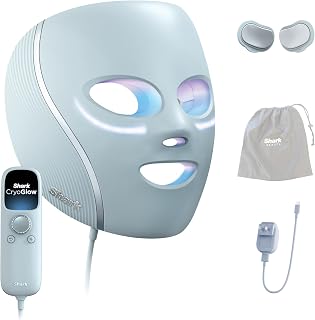
A rigid LED face mask combining red, blue, and deep infrared light with adjustable under-eye cooling pads.
Pros & ConsViewHide
Pros
- InstaChill under-eye cooling with 3 temperature levels
- Combines red, blue, and deep infrared light modes
- Short preprogrammed sessions of 4, 6, and 8 minutes
- Includes storage bag, USB-C cable and plug, and remote
Cons
- No warranty term stated in listing
- No safety certifications stated in listing
- Rigid plastic construction rather than flexible silicone
- Weighs 675 grams without neck coverage

A cordless 324-LED face mask featuring 850nm near-infrared light, heat therapy, and 120 minutes of battery life.
Pros & ConsViewHide
Pros
- High LED count with 324 LEDs
- Fast 30-minute charging for 120 minutes of wireless runtime
- Combines red, blue, and 850nm NIR light with gentle heat
- Built-in auto timer for hands-free sessions
Cons
- No safety certifications stated in listing
- No warranty term stated in listing
- Specific red and blue wavelengths omitted from listing
- Package weighs 1.65 pounds with no neck piece
More to compare
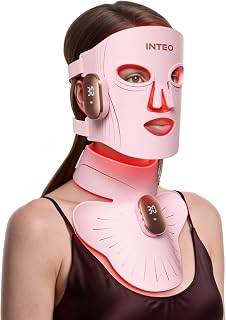 Red Light Therapy Mask for Face & NeckCheck price on Amazon
 FDA-Cleared LED Light Therapy MaskCheck price on Amazon
 IFAE Red Light Therapy Mask for Face and Neck with 396 LEDsCheck price on Amazon
 Red Light Therapy Mask for FaceCheck price on Amazon
 FDA-Cleared Red Light Therapy Mask for FaceCheck price on Amazon
 4D Red Light Therapy Mask for FaceCheck price on Amazon
Red light therapy mask vs helmet: key differences
| Feature | Red light therapy mask | Red light therapy helmet or cap |
|---|---|---|
| Primary target | Facial skin (cheeks, forehead, chin, nose) | Scalp and hair follicles (crown, hairline) |
| Typical structure | Flexible silicone sheet or contoured face shell | Rigid dome, helmet shell, or lined cap |
| Common light modes | Red light, near-infrared, and optional blue light | Red light and near-infrared light |
| Eye protection | Integrated eye shields, eye cups, or goggles | Downward shield or brim directed away from eyes |
| Fit mechanism | Adjustable head straps or ear loops | Internal sizing pads, headband, or chin strap |
| Session posture | Varies from reclining to mobile cordless use | Upright seated or hands-free tasks |
The comparison shows that these two categories serve completely different personal recovery routines. Face masks rely on closely contoured materials, such as flexible food-grade silicone or molded plastic, to keep diodes positioned near facial tissue. Helmets use a dome structure designed to direct light past hair strands down onto the scalp surface. Attempting to use a helmet on your face is awkward and leaves the eyes unprotected, while placing a facial mask on top of your head leaves hair strands blocking the light from reaching the scalp.
Why wavelength selection and tissue depth matter
Both masks and helmets rely on photobiomodulation, but the wavelengths chosen depend directly on the tissue being targeted. In the facial mask category, makers that publish specific wavelengths list red light (such as 630nm), near-infrared light (such as 850nm), and blue light (such as 415nm). As detailed in our guide to red light wavelengths, red light interacts with superficial skin layers to support tone and smoothness, blue light targets surface blemishes, and near-infrared light penetrates deeper into underlying tissue.
For scalp helmets, makers focus on red and near-infrared wavelengths intended to reach the scalp surface around hair follicles. Because hair shafts absorb and scatter light, helmets use diode placements aimed directly at the scalp rather than diffuse panels. Understanding your primary goal determines which device is appropriate: choose a mask for facial skin appearance, or a cap device like those in our best red light therapy caps guide for scalp care.
Form factor, fit, and eye safety considerations
The physical construction of a device dictates how comfortable and practical your daily session will be. Facial masks come in two primary formats: soft silicone that flexes to the contours of your cheeks and jaw, and rigid molded plastic shells. Soft silicone sits flush against the skin, delivering consistent proximity across the face. Eye safety is an essential factor whenever LEDs operate near the face. Some masks include built-in eye shields or opaque inserts, while others provide open cutouts or separate goggles. Our breakdown of red light therapy eye safety covers when extra eye protection is advisable.
Helmets and caps present fewer direct eye exposure risks during normal use because the diodes point downward toward the skull, away from your line of sight. However, fit becomes the central challenge with helmets. A helmet must sit securely without creating uncomfortable pressure points on the crown or temples. Many models include internal foam pads or adjustment dials to accommodate different head sizes. While helmets generally allow you to walk around or work at a desk during treatment, facial masks range from cordless models suited for light tasks to heavier or wired units best enjoyed while resting.
Red light therapy masks worth considering
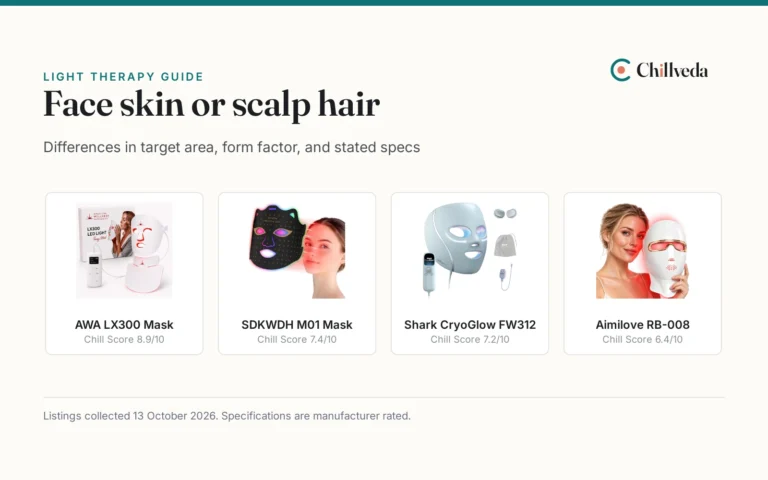
These are scored on the Chill Score, which weighs performance 35, build 25, value 25, safety certifications 10 where it applies and warranty 5. Models with documented regulatory filings or third-party safety standards earn higher safety marks, while stated manufacturer warranties add protection for your investment.
| Product | Chill Score | Perf. /35 | Build /25 | Value /25 | Safety /10 | Warranty /5 |
|---|---|---|---|---|---|---|
| AWA LX300 Mask | 9.8 | 32 | 22 | 21 | 9 | 4 |
| SDKWDH M01 Mask | 9.5 | 28 | 19 | 19 | 8 | 0 |
| Shark CryoGlow FW312 | 9.5 | 30 | 21 | 20 | 0 | 0 |
| Aimilove RB-008 | 9.4 | 28 | 18 | 19 | 0 | 0 |
Scores run from 9.2 to 9.8: each product’s point total is placed on that range, so more points always means a higher score.
For more options across different designs and price ranges, browse our best red light therapy masks roundup.
Choosing between a mask and a helmet in practice
- Identify your primary priority. If your main goal is smoothing facial lines, clearing mild breakouts, or supporting skin tone, choose a face mask. If your concern is hair thinning or supporting scalp vitality, choose a helmet.
- Do not expect cross-purpose results. A facial mask will not deliver effective energy to your scalp through dense hair, and a rigid helmet cannot be safely or comfortably positioned over facial skin.
- Check your daily routine and mobility needs. A helmet allows you to remain upright, read, or work at a desk during a session. A face mask may be cordless for light tasks or require a wired connection best paired with reclining.
- Verify regulatory documentation. Look for listings with verified FDA 510(k) clearances or IEC electrical safety standards, such as those discussed in our review of FDA cleared light devices.
- Maintain consistency over intensity. Both facial and scalp devices require regular sessions over several weeks or months as specified in the maker manual. Sporadic use will not yield noticeable improvements.
Common mistakes
- Buying a helmet expecting it to treat facial blemishes or forehead wrinkles.
- Resting a flat facial mask on top of hair and expecting the light to reach the scalp through dense strands.
- Skipping eye protection or opening your eyes toward illuminated diodes during facial sessions.
- Assuming all light devices carry third-party safety certifications when many listings disclose none.
- Using either device more frequently than the manufacturer manual recommends in an attempt to rush results.
Common questions
Can I use a red light therapy mask on my head for hair growth?
A facial mask is not designed for hair growth. Its diodes and light angles are calibrated for bare facial skin, and hair strands intercept the light before it reaches the scalp. A dedicated red light helmet or cap uses diodes configured to shine directly past hair to the scalp surface.
Can a red light therapy helmet be used on the face?
No, a helmet should not be used on your face. Helmets are rigid domes shaped specifically for the crown of the head, making them unstable and ineffective when held near facial contours. More importantly, helmets lack proper facial eye shields, exposing your eyes to direct light.
What wavelengths do red light therapy masks use?
Makers that publish wavelength specifications typically list red light (such as 630nm) for skin texture and near-infrared light (such as 850nm) for deeper tissue layers. Some listings also include blue light (such as 415nm) for surface blemishes. Check the product specifications, as not all makers publish exact nanometer ratings.
Do I need eye protection when using a red light therapy mask?
Yes, protecting your eyes is always recommended during facial light therapy. Many masks include built-in silicone eye cups, opaque inserts, or separate goggles to shield retinas from bright LEDs. Never look directly into illuminated diodes during your treatment session.
How often should I use a red light therapy mask or helmet?
Session times and schedules vary by device and maker. In our dataset, face masks list preprogrammed sessions from 4 to 8 minutes or adjustable timers between 10 and 30 minutes, with frequencies from once daily to two or three times weekly. Helmet makers set their own schedules. Always follow the instructions in your specific model manual.
Sources: Amazon product listings for the light therapy devices named above, collected 13 October 2026. Related: our best red light therapy caps and red light wavelengths explained.
Back to all masks and wearables reviews.