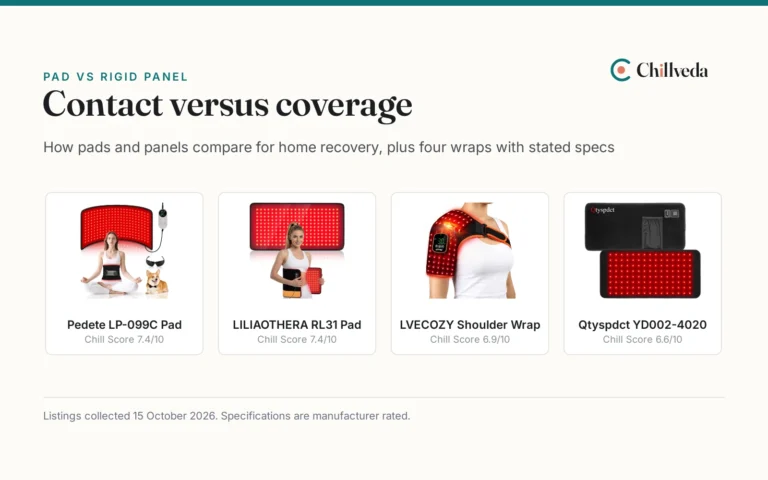
When deciding between a flexible red light pad vs rigid panel for your home routine, choose a flexible pad if you want targeted, direct-contact sessions while relaxing on the couch or working at your desk, and choose a rigid panel if you want broader, hands-free body coverage from across the room. A flexible wrap contours directly against the skin to minimize light scatter and packs into a travel bag, whereas a rigid panel covers larger treatment areas at once from a fixed stand or door mount but requires dedicated setup space and a nearby power outlet. Neither format is universally superior; your choice depends on whether you value portable, targeted contact or whole-body treatment distance.
This guide breaks down the core differences between flexible pads and rigid panels, how direct contact alters energy delivery, and reviews four flexible wraps with stated manufacturer specifications. Listings were collected 15 October 2026.
This article is informational and is not medical advice. Red and near-infrared light can strain or damage unprotected eyes. Never look directly into active LEDs, use appropriate protective goggles during sessions, and consult a doctor before using light therapy if you take photosensitizing medications or have an eye condition. See our Medical Disclaimer.
Chillveda earns a commission when you buy through links on this page, at no extra cost to you. As an Amazon Associate I earn from qualifying purchases. Affiliate disclosure.
Quick picks
-
1
 Pedete Red Light Therapy Mat for Body, 24’’×12’’ Chill Score 9.5/10Check price on Amazon
A 24 by 12 inch flexible red light therapy mat with 242 dual-chip LEDs, an elastic strap, and a stated 24-month warranty.
-
2
 Red Light Therapy Pad for Body 242 LEDs 24"x12" Chill Score 9.5/10Check price on Amazon
A 24 by 12 inch high-power mat featuring 242 tri-chip LEDs, 33W peak power, a 10Hz pulse mode, and a frosted TPU surface.
-
3
 Cordless Red Light Therapy for Shoulder Chill Score 9.4/10Check price on Amazon
A cordless contoured shoulder wrap combining 76 dual-wavelength LEDs with 3 heat levels and dual-motor massage powered by a 5000mAh battery.
-
4
 Red Light Therapy for Body Chill Score 9.4/10Check price on Amazon
A 16 by 7.9 inch light therapy pad belt with 120 LEDs, 6 operational modes, and dual-power options via adapter or power bank.

A 24 by 12 inch flexible red light therapy mat with 242 dual-chip LEDs, an elastic strap, and a stated 24-month warranty.
Pros & ConsViewHide
Pros
- Stated 24-month manufacturer warranty
- Generous 24 by 12 inch surface area
- 242 LEDs with dual chips for 660nm and 850nm
- 5 adjustable intensity levels and 3 light modes
Cons
- Spec table lists dimensions as 16.77 by 8.15 by 2.64 inches, conflicting with 24 by 12 inch title
- No safety certifications stated
- Requires wall outlet connection via power adapter
- Weight is 2.25 pounds

A 24 by 12 inch high-power mat featuring 242 tri-chip LEDs, 33W peak power, a 10Hz pulse mode, and a frosted TPU surface.
Pros & ConsViewHide
Pros
- 242 tri-chip beads delivering equivalent of 726 LEDs
- 33W peak power with 3 adjustable levels
- 10Hz pulse mode plus 3 constant light modes
- Hygienic frosted TPU surface with 30-minute timer
Cons
- No warranty term is stated
- No safety certifications stated
- Requires power adapter with 6ft cable
- Package weight is 1.9 pounds

A cordless contoured shoulder wrap combining 76 dual-wavelength LEDs with 3 heat levels and dual-motor massage powered by a 5000mAh battery.
Pros & ConsViewHide
Pros
- Cordless operation with built-in 5000mAh battery
- 3-in-1 control for red light, heating, and massage
- 3 heating levels (45 C, 50 C, and 55 C)
- Ergonomic 3D contoured fit for shoulder joint
Cons
- Lower LED count with only 76 beads
- Shoulder-specific shape limits use on other body areas
- No warranty term is stated
- No safety certifications stated

A 16 by 7.9 inch light therapy pad belt with 120 LEDs, 6 operational modes, and dual-power options via adapter or power bank.
Pros & ConsViewHide
Pros
- Dual wired power options via wall adapter or USB power bank
- 6 modes including 10Hz pulse settings
- Compact 16 by 7.9 inch size with 33.5 inch strap
- Includes 47.2 inch adapter cord and 59 inch power cord
Cons
- Title claims dual-chip while bullets describe trip-chip beads
- No concrete warranty term is stated despite listing claim
- Smaller light surface than 24 by 12 inch pads
- No safety certifications stated
More to compare
 24" × 12" Red Light Therapy Pad for Body Pain ReliefCheck price on Amazon
 Red Light Therapy Pad for BodyCheck price on Amazon
 Red Light Therapy Pad for Body Back Knee Shoulder 660nm &Check price on Amazon
 Comfytemp Red Light Therapy Pad for BodyCheck price on Amazon
 Comfytemp Red Light Pad for BodyCheck price on Amazon
 Red Light Therapy PadCheck price on Amazon
Flexible red light pad vs rigid panel: key differences
| Feature | Flexible red light pad | Rigid red light panel |
|---|---|---|
| Primary placement | Direct contact against skin or thin fabric | Positioned at a distance on a stand, desk, or door mount |
| Typical coverage | Targeted localized area (such as 16×7.9 to 24×12 inches) | Targeted, half-body, or full-body coverage depending on panel size |
| Power draw | Lower power draw (such as 18.5 to 33W stated) | Higher power draw designed for open-air light projection |
| Cooling mechanism | Passive surface dissipation without fans | Passive aluminum heat sinks or active internal fans |
| Portability | Pliable wrap that rolls up for storage or travel | Rigid casing designed primarily for stationary home setups |
| Eye exposure | Low ambient glare when wrapped inward against the body | Direct line-of-sight illumination requiring eye protection |
| Routine position | Seated, reclining, or secured with straps during daily activities | Stationary position facing the panel during sessions |
The operational divide between these two form factors is substantial. Flexible pads prioritize mechanical compliance, allowing LEDs to sit flush against body contours like the lower back, shoulder, or knee. Rigid panels prioritize optical projection across open air, allowing you to treat larger areas without strapping gear to your body.
How direct skin contact changes light delivery
As light travels through open air, beam divergence and surface reflection reduce the concentration of optical energy reaching tissue. Positioning a panel at a distance spreads the light over a broad area, but a portion of that energy scatters away from the target.
A flexible pad rests directly against the skin or a thin layer of clothing. By placing the diodes flush against tissue, reflection losses are minimized and light scatter into the room is virtually eliminated. This allows flexible pads to deliver concentrated surface light using a lower total wattage than an open-air panel.
Why distance and irradiance numbers mislead
Panel manufacturers often publish elevated irradiance figures measured directly at the glass surface, but those numbers drop quickly once you back away to a realistic sitting distance. With a rigid panel, slight shifts in posture or standing distance alter the light intensity reaching your body.
With a flexible wrap, distance is eliminated as a variable because the pad is secured directly to the body with elastic straps. However, placing diodes close to skin requires careful thermal management. For standard light-only wraps, moderate power keeps surface temperatures comfortable, such as the 111.2 F (44 C) maximum listed for the Qtyspdct pad. Other specialized wraps, such as the LVECOZY model, deliberately incorporate independent heating elements for users who want warmth alongside light.
Flexible red light therapy pads worth considering
These are scored on the Chill Score, which weighs performance 35, build 25, value 25, safety certifications 10 where it applies and warranty 5. Wraps carry no stated safety listing, so all four score 0 for safety.
| Product | Chill Score | Perf. /35 | Build /25 | Value /25 | Safety /10 | Warranty /5 |
|---|---|---|---|---|---|---|
| Pedete LP-099C Pad | 9.5 | 29 | 20 | 21 | 0 | 4 |
| LILIAOTHERA RL31 Pad | 9.5 | 32 | 21 | 21 | 0 | 0 |
| LVECOZY Shoulder Wrap | 9.4 | 29 | 20 | 20 | 0 | 0 |
| Qtyspdct YD002-4020 | 9.4 | 27 | 19 | 20 | 0 | 0 |
Scores run from 9.2 to 9.8: each product’s point total is placed on that range, so more points always means a higher score.
For more choices, including standing and door-mounted setups, see our best full body red light panels roundup.
Using a flexible pad or rigid panel at home
- Electrical requirements and power connections. Flexible wraps run at modest power levels, such as the 33W peak draw listed for the LILIAOTHERA mat. Most connect to standard household wall outlets using an included adapter and power cord, such as the 6ft cable on the LILIAOTHERA or the 59-inch cord on the Qtyspdct. The Qtyspdct model also supports USB power bank connections for portable sessions. Rigid panels typically operate at higher wattages and require steady placement on a stand, desk, or door mount near a wall outlet.
- Protect your eyes during sessions. While pads wrapped around knees or lower backs emit little ambient glow, rigid panels flood the room with intense visible red light. Always wear dedicated protective eyewear when facing active LEDs.
- Position straps securely without overtightening. When using elastic straps like the 26-inch or 33.5-inch bands included with these pads, fasten them snugly against the body to maintain steady contact without compressing circulation.
- Direct contact versus clothing layers. Diodes deliver light most efficiently against clean, bare skin. As the Qtyspdct manual notes, heavy or dark fabrics absorb and block light energy. If using a layer between the pad and skin for hygiene, choose a thin, light-colored fabric.
Common mistakes
- Chasing high panel wattage figures when your primary goal is treating an isolated joint or localized lower back area.
- Pressing a rigid panel directly against skin, which can block ventilation paths or cause discomfort from hard edges.
- Assuming all wraps include internal batteries; most require continuous connection to a wall adapter or an external power bank unless specifically stated like the cordless 5000mAh LVECOZY model.
- Skipping eye protection when using high-output red light devices near the upper chest, neck, or face.
Common questions
Is a flexible red light pad as effective as a rigid panel?
A flexible pad delivers light directly against the skin, avoiding the power dissipation that occurs when light travels through open air from a panel. However, a rigid panel illuminates a far larger surface area at one time. Pads excel for localized joints and muscles, while panels are preferable for broad half-body or whole-body routines.
Can you place a rigid red light panel directly against your skin?
Rigid panels are designed for distance illumination rather than contact use. Their hard enclosures, glass or acrylic fronts, and heat sink vents require surrounding airflow to manage thermal dissipation. Placing a rigid panel directly against bare skin is awkward, can obstruct cooling, and may cause uncomfortable warmth. Flexible pads are specifically engineered with pliable backings and moderate power draws for safe direct contact.
Do flexible red light pads require protective goggles?
When securing a flexible pad around your lower back, thigh, or knee, the diodes face inward toward your body, producing minimal ambient glare. However, if you position a pad near your chest, neck, or face where light can enter your line of sight, wearing protective goggles is necessary.
Can flexible red light therapy pads be used on pets?
Several pad makers explicitly indicate pet suitability in their listings. The Pedete, Qtyspdct, and LILIAOTHERA listings all note that their flexible pads can be used on household pets for gentle warmth and comfort. Always supervise pets during sessions and keep power cords out of reach.
Which option is better for travel, a pad or a panel?
A flexible pad is far better suited for travel. Flexible wraps roll into a compact cylinder and pack easily into a suitcase or backpack, with models like those reviewed here ranging from 1.28 to 2.25 pounds. Rigid panels feature heavy metal housings, glass covers, and mounting hardware that make frequent transport impractical.
Sources: Amazon product listings for the wraps named above, collected 15 October 2026. Related: see our red light therapy pad vs panel comparison, how far should you sit from a red light panel guide, and red light wavelengths overview.
Back to all red light therapy reviews.