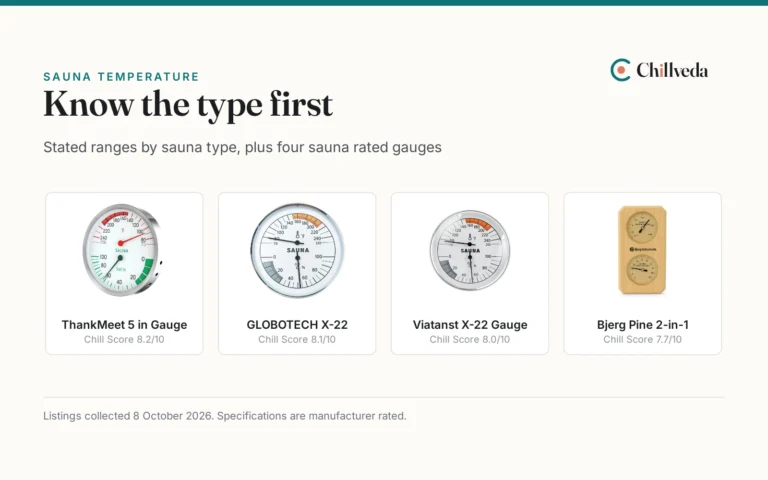
What temperature should a sauna be? It depends on the type. Traditional saunas with a stove are built to reach about 150 to 195 F, while infrared cabins are built to run cooler, with most listings stating a maximum between 130 and 150 F. Portable infrared tents usually stop at 140 F or lower. Within those limits, the right setting is the one you find comfortable for a short session, set by your device manual and your doctor, not by a number online.
This guide sets out the ranges makers actually state, why the reading on your thermometer depends on where you hang it, and four sauna rated gauges if your sauna has no reliable display. Listings were collected 8 October 2026.
This article is informational and is not medical advice. Heat exposure strains the heart and causes fluid loss. Do not use a sauna after alcohol, when pregnant, when unwell, or with a heart condition or low blood pressure without asking a clinician first. Leave at once if you feel dizzy, sick or confused. See our Medical Disclaimer.
Chillveda earns a commission when you buy through links on this page, at no extra cost to you. As an Amazon Associate I earn from qualifying purchases. Affiliate disclosure.
Quick picks
-
1
 5-Inch Large Display Sauna Thermometer Hygrometer Chill Score 9.7/10Check price on Amazon
A 5 inch stainless steel thermometer and hygrometer rated 70 to 250 F, with a color coded dial and a 6 month warranty.
-
2
 Sauna Thermometer Hygrometer Chill Score 9.6/10Check price on Amazon
A low cost aluminum and glass gauge that reads 70 to 250 F and humidity, with a stated accuracy of plus or minus 2 F.
-
3
 Sauna Thermometer Hygrometer Chill Score 9.6/10Check price on Amazon
A 4 inch stainless and glass gauge on the same X-22 pattern, reading 70 to 250 F, with anti fog vents and two mounting options.
-
4
 Sauna Thermometer and Hygrometer Chill Score 9.6/10Check price on Amazon
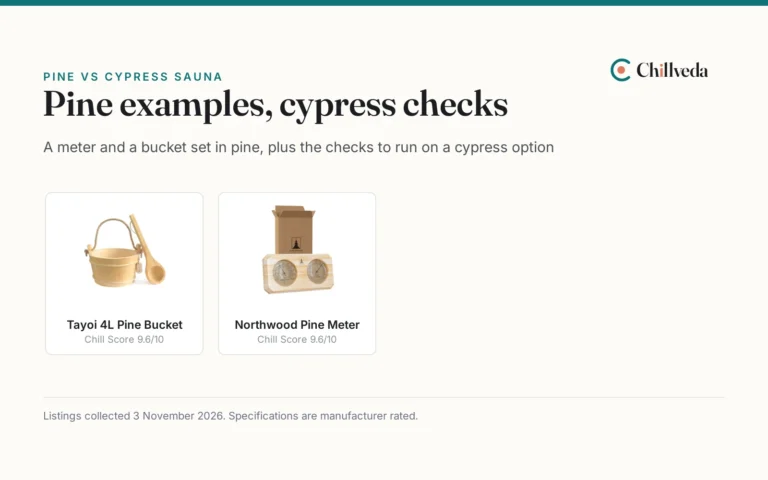
A pine framed analog thermometer and hygrometer for sauna rooms, reading up to 248 F on a 3.5 inch dial.
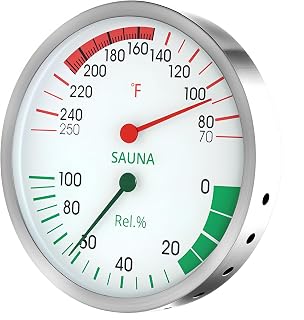
A 5 inch stainless steel thermometer and hygrometer rated 70 to 250 F, with a color coded dial and a 6 month warranty.
Pros & ConsViewHide
Pros
- Largest dial here, 5 inches
- Color zones mark 150 to 212 F in red
- 403 stainless steel body, tempered glass
- 6 month warranty stated
Cons
- No accuracy figure stated
- Color zones are the seller’s, not a safety standard
- Wall mount only

A low cost aluminum and glass gauge that reads 70 to 250 F and humidity, with a stated accuracy of plus or minus 2 F.
Pros & ConsViewHide
Pros
- Accuracy stated, plus or minus 2 F
- Reads 70 to 250 F and 0 to 100% RH
- Hangs or stands
Cons
- No warranty stated
- Small 4 in dial
- Same X-22 design sold under other names
- Listing hints at health benefits we do not repeat

A 4 inch stainless and glass gauge on the same X-22 pattern, reading 70 to 250 F, with anti fog vents and two mounting options.
Pros & ConsViewHide
Pros
- Reads 70 to 250 F and 0 to 100% RH
- Anti fog ventilation holes
- Wall or tabletop mounting
- Mechanical, no batteries
Cons
- Accuracy field reads 1 F, unclear if that is accuracy or scale
- No warranty stated
- Small 4 in dial

A pine framed analog thermometer and hygrometer for sauna rooms, reading up to 248 F on a 3.5 inch dial.
Pros & ConsViewHide
Pros
- Most ratings here, 329
- Pine frame suits a traditional room
- Reads up to 248 F and 0 to 100% RH
- Arrives assembled with a hanging point
Cons
- Smaller 3.5 in dials
- No accuracy or warranty stated
- CE mark is not a UL or ETL safety listing
More to compare
 Stainless Steel Sauna Hygrometer Thermometer with Color-CodedCheck price on Amazon
 SuperlightingLED DC24V 3000K White LED Strip for SaunaCheck price on Amazon
 Mechanical Sauna Thermometer HygrometerCheck price on Amazon
 HAMRVL DC24V 3000K Warm White Sauna LightsCheck price on Amazon
 Comfytemp Extra Large 35"X78" Sauna BlanketCheck price on Amazon
 SuperlightingLED 24V 2700K Warm White Sauna Lights HighCheck price on Amazon
Sauna temperature by type, from maker listings
| Sauna type | Example listing | Stated temperature |
|---|---|---|
| Traditional, electric stove | Outdoor cube sauna, Harvia 4.5 kW, 220V | About 32 to 195 F adjustable |
| Traditional, electric stove | Outdoor 2 to 3 person, Harvia 6 kW, 240V | Up to 195 F |
| Hybrid, stove plus infrared | 3 to 4 person hemlock, 4.5 kW stove | Up to 194 F on the stove, 149 F on infrared |
| Infrared cabin, 1 person | Dynamic Saunas Elite | Up to 140 F, 118 to 132 F typical |
| Infrared cabin, 1 person | Kanlanth 905W, Homsido 900W | Up to 140 F |
| Infrared cabin, 1 person | Albott, OUTEXER 1550W | Up to 149 F |
| Infrared cabin, 3 person | Dynamic Saunas Madrid Elite | Up to 135 F, 115 to 130 F recommended |
| Infrared cabin, 4 person | HEATWAVE Tucson | Up to 140 F |
| Portable infrared tent | SereneLife sauna box | Up to 140 F |
| Portable infrared tent | ZONEMEL 1 person | Up to 115 F |
The pattern is clear. Traditional heaters in these listings top out around 195 F, which is about 90 C, while infrared cabins stop between 130 and 150 F. The hybrid cabin shows the gap in one product: the same room reaches 194 F with its stove and 149 F with its infrared panels. One infrared dome listing claims 194 F, an outlier we would ask the seller to explain.
Why infrared runs cooler and still feels hot
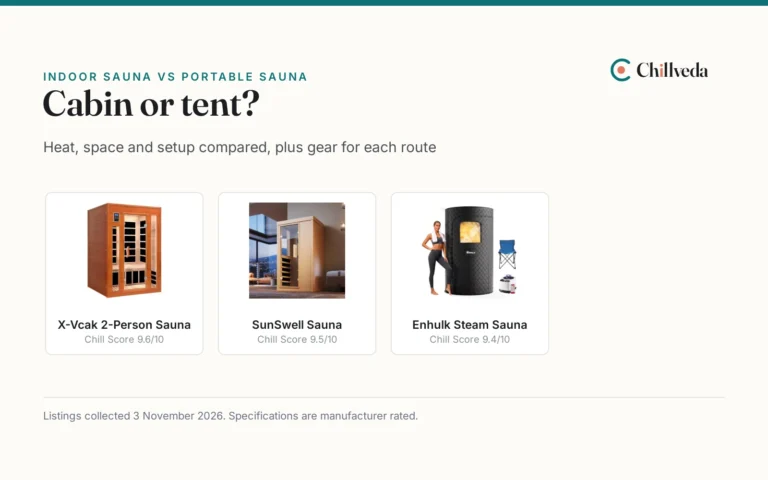
A traditional sauna heats the air, and the air heats you. An infrared sauna warms your skin directly, so the air can stay much cooler while you still sweat. That is why an infrared cabin at 140 F and a traditional room at 180 F are not as different to sit in as the numbers suggest. Our infrared vs traditional sauna guide explains the trade offs in more detail.
Humidity changes how hot a traditional room feels. Water poured on the stones raises humidity for a few minutes, and the same air temperature then feels much hotter. A gauge that reads both temperature and humidity, like the ones below, shows you what is happening.
Where you measure changes the number
Heat rises, so a thermometer near the ceiling reads higher than one at bench height, and the gap can be large in a traditional room. A built in display reads a sensor wherever the maker mounted it, which may be well above your head. For a reading that matches what you feel, hang a separate gauge near head height when seated, away from the stove or the panels, and give a mechanical gauge a few minutes to settle.
Do not put a regular household thermometer or a phone in a sauna. Look for a gauge rated to at least 230 F, and preferably 250 F, like the four here.
Sauna thermometers worth hanging
These are scored on the Chill Score, which weighs performance 35, build 25, value 25, safety certifications 10 where it applies and warranty 5. Gauges carry no safety listing, so all four score 0 for safety.
| Product | Chill Score | Perf. /35 | Build /25 | Value /25 | Safety /10 | Warranty /5 |
|---|---|---|---|---|---|---|
| ThankMeet 5 in Gauge | 9.7 | 29 | 21 | 22 | n/a | 1 |
| GLOBOTECH X-22 | 9.6 | 29 | 20 | 24 | n/a | 0 |
| Viatanst X-22 Gauge | 9.6 | 29 | 20 | 22 | n/a | 0 |
| Bjerg Pine 2-in-1 | 9.6 | 28 | 20 | 21 | n/a | 0 |
Scores run from 9.2 to 9.8: each product’s point total is placed on that range, so more points always means a higher score. Safety counts only for powered gear or where the listing states safety features; where it does not apply, the score is taken over the remaining 90 points.
For more choices, including digital models with an outside display, see our best sauna thermometers roundup.
Setting the temperature in practice
- Start below the maximum. Makers state a top limit, not a target. One infrared listing recommends a comfort range of 115 to 130 F, below its 135 F maximum.
- Follow your manual on session length. One cabin listing here recommends 10 to 15 minutes, starting at low temperatures. Your manual and your doctor come before anything you read online.
- Allow warm up time. Infrared cabins usually warm in 10 to 15 minutes, while a traditional stove takes longer, and outdoor saunas take longer again in winter.
- Drink water before and after, and never use a sauna after alcohol.
- Respect the cutoff. Electric saunas have overheat protection. Kanlanth, for example, states a 230 F cutoff. If yours trips often, have it checked rather than resetting it again and again.
Common mistakes
- Comparing an infrared reading with a traditional sauna number and turning the infrared up to chase it.
- Trusting a ceiling sensor as the temperature at your head.
- Treating the colored zones on a dial as a safety rating. They are the seller’s markings.
- Staying in longer because the room feels cooler than expected.
Common questions
What is a normal temperature for a traditional sauna?
Traditional sauna listings with electric stoves state maximums of about 194 to 195 F. Many people sit well below the maximum. Start lower and follow the manual for your heater.
What temperature should an infrared sauna be?
Infrared cabin listings state maximums of 130 to 150 F, and one recommends a comfort range of 115 to 130 F. Infrared warms you directly, so a lower air temperature is normal.
Is 200 F too hot for a sauna?
None of the electric heater listings we collected state a setting above 195 F. If a reading goes above your heater’s stated maximum, check where the thermometer is hung and whether the overheat protection is working.
Why does my sauna thermometer read differently from the control panel?
The panel sensor may be mounted high on the wall, where the air is hottest, while a separate gauge at head height reads lower. Mechanical gauges also need a few minutes to settle.
Does a portable sauna get as hot as a cabin?
Usually not. The portable tents we found state maximums of 115 to 140 F. See our portable infrared saunas roundup for details.
Sources: Amazon product listings for the saunas and gauges named above, collected 8 October 2026. Related: our best 1 person saunas and sauna electrical requirements.
Back to all sauna reviews.