


The sauna you are looking at has a wattage on its spec sheet. That number decides whether installation is a plug and a weekend, or an electrician, a permit, and a new circuit from your panel. It is the single most common surprise in home sauna buying, and it is almost never mentioned on the product page.
This guide shows you how to read the number, what each heater size draws, and what questions to put to an electrician before you spend anything.
This article is informational and is not electrical or medical advice. Electrical work must be carried out by a licensed electrician in accordance with your local code. Please also read our Medical Disclaimer before using any sauna.
Turning watts into amps
Current is watts divided by volts. That is the whole calculation.
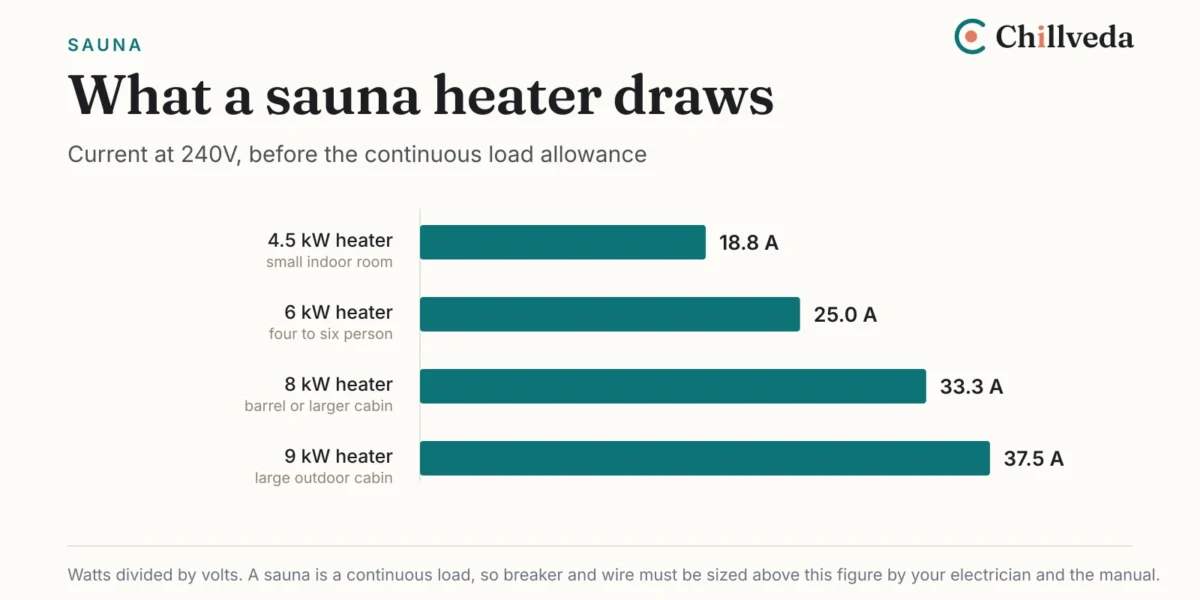
A 6 kW heater on a 240V supply draws 6000 ÷ 240, which is 25 amps. A 1.75 kW infrared cabin on 120V draws 1750 ÷ 120, which is 14.6 amps.
Those two results sit on opposite sides of an important line. The infrared cabin is close to the limit of a standard 15 amp household circuit, so it usually wants a dedicated 20 amp circuit but no new service. The 6 kW heater needs 240V, which most homes only run to a range, a dryer, or an air conditioner.
What a sauna is, electrically speaking
A sauna heater is what the National Electrical Code calls a continuous load, because it runs for three hours or more. Continuous loads are not wired to their raw amperage. The circuit conductors and the breaker have to be sized above the calculated draw, with a margin the code specifies.
We are deliberately not printing breaker sizes and wire gauges here. The correct values depend on the specific heater, the length of the run, the conductor material, the ambient temperature, and your local amendments to the code. Take the figure from the manufacturer’s installation manual and have a licensed electrician confirm it against your panel and your local code. An article on the internet is not a substitute for either.
What the table above gives you is the starting figure, so you can tell at a glance whether you are in plug-in territory or panel territory.
The four questions to ask before you buy
1. Does my panel have capacity?
Adding a 40 amp circuit to a panel that is already full means either a subpanel or a service upgrade. A service upgrade can cost more than the sauna. Have an electrician look at your panel before you order, not after the crate arrives.
2. How far is the run?
Distance from panel to sauna drives conductor size and therefore cost. A heater on the other side of the garage wall is a different job from one at the bottom of the yard. For outdoor cabins, the run is usually the largest line on the quote.
3. Is it hard wired or does it plug in?
Most 240V sauna heaters are hard wired, which means the circuit terminates at the heater and there is no cord or plug. That is normal, and it is also why you cannot move the sauna later without an electrician.
4. What protection does the location require?
Outdoor installations and damp locations have specific requirements, and ground fault protection is standard among them. Your electrician will know what applies where you live. Do not treat this as an optional upgrade to save a few dollars on a wet, hot, metal-and-water appliance.
Sizing the heater to the room
Heater manufacturers publish sizing charts, and the common rule of thumb for a traditional indoor sauna is roughly one kilowatt per fifty cubic feet of room volume. Glass, uninsulated walls, and exterior exposure all push the requirement up, which is why outdoor barrels of the same internal volume take a bigger heater than an indoor room.
Measure your space and check the chart for the specific heater. Undersizing is the more common mistake and it is the worse one: an undersized heater runs at full draw for longer, never quite reaches temperature, and costs more to operate. We work through what that does to your bill in what it costs to run a home sauna.
What this means for each type of sauna
Sauna blankets plug into a normal outlet and need nothing else. If your electrical situation is complicated or you rent, this is the answer. See our infrared sauna blanket coverage.
Small infrared cabins generally run on 120V but want a dedicated circuit so they are not sharing with a fridge or a power tool. Check the manual: some larger infrared units are 240V.
Traditional heaters from about 4.5 kW upward are 240V, hard wired, and an electrician job. Budget for it as part of the purchase.
Outdoor cabins combine the largest heaters with the longest runs and the strictest location requirements. This is the configuration where installation most often approaches or exceeds the cost of the unit. Our outdoor sauna cabin coverage goes into the rest of what that install involves.
Who should stop here
If you rent, a hard wired 240V heater is almost certainly not happening, and a landlord is unlikely to approve one. Buy a blanket or a plug-in infrared unit and enjoy it.
If your panel is full and a service upgrade is not in the budget, size down to something that runs on an existing circuit rather than buying the cabin now and hoping to solve the electrics later. People do this, and the cabin sits unused in a garage for a year.
And if an electrician tells you a job needs a permit, get the permit. An uninspected 40 amp circuit feeding a wet room is the kind of thing an insurer asks about after a fire.
Before you order
Get the installation manual, find the electrical requirements page, and send that page to an electrician for a quote. Do this before you buy, not after. The quote you get back is part of the real price of the sauna, and for outdoor units it is frequently the part that changes the decision.






Write Your Review
No reviews yet. Be the first to share your experience!