Short answer
Can a red light therapy panel replace a face mask?
Yes, for facial coverage. A panel delivers red and near-infrared light to the entire face at once while positioned on a stand or desk. You lose the hands-free mobility of a strap-on mask, but you gain higher power output and the ability to direct light toward your neck, chest, and body.
A red light therapy panel vs mask choice comes down to coverage area and portability. A panel delivers higher power and wider coverage across the face, neck, back, and limbs from several inches away, while a mask offers hands-free convenience contoured directly to facial skin. If you want broad body coverage and higher stated output, choose a panel; if you want a lightweight, hands-free option designed specifically to contour around facial skin during quiet sessions, choose a mask.
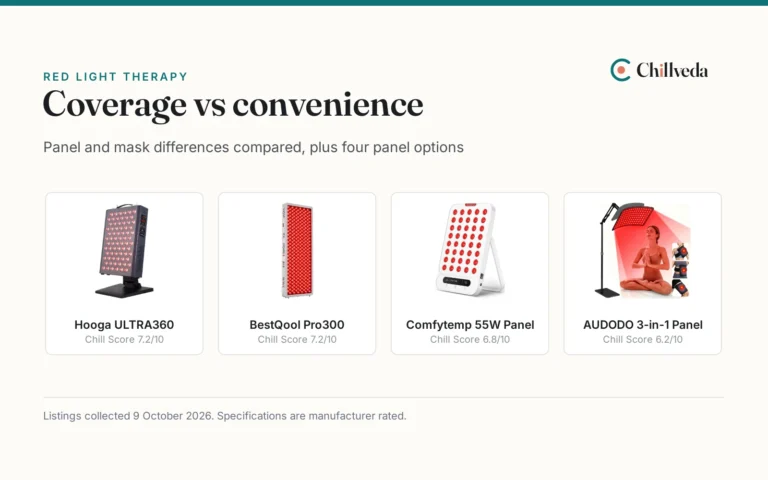
This guide explains how panels and masks differ in stated wattage, irradiance, wavelength selection, and eye safety requirements, followed by four home panels compared from stated manufacturer listings. Listings were collected 9 October 2026.
This article is informational and is not medical advice. Red light and near-infrared devices emit concentrated optical radiation. Always wear appropriate eye protection and never stare directly into active light arrays. Consult a healthcare provider before use if you are pregnant, take photosensitizing medications, or have light-sensitive medical conditions. See our Medical Disclaimer.
Chillveda earns a commission when you buy through links on this page, at no extra cost to you. As an Amazon Associate I earn from qualifying purchases. Affiliate disclosure.
Quick picks
-
1
 Hooga Red Light Therapy Panel Device Chill Score 9.5/10Check price on Amazon
A compact aluminum red light panel featuring 72 quad-chip LEDs across four wavelengths, independent brightness controls, and a stated 3 year warranty.
-
2
 BestQool Red Light Therapy Panel Chill Score 9.5/10Check price on Amazon
A 36.4 inch modular red light panel delivering 470W across four wavelengths with a stated irradiance exceeding 106 mW/cm² at 3 inches.
-
3
 Comfytemp 55W Red Light Therapy Panel for Body Chill Score 9.4/10Check price on Amazon
A portable 55W dual-wavelength panel with 40 dual-chip LEDs, an integrated 180 degree stand, and a stated irradiance of 159 mW/cm² at 6 inches.
-
4
 Red Light Therapy for Body Face Chill Score 9.3/10Check price on Amazon
A dual-wavelength light therapy system with a 19.3 by 11.6 inch panel, detachable wrap pad, floor stand, desktop stand, and included goggles.

A compact aluminum red light panel featuring 72 quad-chip LEDs across four wavelengths, independent brightness controls, and a stated 3 year warranty.
Pros & ConsViewHide
Pros
- Stated 3 year manufacturer warranty
- Four wavelengths from 72 quad-chip LEDs
- Independent brightness controls for red and near-infrared light
- Durable aluminum construction with pulley and door mounts
Cons
- Spec table contradicts title by listing wattage as 5 milliwatts
- Spec table lists dimensions for a different 69 inch model
- No irradiance figure stated in the listing
- No safety certifications stated

A 36.4 inch modular red light panel delivering 470W across four wavelengths with a stated irradiance exceeding 106 mW/cm² at 3 inches.
Pros & ConsViewHide
Pros
- High stated power of 470W with 300 dual-chip LEDs
- Four stated wavelengths: 630nm, 660nm, 850nm, and 940nm
- Stated irradiance exceeding 106 mW/cm² at 3 inches
- Modular design can connect multiple panels
Cons
- No warranty term is stated
- Heavy unit at 19.18 pounds
- No safety certifications stated
- Large 36.4 inch frame requires dedicated floor or stand space

A portable 55W dual-wavelength panel with 40 dual-chip LEDs, an integrated 180 degree stand, and a stated irradiance of 159 mW/cm² at 6 inches.
Pros & ConsViewHide
Pros
- Stated irradiance of 159 mW/cm² at 6 inches
- Lightweight at 1.59 pounds with built-in 180 degree stand
- Stated 55W peak power output with 40 dual-chip LEDs
- Four operating modes and integrated timer
Cons
- No warranty term is stated
- Covers only two wavelengths: 660nm and 850nm
- Compact 10.3 by 6.7 inch panel covers limited surface area
- No safety certifications stated

A dual-wavelength light therapy system with a 19.3 by 11.6 inch panel, detachable wrap pad, floor stand, desktop stand, and included goggles.
Pros & ConsViewHide
Pros
- Includes both floor stand and desktop stand
- Detachable light pad with extension strap for targeted wrapping
- Large 19.3 by 11.6 inch panel surface
- Includes eye protection goggles and controller
Cons
- No wattage or irradiance figures stated
- No LED count stated in the listing
- No warranty term is stated
- Covers only two wavelengths with no safety certifications
More to compare
 Red Light Therapy PanelCheck price on Amazon
 BestQool Red Light Therapy Panel for BodyCheck price on Amazon
 Red Light Therapy Panel for Face andCheck price on Amazon
 LED-Red-Light-Therapy-DeviceCheck price on Amazon
 45W Red LED Light Therapy PanelCheck price on Amazon
 BestQool Red Light Therapy PanelCheck price on Amazon
Red light therapy panel vs mask: key differences compared
| Feature | Red light therapy panel | Red light therapy mask |
|---|---|---|
| Primary treatment zone | Face, neck, chest, back, and limbs | Face only |
| Skin contact | Positioned at a distance (select models include wrap pads) | Direct contact with facial skin |
| Power connection | Corded electric wall plug | Low-voltage rechargeable battery or USB cord |
| Stated power output | Corded wall power (from 55W to 470W on models with stated wattage) | Low-voltage battery power |
| Stated wavelengths | Two to four wavelengths (from 630nm to 940nm across models) | Red and near-infrared bands |
| Session mobility | Stationary setup in front of panel | Hands-free convenience while resting |
| Eye protection | Dedicated opaque goggles required | Built-in eye shields or cutouts (goggles still advised) |
| Housing design | Rigid metal or composite frame | Flexible silicone |
As the table demonstrates, the mechanical differences dictate how each device fits into your routine. A panel uses high-output LEDs mounted in a rigid frame, with listings in this guide stating power figures from 55W up to 470W on models that publish electrical wattage. That power allows you to sit back while bathing broad body areas in red and near-infrared light. While most panels are designed to deliver light across a distance from a stand or wall mount, versatile kits like the AUDODO also include detachable wrap pads for localized contact. For shoppers comparing wearable facial options, our guide to the best red light therapy masks compares facial models.
A mask trades that raw optical power for physical contact. Because flexible silicone rests directly against facial skin, light does not have to travel through the air, minimizing light scatter. Masks are battery powered and lightweight, making them easy to wear while resting or relaxing in a chair. However, a standard facial mask cannot treat sore shoulders, knees, or lower back areas.
Power output and stated irradiance
Electrical power is where panels and masks diverge most sharply. A face mask operates on a low-voltage battery pack, while home panels draw substantial power to drive dozens or hundreds of diodes. The BestQool Pro300 lists a stated power output of 470W across 300 dual-chip LEDs, while the compact Comfytemp lists 55W across 40 dual-chip LEDs. This extra electrical capacity allows panels to project light across greater surface areas without resting directly on the skin.
Irradiance measures optical energy reaching a target surface, expressed in milliwatts per square centimeter. Panel makers publish irradiance measured at specific distances: Comfytemp advertises an irradiance of 159 mW/cm² at 6 inches, with its listing claiming a 10-minute session equals 20 mins on standard output devices. BestQool advertises an irradiance exceeding 106 mW/cm² at a 3-inch distance. Wearable masks rarely publish distance-based irradiance because the diodes rest directly against the skin. Learn how to interpret manufacturer specifications in our guide on how to read a red light irradiance number.
Wavelengths: facial routines versus full-body sessions
Both panels and masks focus on two core spectral bands: visible red light and near-infrared light. Across the listings analyzed here, manufacturers specify visible red wavelengths at 630nm and 660nm, alongside near-infrared wavelengths at 810nm, 850nm, and 940nm. Visible red light is easily seen by the human eye and targets superficial skin layers, while near-infrared wavelengths sit at the edge of or beyond human vision and penetrate into deeper tissues. Our guide on red light wavelengths explained covers how these bands behave.
Select panels offer granular control over individual spectral bands. For example, Hooga’s ULTRA360 features independent dimming adjustments, allowing users to tune red and near-infrared outputs separately across its 72 quad-chip LEDs, while Comfytemp provides 4 selectable operating modes. Many wearable masks, by contrast, run fixed preset programs that activate both red and near-infrared diodes simultaneously.
Eye protection requirements and FDA clearance rules
Eye safety is an essential practical distinction. High-output panels produce powerful light arrays. When sitting in front of a panel, wear opaque protective goggles to prevent direct exposure to your retinas. While masks incorporate built-in eye rings or cutouts, closing your eyes and adding protective eye covers beneath the silicone shield remains the safest approach during facial sessions.
Be cautious with regulatory claims on product listings. An FDA establishment registration simply confirms a business registered its facility with the agency. It does not evaluate device safety or performance. Genuine medical clearance requires official premarket clearance from the agency. See our analysis on FDA clearance rules to understand what these terms mean.
Red light therapy panels worth considering
These four panels are scored using our standardized Chill Score, which evaluates performance across 35 points, build quality across 25 points, value across 25 points, safety certifications across 10 points where it applies, and stated warranty terms across 5 points. Because none of these four listings state recognized UL or ETL electrical safety certifications, all four score zero for safety.
| Product | Chill Score | Perf. /35 | Build /25 | Value /25 | Safety /10 | Warranty /5 |
|---|---|---|---|---|---|---|
| Hooga ULTRA360 | 9.5 | 28 | 20 | 20 | 0 | 4 |
| BestQool Pro300 | 9.5 | 32 | 22 | 21 | 0 | 0 |
| Comfytemp 55W Panel | 9.4 | 28 | 20 | 20 | 0 | 0 |
| AUDODO 3-in-1 Panel | 9.3 | 24 | 19 | 19 | 0 | 0 |
Scores run from 9.2 to 9.8: each product’s point total is placed on that range, so more points always means a higher score.
If you decide a panel is right for your space and want larger coverage, check our roundup of the best full body red light panels for tall modular setups.
Choosing between a panel and a mask in practice
- Define your treatment goals. If your sole priority is facial skin care, a mask provides a hands-free routine you can maintain while resting comfortably.
- Consider multi-area use. If you also want light exposure on your neck, shoulders, lower back, or joints, a panel or modular kit is far more adaptable because a standard facial mask cannot contour to broad muscle groups.
- Evaluate room setup and storage. Panels like the BestQool Pro300 weigh 19.18 pounds and measure 36.4 inches tall, requiring tabletop or floor space, whereas flexible silicone masks roll up into a drawer or travel bag.
- Account for eye protection routines. Facing an active panel directly requires wearing opaque protective goggles throughout the session. While masks feature molded eye sockets to reduce direct glare, closing your eyes and using protective inserts remains recommended during facial light therapy.
- Check electrical capacity. High-output panels like the 470W BestQool plug into standard household wall outlets without requiring dedicated wiring upgrades.
Common mistakes to avoid
- Assuming a facial mask can flex to treat broad back or shoulder areas.
- Skipping protective goggles when sitting directly in front of an active panel.
- Staring directly into active near-infrared diodes because they look faint or unlit to the human eye.
- Confusing simple FDA establishment registration with official medical clearance.
- Overlooking contradictions between listing titles and specification tables.
Common questions
Can a red light therapy panel replace a face mask?
Yes, for facial coverage. A panel delivers red and near-infrared light to the entire face at once while positioned on a stand or desk. You lose the hands-free mobility of a strap-on mask, but you gain higher power output and the ability to direct light toward your neck, chest, and body.
Do I need eye protection with a panel or a mask?
Always wear protective goggles when facing a high-output red light panel directly. High-output panels emit concentrated optical radiation that should not shine unprotected into open eyes. Masks typically feature built-in silicone eye rings or cutouts, but keeping your eyes closed or using additional eye shields remains strongly advisable for all users.
Why are panels rated for higher wattage than masks?
Panels connect directly to standard household wall outlets and power dozens or hundreds of LEDs across a large frame. Masks rely on compact rechargeable batteries or USB cables to stay lightweight and safe against bare skin. That electrical difference allows panels to deliver high irradiance from several inches away.
Is a red light mask or panel better for travel?
A flexible silicone mask is easier to pack for travel because it folds flat into luggage and adds minimal weight. Small panels like the Comfytemp weigh 1.59 pounds and can fit in a carry-on bag, but larger units like the BestQool Pro300 weigh 19.18 pounds and require a fixed home setup.
Can I use near-infrared light on my face?
Many panels and masks combine near-infrared wavelengths with visible red light. Near-infrared light falls mostly outside normal human visual perception, appearing only as a faint glow or completely unlit depending on the specific wavelength, while penetrating deeper into body tissue than visible red light. If you prefer visible red light alone for facial sessions, choose a panel with independent wavelength controls.
Sources: Amazon product listings for the panels named above, collected 9 October 2026. Related: our best targeted red light devices and FDA clearance facts.
Back to all red light therapy reviews.