Short answer
What is the main difference between an infrared sauna and a steam room?
An infrared sauna uses dry radiant light waves to warm the body directly without creating humidity. A steam room or steam tent boils water in a generator, releasing hot vapor to create high humidity. The choice depends on whether you prefer dry air or moist heat.
An infrared sauna uses dry radiant heat to warm your body directly, while a steam room relies on an external steam generator to boil water and fill an enclosed space with hot moisture. In permanent installations, infrared cabins use ceramic or carbon panels, whereas traditional steam rooms use dedicated plumbing and tiled walls. In home portable gear, manufacturers adapt these principles using reflective folding cabins or fabric steam enclosures powered by standalone boilers. Choosing between an infrared sauna and a steam room comes down to whether you prefer dry warmth that warms skin directly or moist heat produced by boiling water.
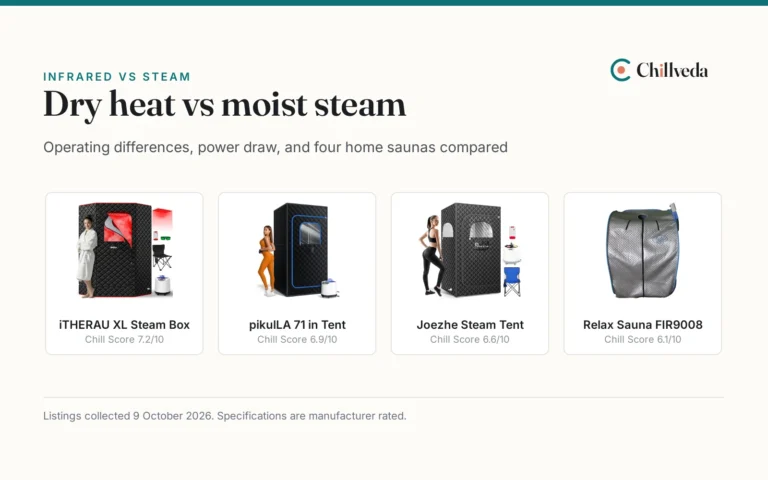
This guide explains the operating differences between dry infrared heat and moist steam, space and installation considerations, and four home steam and infrared enclosures compared on checkable listing specifications. Listings were collected 9 October 2026.
This article is informational and is not medical advice. Heat exposure strains the heart and causes fluid loss. Do not use a sauna after alcohol, when pregnant, when unwell, or with a heart condition or low blood pressure without asking a clinician first. Leave at once if you feel dizzy, sick or confused. Verify electrical safety and GFCI protection before operation. See our Medical Disclaimer.
Chillveda earns a commission when you buy through links on this page, at no extra cost to you. As an Amazon Associate I earn from qualifying purchases. Affiliate disclosure.
Quick picks
-
1
 I-THERA-U XL Infrared Sauna Box with True 660 Chill Score 9.5/10Check price on Amazon
A 73 inch tall pentagonal steam tent with a 1200W 3L steam generator and an integrated 660nm and 850nm light panel.
-
2
 pikulLA Portable Steam Sauna, 71 in Sauna Tent Chill Score 9.4/10Check price on Amazon
A 71 inch tall portable steam sauna tent powered by a 1200W 3L boiler with 15 heat levels and automatic shut-off protection.
-
3
 Portable Steam Sauna Tent for Home Chill Score 9.4/10Check price on Amazon
A full body portable steam enclosure with a 1200W 3L steamer rated up to 140 F and a 95 minute remote timer.
-
4
 Portable Far Infrared Sauna in Silver Chill Score 9.3/10Check price on Amazon
A 26 pound personal far infrared sauna tent featuring semiconductor emitters that produce 7 to 14 micron wavelengths.
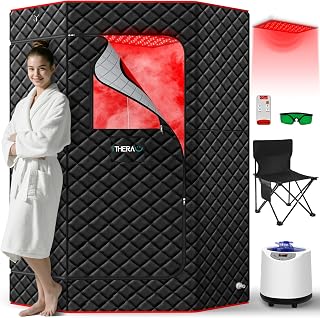
A 73 inch tall pentagonal steam tent with a 1200W 3L steam generator and an integrated 660nm and 850nm light panel.
Pros & ConsViewHide
Pros
- Combines 1200W steam boiler with 660nm and 850nm light lamp
- Spacious pentagonal cabin measures 45 by 35 by 73 inches
- Steamer features 304 stainless steel tank and 15 heat settings
- Timer adjustable from 1 to 90 minutes with remote control
Cons
- No warranty term is stated
- Listing labels a steam tent as an infrared sauna box
- Heaviest steam enclosure in this group at 20.1 pounds
- Requires battery for remote control
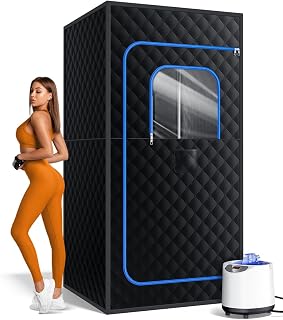
A 71 inch tall portable steam sauna tent powered by a 1200W 3L boiler with 15 heat levels and automatic shut-off protection.
Pros & ConsViewHide
Pros
- Tall 71 inch cabin fits users up to 6 ft 3 in
- 1200W 3L steamer includes 15 heat levels and remote control
- Steamer features automatic shut-off and boil-dry protection
- Includes foldable chair and storage-friendly frame
Cons
- No warranty term is stated
- No maximum operating temperature stated in degrees
- No independent electrical safety certification listed
- Single color option sky blue black listed

A full body portable steam enclosure with a 1200W 3L steamer rated up to 140 F and a 95 minute remote timer.
Pros & ConsViewHide
Pros
- 1200W 3L steamer reaches stated temperatures up to 140 F
- Steam production begins in approximately 10 to 15 minutes
- Timer adjusts from 45 up to 95 minutes via remote control
- Lightest steam enclosure here at 16.46 pounds
Cons
- No warranty term is stated
- Bullet dimensions conflict with spec table measurements
- No automatic shut-off feature stated in bullets
- No independent electrical safety certification listed

A 26 pound personal far infrared sauna tent featuring semiconductor emitters that produce 7 to 14 micron wavelengths.
Pros & ConsViewHide
Pros
- Semiconductor emitters produce 7 to 14 micron far infrared wavelengths
- Silver reflective exterior with folding frame
- Pure far infrared design without boiling water or humidity
- Compact footprint measuring 31.5 by 31.5 inches
Cons
- No warranty term is stated
- No operating wattage or temperature range stated in listing
- Shortest enclosure here at 45.28 inches height for seated use only
- Heaviest unit in this group at 26 pounds
More to compare
 Portable Steam Sauna at HomeCheck price on Amazon
 Infrared Sauna Blanket for Relaxation & Self-CareCheck price on Amazon
 Portable Sauna for Home with 3L 1200W SteamerCheck price on Amazon
 MIXC Upgraded Low EMF Infrared Sauna BoxCheck price on Amazon
 Portable Personal Far Infrared Sauna Box for Home with 660nmCheck price on Amazon
 Portable Infrared Home Steam Sauna Box with 660nm 850nm RedCheck price on Amazon
Infrared sauna vs steam room: comparing maker specifications
| Product type | Model | Heating mechanism | Stated power and capacity | Stated temperature |
|---|---|---|---|---|
| Portable far-infrared tent | Relax Sauna FIR9008 | 7 to 14 micron semiconductor emitters | Wattage not stated | Not stated |
| Portable steam tent | pikulLA TY-XZ07 | 1200W steam generator | 3L reservoir, 15 heat levels | Not stated |
| Portable steam tent | Joezhe SAUNA2025001 | 1200W steam generator | 3L reservoir, 10 to 15 min warm up | Generator reaches up to 140 F |
| Hybrid steam and light tent | iTHERAU SAUNA-R | 1200W steamer, 660nm and 850nm light panel | 3L reservoir, 15 heat levels | Not stated |
The fundamental distinction between an infrared sauna and a steam room is how heat is created and transferred to your body. In an infrared sauna, heating elements emit radiant energy that warms skin tissue directly without requiring high ambient humidity. In contrast, a steam room or steam tent relies on a dedicated boiler to turn water into vapor, filling the enclosure with dense humidity. If you want to compare dry cabins to traditional stove-heated rooms, see our infrared vs traditional sauna guide.
Dry radiant heat versus moist steam
Radiant heat and moist steam create very different physical sensations. Far-infrared emitters, such as the 7 to 14 micron semiconductor emitters on the Relax Sauna, warm the body directly through electromagnetic radiation. Because moisture is absent, your sweat evaporates more readily, and the surrounding air feels light and dry.
Steam enclosures operate on an entirely different principle. In the portable steam units evaluated here, a 1200W boiler heats 3L of water until steam flows through a connecting hose into the sealed cabin. The air becomes saturated with warm vapor, causing condensation on your skin and the interior fabric. For people who dislike dry air, moist steam provides a completely different experience. However, cleanup requires draining residual water from the boiler tank and thoroughly drying the enclosure interior after each session to prevent mildew.
Installation and space requirements
Operating a home sauna or steam generator requires careful attention to electrical load and physical space. Portable steam units in this guide feature 1200W heating elements. A 1200W appliance draws substantial electrical load on a household circuit, making circuit capacity and direct wall outlet access essential practical considerations.
Floor space and vertical clearance are equally critical factors. The Relax Sauna occupies a compact footprint of 31.5 by 31.5 inches with a height of 45.28 inches, designed strictly for seated use in tighter rooms. Full-height steam tents demand substantially more room. The pikulLA tent measures 36 by 36 by 71 inches to accommodate users up to 6 feet 3 inches, while the Joezhe enclosure measures 68.5 by 39.7 by 30.3 inches and the iTHERAU pentagonal design occupies 45 by 35 by 73 inches, claiming 20 percent more interior space than standard enclosures.
Home steam and infrared saunas compared
These products are scored on the Chill Score, which weighs performance 35, build 25, value 25, safety certifications 10 where it applies and warranty 5. None of these four listings document an independent UL, ETL or equivalent electrical safety certification, nor do they state a concrete warranty duration, so all four score 0 for safety and warranty.
| Product | Chill Score | Perf. /35 | Build /25 | Value /25 | Safety /10 | Warranty /5 |
|---|---|---|---|---|---|---|
| iTHERAU XL Steam Box | 9.5 | 29 | 21 | 21 | 0 | 0 |
| pikulLA 71 in Tent | 9.4 | 28 | 20 | 21 | 0 | 0 |
| Joezhe Steam Tent | 9.4 | 27 | 19 | 20 | 0 | 0 |
| Relax Sauna FIR9008 | 9.3 | 24 | 19 | 18 | 0 | 0 |
Scores run from 9.2 to 9.8: each product’s point total is placed on that range, so more points always means a higher score.
For more dedicated steam options, explore our best portable steam saunas roundup, or check our guide to best portable infrared saunas for dry heat alternatives.
Choosing between infrared and steam
- Assess your tolerance for humidity. If you dislike humid air or heavy condensation, choose infrared. If you prefer high-humidity warmth, select steam.
- Consider cleanup and maintenance time. An infrared tent requires wiping down perspiration from the seat and interior after use. A portable steam tent requires emptying the water boiler, venting the cabin, and drying interior surfaces after every session.
- Check standing versus seated preference. Portable infrared tents like the Relax Sauna stand 45.28 inches tall for seated use. Taller steam tents like the pikulLA reach 71 inches and iTHERAU reaches 73 inches, offering standing clearance for taller users.
- Verify timer settings before use. Steamer timers range from 45 to 95 minutes on Joezhe and 1 to 90 minutes on iTHERAU. Because sessions should be kept moderate, users should exit and turn off the unit manually rather than remaining inside for extended timer durations.
Common mistakes
- Leaving water inside the steam generator between sessions, which encourages mineral scale build-up in the stainless steel tank.
- Confusing near-infrared light therapy lamps with far-infrared heating panels when evaluating hybrid tent listings.
- Placing a steam tent on unsealed wood floors without a protective waterproof mat underneath.
- Operating a 1200W heating appliance on an overloaded circuit alongside other high-draw household devices.
- Assuming uncertified home wellness equipment carries independent UL or ETL safety listings.
Common questions
What is the main difference between an infrared sauna and a steam room?
An infrared sauna uses dry radiant light waves to warm the body directly without creating humidity. A steam room or steam tent boils water in a generator, releasing hot vapor to create high humidity. The choice depends on whether you prefer dry air or moist heat.
Does an infrared sauna get as hot as a steam room?
They heat the body through entirely different mechanisms. An infrared sauna uses radiant energy that warms the body directly in dry air, allowing perspiration to evaporate. A steam room relies on moisture-saturated air from boiling water; because humidity limits sweat evaporation, moist steam feels intensely hot even when air temperatures remain moderate. In our dataset, only the Joezhe listing publishes a temperature figure, stating its steam generator reaches up to 140 F.
How much power does a portable steam sauna consume?
The portable steam saunas evaluated here feature 1200W heating elements to boil water in their 3L reservoirs. High-draw 1200W heating units draw substantial current and should be connected directly to an appropriate wall outlet. Consult your device manual and electrical panel before running high-wattage wellness equipment.
Which is easier to maintain, an infrared sauna or a steam tent?
An infrared sauna is significantly easier to clean and maintain. Because infrared creates dry heat, you only need to towel off perspiration from the seat and interior surfaces. A steam sauna requires emptying the water reservoir, clearing moisture, and airing out the enclosure to prevent mildew.
Can you combine infrared and steam in one unit?
Certain portable tents, such as the iTHERAU XL, attempt a hybrid setup by adding overhead 660nm and 850nm light therapy lamps inside a steam enclosure. However, the heat in these units comes entirely from a 1200W steam boiler rather than far-infrared thermal panels. True far-infrared cabins remain dry environments.
Sources: Amazon product listings for the steam generators and infrared saunas named above, collected 9 October 2026. Related: see our home sauna running cost analysis and our infrared vs traditional sauna comparison.
Back to all sauna reviews.