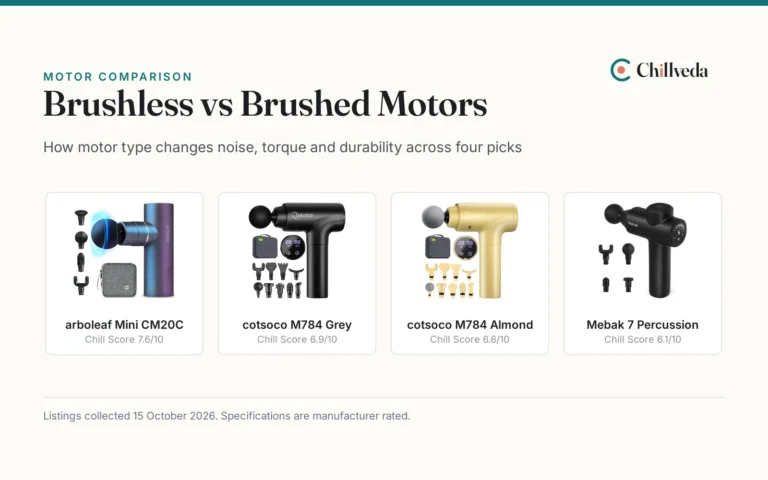
When you sit down on the living room rug after an evening workout to work out tightness in your calves, choosing between a brushless motor vs brushed motor massage gun comes down to noise, motor lifespan, and stall resistance. A brushless motor massage gun uses electronic commutation rather than physical carbon brushes, which reduces friction, lowers operating heat, and eliminates brush wear over time. While brushed motors remain common in entry-level massagers due to lower manufacturing costs, brushless motors generally offer better energy efficiency, quieter operation, and greater sustained torque under load.
This guide explains how brushless and brushed motors differ in percussion tools, what manufacturer specifications reveal about noise and torque, and four massage guns compared by motor design. Listings were collected 15 October 2026.
This article is informational and is not medical advice. Percussion tools exert direct force on soft tissue. Do not use a massage gun on the neck, spine, throat, head, major arteries, or acute injuries, and consult a doctor before use if you have circulatory issues, nerve sensitivity, or take blood thinners. Stop at once if you feel sharp pain or numbness. See our Medical Disclaimer.
Chillveda earns a commission when you buy through links on this page, at no extra cost to you. As an Amazon Associate I earn from qualifying purchases. Affiliate disclosure.
Quick picks
-
1
 arboleaf Mini Massage Gun Deep Tissue Chill Score 9.6/10Check price on Amazon
A compact aluminum percussion massager with a quiet brushless motor, 35 pounds of stall force, and 4 silicone heads.
-
2
 cotsoco Massage Gun, Muscle Massage Gun Deep Chill Score 9.4/10Check price on Amazon
A full-sized handheld massager featuring a silent brushless motor, 20 speeds, and a stated 12 mm massage stroke depth.
-
3
 cotsoco Massage Gun Deep Tissue Chill Score 9.4/10Check price on Amazon
An almond-colored percussion massager with a silent brushless motor, 20 speeds, and a 2 hour recharge time.
-
4
 Mebak 7 Deep Tissue Massage Gun Chill Score 9.3/10Check price on Amazon
A 5 speed percussion massage gun with an LED touch screen, 7 mm amplitude, and a 45 to 55 dB quiet motor.

A compact aluminum percussion massager with a quiet brushless motor, 35 pounds of stall force, and 4 silicone heads.
Pros & ConsViewHide
Pros
- Quiet brushless motor rated 35 to 55 dB
- Stall force listed at 35 lbs
- Full-metal aluminum body with silicone heads
- Pressure-responsive adaptive speed mode
Cons
- No warranty term is stated
- Mini handle provides less reach than full-size designs
- No stroke depth or amplitude figure stated
- Recharge time listed at 3 hours

A full-sized handheld massager featuring a silent brushless motor, 20 speeds, and a stated 12 mm massage stroke depth.
Pros & ConsViewHide
Pros
- Brushless motor with noise rated under 40 dB
- Stated 12 mm massage stroke depth
- 20 speed settings reaching up to 3200 RPM
- Includes 9 interchangeable heads and case
Cons
- No warranty term is stated
- Spec table labels form factor as Massage Wand
- No stall force figure stated
- No electrical safety certification listed

An almond-colored percussion massager with a silent brushless motor, 20 speeds, and a 2 hour recharge time.
Pros & ConsViewHide
Pros
- Silent brushless motor stated
- 20 speed levels reaching up to 3200 RPM
- Stated 2 hour charging time with 6 hour battery life
- Includes 9 attachment heads and carrying case
Cons
- No warranty term is stated
- Heavier listed weight of 2.8 pounds (1.27 kg)
- No stall force, amplitude, or decibel number stated
- No electrical safety certification listed

A 5 speed percussion massage gun with an LED touch screen, 7 mm amplitude, and a 45 to 55 dB quiet motor.
Pros & ConsViewHide
Pros
- Stated 7 mm stroke length
- Motor noise rated 45 to 55 dB
- LED touch screen with 5 speed levels
- Lightweight frame at 1.65 lbs (0.75 kg)
Cons
- Listing does not state a brushless motor
- Shorter battery runtime of 120 minutes on highest speed
- Wall charger not included with USB-C cable
- No warranty term is stated
More to compare
 cotsoco Massage Gun Deep TissueCheck price on Amazon
 Medcursor Massage GunCheck price on Amazon
 3-in-1 Massage Gun with Detachable Long HandleCheck price on Amazon
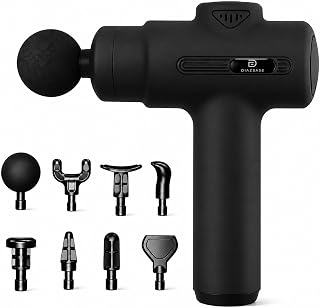 Massage Gun Deep TissueCheck price on Amazon
 Super Mini Massage GunCheck price on Amazon
 Massage GunCheck price on Amazon
Brushless motor vs brushed motor massage gun: key differences
| Motor feature | Brushless motor | Brushed motor |
|---|---|---|
| Internal contact | Electronic commutation, no physical brushes | Carbon brushes contact spinning commutator |
| Acoustic noise | Less mechanical noise; sound is mostly airflow | Additional mechanical noise from brush friction |
| Heat generation | Minimal electrical contact heat; runs cooler | Noticeable heat buildup at commutator interface |
| Energy efficiency | Higher electrical efficiency, lower thermal loss | Lower electrical efficiency; energy lost as heat |
| Wear and maintenance | No wearable brushes; wear limited to bearings | Brushes wear down, reducing motor lifespan |
| Torque under load | Better torque retention under downward pressure | Prone to dropping speed or stalling under load |
The core distinction lies in how electrical current is switched. Traditional brushed motors rely on stationary carbon blocks pressing against a spinning copper commutator to reverse magnetic polarity. Over time, that constant physical rubbing causes mechanical wear, carbon dust buildup, and elevated operating temperatures. Brushless motors replace that mechanical contact with an electronic controller and permanent magnets, eliminating the friction and wear associated with carbon brushes.
Why brushless motors run quieter and last longer
Operating sound is often the first difference you notice in a quiet room. In a brushed motor, the physical contact between carbon brushes and the rotating commutator adds a mechanical whine to the percussive sound. Brushless motors eliminate that contact, meaning the sound you hear comes primarily from the percussive mechanism and air movement. In manufacturer listings, stated noise ratings reflect this: the arboleaf mini lists 35 to 55 dB, while the dark grey cotsoco listing states noise will not exceed 40 dB.
Durability is the second major factor. Carbon brushes are wearable contact items. In heavy percussion use, the rapid vibration and heat degrade brush contacts, eventually causing motor failure or sudden loss of power. A brushless motor has no brushes to wear down, giving the tool a longer operational life. Our how to choose a massage gun guide provides additional details on motor types across different designs.
Noise levels and stall force in everyday use
Percussion tools require sustained torque to reach tight muscle tissue. When you press a massage gun firmly into thick muscle groups like the quadriceps, the motor faces heavy resistance. In brushed motors, increased load causes speed to drop, and the motor can grind to a complete stop.
Brushless motors use electronic feedback loops to monitor rotor position and adjust electrical current dynamically. This delivers consistent torque even under heavy force. In checkable specifications, this capability is measured as stall force. For instance, the arboleaf mini listed below specifies 35 pounds of stall force from its brushless motor, providing resistance against stalling when moderate downward pressure is applied. Our massage gun specs explained guide details how stall force and amplitude interact during recovery sessions.
Energy efficiency also directly impacts battery life and heat dissipation. Because brushed motors lose energy through friction and electrical arcing at the commutator, a greater share of battery power is converted into heat rather than mechanical motion. Brushless designs convert electrical power more efficiently, helping compact devices run cooler during extended sessions. Stated battery life figures among the brushless picks here range from 6 hours on the cotsoco models to 7.5 hours on the arboleaf, though actual duration varies based on the chosen speed and applied pressure.
Massage guns compared by motor design
These are scored on the Chill Score, which weighs performance 35, build 25, value 25, safety certifications 10 where it applies and warranty 5. Because none of these listings carry a recognized electrical safety certification, all four score 0 for safety.
| Product | Chill Score | Perf. /35 | Build /25 | Value /25 | Safety /10 | Warranty /5 |
|---|---|---|---|---|---|---|
| arboleaf Mini CM20C | 9.6 | 32 | 22 | 22 | 0 | 0 |
| cotsoco M784 Grey | 9.4 | 29 | 19 | 21 | 0 | 0 |
| cotsoco M784 Almond | 9.4 | 28 | 18 | 20 | 0 | 0 |
| Mebak 7 Percussion | 9.3 | 26 | 18 | 18 | 0 | 0 |
Scores run from 9.2 to 9.8: each product’s point total is placed on that range, so more points always means a higher score.
For more choices across sizes and formats, see our best mini massage guns guide.
Choosing the right motor in practice
- Look for explicit brushless labeling. If a listing only states “quiet motor” without naming brushless technology, do not assume it has a brushless motor.
- Check the stall force rating. Look for checkable stall force figures, such as the 35 pounds stated on the arboleaf model, to ensure the motor resists stalling when working larger muscle groups.
- Verify stated decibel numbers. Look for listings that specify noise ratings between 35 and 55 dB if you plan to use the massager in shared living spaces.
- Check operating conditions for battery ratings. Listings often state battery life under different conditions, such as average daily use or continuous operation at maximum speed. Check whether runtime numbers reflect low-speed relaxation or high-speed percussion.
- Respect auto-shutoff timers. Handheld massagers frequently include an automatic shutoff feature, such as the 10-minute timers noted on several picks here, to help manage motor heat and battery life.
Common mistakes
- Assuming every quiet massager uses a brushless motor, even when the listing omits motor specifications.
- Pressing down with excessive force on a low torque motor, forcing it to stall and straining internal parts.
- Focusing solely on top speed while overlooking torque, amplitude, and motor durability.
- Assuming high-speed battery runtime will match manufacturer claims based on low-speed operation.
Common questions
What is the main advantage of a brushless motor in a massage gun?
A brushless motor operates without physical carbon brushes rubbing against a commutator. This reduces internal friction and heat generation, resulting in quieter operation, higher energy efficiency, and a longer operational lifespan.
How can you tell if a massage gun has a brushless motor?
Makers almost always highlight brushless motors prominently in the product title, bullet points, or specifications because it is a premium feature. If a listing only mentions a quiet motor without explicitly stating brushless, it likely uses a standard brushed motor.
Does a brushless motor make a massage gun stronger?
Brushless motors generally deliver better torque retention under pressure than comparable brushed motors. While maximum speeds may look similar on paper, a brushless unit maintains its percussion speed more effectively when pressed into muscle tissue.
Are brushed motor massage guns worth buying?
Brushed motor models can serve as entry tools for occasional, light surface massage. However, they tend to generate more mechanical noise, run warmer, and wear down sooner as their physical brushes degrade over time.
Do brushless massage guns require maintenance?
Brushless motors are electronically commutated and sealed, meaning they require no brush replacements or internal lubrication. Basic care involves wiping down exterior attachment heads and keeping the charging port free of dust and moisture.
Sources: Amazon product listings for the massage guns named above, collected 15 October 2026. Related: our how to choose a massage gun and massage gun specs explained.
Back to all massage gun reviews.