


Cold water immersion is not a gentle wellness ritual that happens to be chilly. Dropping into cold water triggers a set of involuntary physiological responses, some of which have killed healthy people. Understanding them is not optional, and it takes about five minutes.
This is the article we would want a friend to read before their first plunge.
This article is informational and is not medical advice. It is not a substitute for advice from a qualified clinician. Please read our full Medical Disclaimer, and speak to your doctor before cold water immersion if you have any health condition, are pregnant, or take any medication.
Talk to a doctor first if any of this applies
This is the part people skip. Please do not.
- Heart condition, arrhythmia, high or low blood pressure, or any history of stroke
- Pregnancy, or possible pregnancy
- Diabetes, a circulatory condition, or reduced sensation in hands or feet
- Epilepsy or any seizure disorder
- Medication affecting blood pressure, heart rate, or thermoregulation
- An implanted medical device
- Recovery from surgery or an acute injury
The list is not exhaustive. Cold immersion raises heart rate and blood pressure sharply within seconds. If you are unsure whether that is safe for you, that uncertainty is itself the reason to ask.
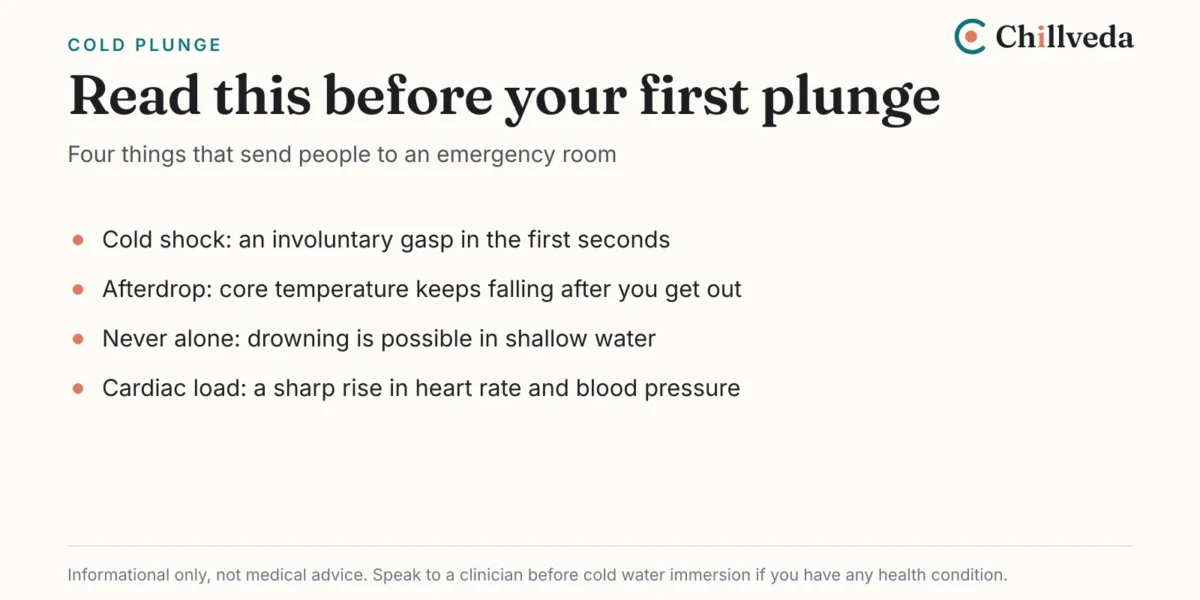
The four things to understand
1. Cold shock
In the first seconds of immersion, cold water triggers an involuntary gasp followed by rapid, uncontrolled breathing. You cannot decide not to do this, and the first time is the worst.
If your face or mouth goes under while that gasp happens, you inhale water. This is the mechanism behind a great many cold water drownings, and it is why the standard advice is to enter slowly, keep your head above water, and get your breathing under control before you do anything else.
2. Afterdrop
Your core temperature does not stop falling when you get out. Cold blood from your limbs continues circulating back toward your core for some minutes afterward, so you can feel colder, and be colder, ten minutes after the plunge than during it.
This is why the minutes after matter. Dry off, put clothes on, move gently, and warm up gradually. It is also why a very hot shower immediately afterward is a poor idea: rapid rewarming of the skin sends more cold blood inward at once.
3. Never plunge alone
The two risks above combine badly with solitude. Drowning is possible in a tub you could stand up in, if a gasp reflex or a faint happens at the wrong moment. Have somebody present, or at minimum within earshot and aware of what you are doing.
This applies to a garden tub at home just as much as to open water.
4. Cardiac load
The cold pressor response raises heart rate and blood pressure quickly. For a healthy person this is generally tolerated. For someone with undiagnosed cardiovascular disease, it is a meaningful stress applied without warning. This is the single strongest reason for the medical conversation above.
Sensible practice for a first session
Start warmer than the internet suggests. There is nothing to be gained from beginning at the lowest temperature your chiller will reach. Many people start somewhere in the fifties Fahrenheit and work down over weeks.
Keep the first session short. Get in, get your breathing under control, and get out. Duration can come later, and it should come slowly.
Enter gradually rather than jumping. Let the gasp reflex happen while you are stable and your head is well clear of the water.
Never combine cold immersion with alcohol, and do not plunge when you are already exhausted or unwell.
Get out if anything feels wrong. Numbness that becomes painful, loss of coordination, confusion, or chest discomfort all mean the session is over.
Things not to do
- Do not put your head under, and do not hold your breath deliberately underwater. Both add drowning risk to a situation that already has some.
- Do not chase a number. Colder and longer is not better, and the competitive framing that surrounds this practice online has no safety basis.
- Do not plunge as a way to push through illness or heavy fatigue.
- Do not use a cold plunge to treat a medical condition. It is not a treatment, and nothing on this site says otherwise.
On what cold plunging does
You will read that cold immersion burns fat, boosts immunity, reduces inflammation, or raises testosterone. Chillveda does not make those claims and does not endorse them when a seller makes them.
Research on cold water immersion exists, it is genuinely interesting, and it is also smaller and more limited than the marketing implies. A finding in a study is not a promise about a specific tub, and it is not a promise about you. Our How We Review page explains how we handle this.
People plunge because they like how they feel afterward. That is a perfectly good reason and it needs no medical justification.
Equipment safety
A chiller is a mains powered appliance next to a tub of water. Ground fault protection is required, and the electrical installation should be done by a licensed electrician. Keep the unit’s air intake clear, and keep cords out of the water and off the ground where they can sit in a puddle.
Keep the tub covered and secured when not in use, particularly around children. A cold plunge is an open body of water in your home.
If you are still deciding
Cold showers cost nothing and carry far less risk. If you want to know whether you actually enjoy cold exposure before buying equipment, start there for a few weeks. Our cold plunge coverage is here when you are ready, along with what the water care and the running costs really involve.



Write Your Review
No reviews yet. Be the first to share your experience!