


Nobody buys a cold plunge because they want a second job. But a tub of water you sit in repeatedly, at a temperature that does not kill much of anything, is a maintenance commitment, and the people who quit usually quit over the water rather than the cold.
This guide sets out what the routine actually involves, how often each task comes around, and what the equipment does or does not do for you.
This article is informational and is not medical advice. Cold water immersion carries real risks. Please read our Medical Disclaimer and our guide to cold plunge safety before your first session.
Why cold water is not self cleaning
Cold slows bacterial growth. It does not stop it, and it does nothing at all about the skin oils, sweat, hair, and dead skin that every bather leaves behind. Those organics are what cloud the water, feed biofilm on the walls, and clog a filter.
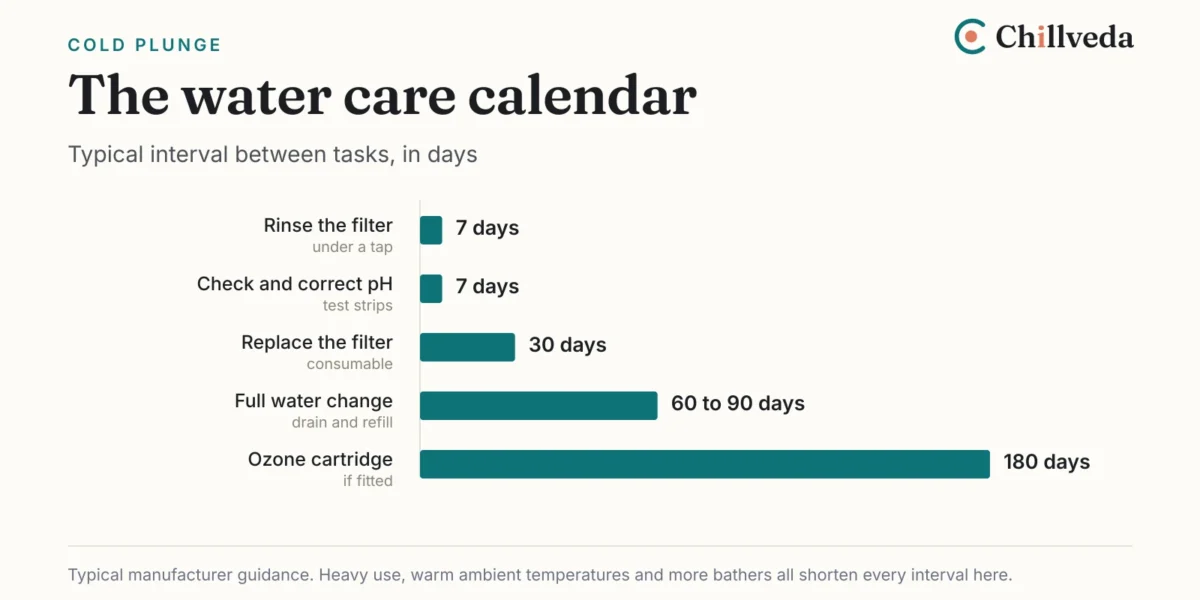
A hot tub runs at a temperature where sanitizer works quickly and predictably. A cold plunge sits in an awkward middle: warm enough for growth over days, cold enough that chemistry works slowly. That combination is why the cadence in the chart above matters more than the specific product you put in the water.
The three things that actually keep water clear
Filtration
The pump and filter do the mechanical work of pulling particles out. A cartridge filter needs rinsing under a tap roughly weekly with regular use, and replacing roughly monthly. These are consumables, and the cost of them belongs in your first year budget alongside the tub.
Run the circulation pump more than you think. Water that sits still stratifies and stagnates. Most units are designed for the pump to run continuously or on a long daily schedule.
Sanitizer
Something has to deal with what filtration cannot. The common options are chlorine or bromine in small doses, ozone systems, and ultraviolet. Ozone and UV reduce how much chemical you need but do not replace it entirely, because neither leaves a residual in the water between cycles.
Follow the manufacturer’s guidance for your specific tub. Dosing a cold plunge like a hot tub is a common error and it is the wrong direction: less water volume and lower temperature change the arithmetic.
pH
Sanitizer stops working properly when pH drifts. Test strips are inexpensive and the check takes fifteen seconds. Doing it weekly is the difference between a system that works and one where you wonder why the chlorine is not doing anything.
The routine, realistically
Weekly: rinse the filter, check pH and sanitizer, wipe the waterline where biofilm starts.
Monthly: replace the filter cartridge, inspect seals and the chiller’s air intake for dust, check that the pump is moving water at the rate it should.
Every two to three months: drain, clean the shell, and refill. This interval shortens with more bathers, warmer ambient temperatures, and heavier use. If the water looks or smells wrong before then, change it rather than adding more chemical.
Twice a year: replace the ozone cartridge if your unit has one, and give the chiller’s condenser coil a proper clean. A dust-choked coil makes the chiller work harder, which shows up directly on your electricity bill. We cover that in what a cold plunge costs to run.
The habit that cuts the work in half
Rinse before you get in.
Most of what fouls the water arrives on the bather. A thirty second shower, or even a rinse with a hose, removes the majority of the skin oils, lotions, and sweat before they reach the tub. Households that do this consistently go noticeably longer between water changes than households that do not, and it costs nothing.
The other free habit is a cover. Keeping the tub covered keeps out leaves, insects, dust, and sunlight, and it also reduces the heat the chiller has to fight, which saves electricity at the same time.
What the equipment does not do
A chiller cools water. It does not clean it. Some units bundle filtration and ozone, many do not, and the marketing rarely makes the distinction obvious. Read the specification for what is actually included before you assume your unit sanitizes anything.
Ozone and UV are labelled by manufacturers with various performance figures. Treat those as manufacturer rated, since there is no common method behind them, and do not use them as a reason to skip the basics. Our chiller and filtration coverage goes into what to look for.
Who should skip an open tub
If you will not commit to a weekly fifteen minute routine, buy an inflatable tub you drain and refill after every use instead. It is more work per session and less work overall, and you never have to think about chemistry.
If your tub lives outdoors in a hot climate with no shade, understand that you are signing up for the short end of every interval above, and a chiller that runs hard. Shade and a cover change that materially.
And if multiple people use it daily, halve every interval in the chart. The load on the water scales with bathers, not with time.
A note on safety
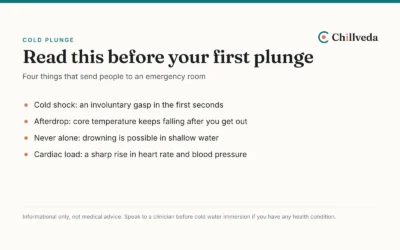
Never plunge alone, and be aware that cold shock and afterdrop are real. Chillers and pumps are mains powered equipment sitting next to a tub of water, so ground fault protection is not optional. Have any electrical work done by a licensed electrician.







Write Your Review
No reviews yet. Be the first to share your experience!