
Short answer
Is a dry sauna hotter than a wet sauna?
It depends on the sauna type and how heat is transferred. Traditional dry saunas run at higher air temperatures than wet steam rooms, while far infrared dry cabins operate at moderate temperatures, with listings stating maximums up to 140 F or 149 F. Wet saunas feel intensely hot at lower air temperatures because saturated air prevents sweat evaporation, keeping warmth trapped against the body.
Stepping into a warm wellness space after a long workday depends on the room you have available, the electrical outlet on your wall, and the type of heat you prefer. When comparing dry sauna vs wet sauna options, the fundamental difference is humidity. Traditional dry saunas and infrared cabins operate with low air moisture, allowing sweat to evaporate and help regulate body temperature. Wet saunas and steam rooms maintain air saturated with water vapor at lower ambient temperatures, where high humidity halts sweat evaporation to create an enveloping sensation of heat. Choosing between them comes down to whether your space can handle permanent plumbing and waterproof drainage, or if a dry plug-in cabin or tent suits your home routine.
This guide compares humidity mechanics, installation challenges, and daily operating needs between dry and wet spaces, and reviews four dry home saunas to help you decide which setup fits your routine. Listings were collected 13 October 2026.
This article is informational and is not medical advice. Heat exposure strains the heart and causes fluid loss. Do not use a sauna after alcohol, when pregnant, when unwell, or with a heart condition or low blood pressure without asking a clinician first. Leave at once if you feel dizzy, sick or confused. See our Medical Disclaimer.
Chillveda earns a commission when you buy through links on this page, at no extra cost to you. As an Amazon Associate I earn from qualifying purchases. Affiliate disclosure.
Quick picks
-
1
 1 Person Infrared Sauna for Home Chill Score 9.6/10Check price on Amazon
A 1-person Canadian Hemlock far infrared cabin rated at 1200W on 110V, featuring 5 heating panels, Bluetooth speakers, and a 3-year warranty.
-
2
 OUTEXER Infrared Sauna Home Sauna Spa Room Chilean Chill Score 9.6/10Check price on Amazon
A Chilean Pine far infrared sauna room drawing 1200W on 120V with 6 carbon panels, an independent footplate, and a 7-year service term.
-
3
 1 Person Far Infrared Sauna for Home Chill Score 9.4/10Check price on Amazon
A 1-person Canadian Hemlock cabin reaching up to 140 F, listing 1200W in its title alongside a 1350W power reference in its bullets.
-
4
 MIXC Upgraded Low EMF Infrared Sauna Box Chill Score 9.3/10Check price on Amazon
A portable far infrared sauna tent with a detachable stainless steel frame, 3 carbon crystal panels, and an included folding chair.

A 1-person Canadian Hemlock far infrared cabin rated at 1200W on 110V, featuring 5 heating panels, Bluetooth speakers, and a 3-year warranty.
Pros & ConsViewHide
Pros
- Canadian Hemlock wood cabin with 32 x 34 x 67 inch footprint
- 1200W far infrared system with 5 heating panels on 110V
- Built-in 7-color ambient lighting and Bluetooth speakers
- Stated 3-year warranty and after-sales support
Cons
- No safety certification such as UL or ETL stated
- Item weight is not stated in the listing
- Single-person capacity only
- Requires indoor assembly of modular panels

A Chilean Pine far infrared sauna room drawing 1200W on 120V with 6 carbon panels, an independent footplate, and a 7-year service term.
Pros & ConsViewHide
Pros
- Natural Chilean Pine construction with tempered glass
- 6 carbon heating panels plus independently controlled footplate
- Adjustable temperature range from 68 to 149 F
- Stated 7-year after-sales service term
Cons
- Exterior product dimensions not stated in the listing
- No UL or ETL safety certification listed
- Substantial 145-pound listed weight requires help to move
- Water-based finish on seating requires gentle towel cleanup

A 1-person Canadian Hemlock cabin reaching up to 140 F, listing 1200W in its title alongside a 1350W power reference in its bullets.
Pros & ConsViewHide
Pros
- Canadian Hemlock wood cabin sized at 32 x 34 x 67 inches
- Stated maximum temperature of 140 F
- Low EMF far infrared design with carbon fiber heating elements
- Standard 110V plug compatibility for home spaces
Cons
- Listing contradicts itself between 1200W title and 1350W bullets
- No warranty term stated
- Item weight omitted from the spec table
- No independent electrical safety certification listed

A portable far infrared sauna tent with a detachable stainless steel frame, 3 carbon crystal panels, and an included folding chair.
Pros & ConsViewHide
Pros
- Portable folding design with detachable stainless steel frame
- Includes heated foot pad and upgraded folding chair
- 3 carbon crystal heating panels and automatic timer up to 60 minutes
- Waterproof fabric shell wipes clean with a towel
Cons
- Spec table contradicts tent design with 22-inch cube and 100-pound figures
- Wattage and voltage ratings are omitted from the listing
- No warranty term stated
- No independent safety certification listed
More to compare
 X-Vcak 1-2 Person Infrared SaunaCheck price on Amazon
 THE POD COMPANY The Sauna Pod 2.0 Dry Sauna for Recovery &Check price on Amazon
 Almost Heaven Bluetooth Sauna SpeakerCheck price on Amazon
 Harvia Saunas Rocks for Electric HeaterCheck price on Amazon
 Waterproof Sauna SpeakerCheck price on Amazon
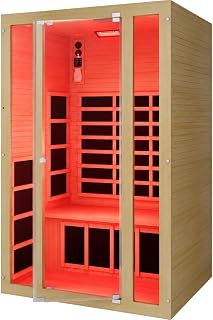 JNH Lifestyles Joyous+ 170°F 2-Person Infrared Sauna with RedCheck price on Amazon
Dry sauna vs wet sauna: key differences by type
The experience of heat in a home wellness space is dictated primarily by the moisture content of the air. While traditional dry saunas and far infrared cabins keep humidity low, wet steam rooms rely on boiling water to fill the enclosure with dense vapor. The table below outlines how these environments differ across construction, moisture, and plumbing requirements.
| Feature | Dry sauna (infrared or traditional) | Wet sauna (steam room) |
|---|---|---|
| Heat source | Far infrared carbon panels or electric stove with rocks | Dedicated steam generator or boiling water reservoir |
| Relative humidity | Dry ambient air with low moisture | Saturated air with heavy water vapor |
| Water supply | None required (optional water ladle on traditional stones) | Continuous plumbing line or manual steam reservoir |
| Drainage needs | Standard dry flooring; wipe sweat with a towel | Sloped waterproof floor and dedicated floor drain |
| Enclosure build | Modular wooden cabin or fabric tent on household floor | Sealed waterproof walls, ceiling vapor barrier, and tile |
| Electrical connection | Standard 110V to 120V household outlet on compact units | Dedicated high-power circuit for steam generators |
In direct maker listings for home infrared dry saunas, operating temperatures are stated up to 140 F or 149 F, using carbon heating panels to warm the body in dry air. Traditional dry saunas with electric or wood stoves run hotter, while wet steam rooms operate at lower air temperatures where high humidity keeps heat close to the skin.
Why dry heat and wet steam feel completely different
The physiological sensation of heat depends heavily on whether your sweat can evaporate. In a dry sauna, dry air absorbs moisture rapidly from your skin. Evaporation is your body’s primary mechanism for cooling, which allows you to sit comfortably in dry heat for the duration of a standard session. Our infrared vs traditional sauna guide breaks down how heating elements deliver warmth across different dry styles.
In a wet sauna or steam room, the air is completely saturated with moisture. Because the surrounding air cannot hold any more water vapor, sweat cannot evaporate from your skin. Heat remains trapped on your body, making the session feel substantially hotter and more intense despite a lower thermometer reading. Our detailed infrared sauna vs steam room comparison explores these physiological differences further.
Installation and electrical requirements compared
Installing a dry sauna in a home is far simpler than building a wet steam space. A compact dry cabin, such as the 32 by 34 by 67 inch footprint stated for Homsido, or a portable fabric tent with 19 stainless steel frame pipes can be placed on existing basement, gym, or bedroom flooring. Post-session cleanup involves only wiping sweat from the bench or footplate with a dry towel. A wet steam room, however, produces constant condensation that requires a fully sealed enclosure, a moisture-proof vapor barrier behind the walls to protect household framing from mold, and a dedicated floor drain for wastewater.
Electrical demands also favor dry home units. Compact wooden cabins in these listings publish power ratings such as 1200W on 110V or 120V lines, designed to plug directly into standard residential outlets without specialized high-voltage wiring. Portable fabric models omit heavy electrical requirements, though buyers should verify individual listing ratings before connecting. For wiring considerations, see our sauna electrical requirements guide.
Operating a dry sauna at home draws consistent power based on listed wattage. For detailed monthly electricity calculations and utility estimates, see our home sauna running cost guide.
Home dry saunas worth considering
These are scored on the Chill Score, which weighs performance 35, build 25, value 25, safety certifications 10 where it applies and warranty 5. None of these listings state an independent electrical safety certification such as UL or ETL, so all four score 0 for safety.
| Product | Chill Score | Perf. /35 | Build /25 | Value /25 | Safety /10 | Warranty /5 |
|---|---|---|---|---|---|---|
| Homsido Hemlock Cabin | 9.6 | 30 | 22 | 21 | 0 | 4 |
| OUTEXER Pine Cabin | 9.6 | 30 | 21 | 21 | 0 | 3 |
| Homsido Compact Cabin | 9.4 | 28 | 20 | 20 | 0 | 0 |
| MIXC Infrared Tent | 9.3 | 24 | 18 | 19 | 0 | 0 |
Scores run from 9.2 to 9.8: each product’s point total is placed on that range, so more points always means a higher score.
For dedicated steam options, see our best portable steam saunas roundup.
Choosing between dry and wet for your routine
- Evaluate your floor space: Dry wooden cabins and portable tents sit on any level interior floor without plumbing, whereas wet steam requires dedicated waterproof tile and drainage.
- Check circuit capacity: When choosing a dry cabin rated at 1200W on a 110V or 120V connection, ensure the circuit is not shared with other heavy appliances during use.
- Plan for cleanup: Dry units require only a quick towel wipe on seating and footplates after use, while steam enclosures require regular mold and mildew prevention.
- Prioritize heat style: Choose dry heat if you prefer lower humidity and dry air, or wet steam if you prefer warm vapor and an enveloping, humid environment.
- Respect session timers: Use built-in automatic timers, such as the 20 to 60 minute controls found on portable units, to manage session length responsibly.
Common mistakes
- Pouring water onto electrical heating panels or controls in a dry sauna to create artificial steam.
- Installing a wet steam enclosure in a standard room without installing a vapor barrier and sloped drain.
- Assuming dry and wet saunas require identical operating temperatures to achieve the same perceived warmth.
- Running a 1200W sauna on an overloaded circuit shared with other heavy household appliances.
- Neglecting to wipe away sweat immediately after sessions on water-painted or unfinished wood surfaces.
Common questions
Is a dry sauna hotter than a wet sauna?
It depends on the sauna type and how heat is transferred. Traditional dry saunas run at higher air temperatures than wet steam rooms, while far infrared dry cabins operate at moderate temperatures, with listings stating maximums up to 140 F or 149 F. Wet saunas feel intensely hot at lower air temperatures because saturated air prevents sweat evaporation, keeping warmth trapped against the body.
Can you turn a dry sauna into a wet sauna?
You cannot convert a dry infrared cabin or portable dry tent into a wet sauna. Adding water to carbon heating panels or electrical controls creates severe shock hazards and damages the equipment. While traditional rock stoves permit small ladles of water, true wet steam saunas require dedicated steam generators and fully waterproof enclosures.
Which is easier to install at home, dry or wet?
A dry sauna is significantly easier to install in a home. The dry units compared here use modular wooden panels or folding frames that assemble on standard flooring and plug into regular 110V or 120V household outlets. A wet sauna requires sealed waterproof walls, plumbing for water supply, and floor drainage to manage heavy condensation.
How much electricity does a home dry sauna use?
Compact dry cabins in these listings often draw 1200W on a standard 110V or 120V connection, though one model also references 1350W and portable tents may omit power ratings. This power level is comparable to a household appliance, allowing plug-in operation on existing residential circuits. Larger traditional saunas require high-voltage lines, but compact home units avoid specialized wiring.
How do you clean and maintain a dry sauna?
Maintenance on a dry sauna is straightforward because there is no standing steam or condensation. After each session, simply wipe down the bench, footplate, and interior wood with a clean, dry towel to remove sweat. Leaving the door open for a few minutes allows fresh air to circulate and keep the interior dry.
Sources: Amazon product listings for the home saunas named above, collected 13 October 2026. Related: our infrared sauna vs steam room guide, sauna electrical requirements, and home sauna running cost analysis.
Back to all sauna reviews.