Short answer
What is the difference between tri chip and dual chip red light?
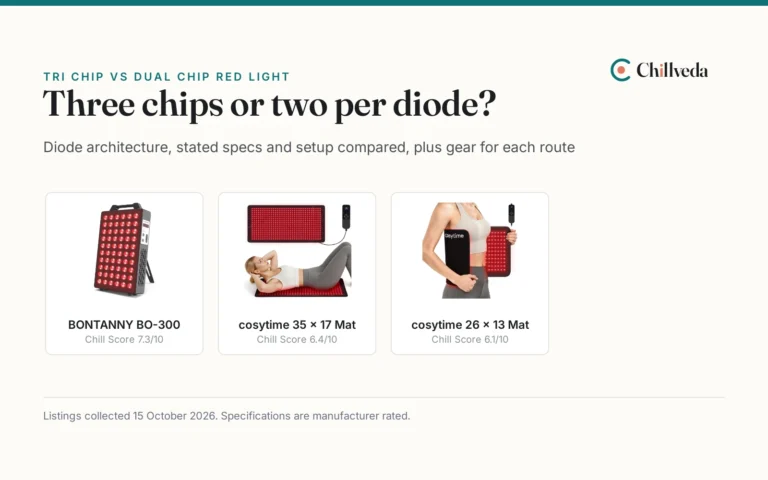
The technical difference is the number of semiconductor chips packaged inside each LED diode bead. A tri-chip LED houses three chips per bead, while a dual-chip LED houses two. In our comparison, the cosytime tri-chip examples pack three chips per bead for 1,089 or 1,536 total chips in flexible mats, while the BONTANNY dual-chip example uses 60 dual-chip LEDs in a 100-watt panel.
Side by side Choose tri chip red light if Choose dual chip red light if
Setting up red light therapy at home usually starts in the bedroom or living room, plugging into a standard wall outlet before an evening stretch or morning routine. Choosing between tri chip vs dual chip red light comes down to diode chip density, wavelength ratios per bead, and how each device delivers light to your body. In the listings compared here, tri-chip diodes (three chips per bead) are featured in flexible mats that hold up to 1,536 chips in close contact, while dual-chip diodes (two chips per bead) power a rigid tabletop panel rated at 100 watts and 131 mW/cm² at 6 inches. Choose the tri-chip mats if you want flexible contact coverage across larger muscle groups, or choose the dual-chip panel if you want a freestanding unit with published wattage and stated irradiance.
This head-to-head comparison breaks down diode architecture, stated power, coverage, and daily setup needs using published Amazon listing data. Listings were collected 15 October 2026.
This article is informational and is not medical advice. Red light and near-infrared devices produce intense light that can harm unprotected vision, so always wear proper eye protection during use. Consult a healthcare provider before using light therapy if you have light sensitivity, take photosensitizing medications, or are pregnant. See our Medical Disclaimer and our red light therapy eye safety guide.
Chillveda earns a commission when you buy through links on this page, at no extra cost to you. As an Amazon Associate I earn from qualifying purchases. Affiliate disclosure.
Quick picks
-
1
 BONTANNY Red Light Therapy Chill Score 9.5/10Check price on Amazon
A 100W tabletop dual-chip red light panel delivering a manufacturer-rated 131 mW/cm² at 6 inches with a 3-year warranty.
-
2
 Red Light Therapy for Body Chill Score 9.4/10Check price on Amazon
A 35 by 17 inch flexible red light mat with 512 tri-chip LEDs packing 1,536 chips for wide body coverage.
-
3
 Red Light Therapy for Body Chill Score 9.3/10Check price on Amazon
A 26 by 13 inch flexible tri-chip red light mat with 363 LED beads holding 1,089 chips and an elastic strap.

A 100W tabletop dual-chip red light panel delivering a manufacturer-rated 131 mW/cm² at 6 inches with a 3-year warranty.
Pros & ConsViewHide
Pros
- 60 dual-chip LEDs deliver 100 watts of stated power
- Manufacturer-rated irradiance of 131 mW/cm² at 6 inches
- Metal housing with cooling fan and adjustable table stand
- 3-year manufacturer warranty stated
Cons
- Remote control requires a 23A 12V battery that is not included
- Smaller coverage area of 14 by 12 inches at 6 inches
- Rigid 7.9-pound metal frame cannot wrap around limbs
- No electrical safety certification stated on the listing
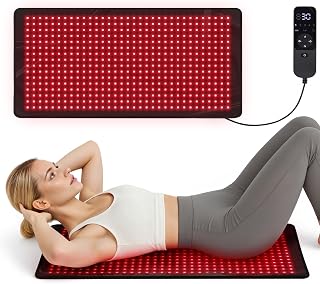
A 35 by 17 inch flexible red light mat with 512 tri-chip LEDs packing 1,536 chips for wide body coverage.
Pros & ConsViewHide
Pros
- 512 tri-chip LEDs pack 1,536 total chips across 660nm and 850nm
- Expansive 35 by 17 inch surface blankets full back or legs
- 4 operating modes including a 10Hz pulsed setting and 5 intensity levels
- Integrated auto-shutoff timer for routine management
Cons
- Wattage and power consumption are not stated on the listing
- Manufacturer-rated irradiance number is not stated
- No warranty term stated on the listing
- No safety certifications such as UL or ETL listed

A 26 by 13 inch flexible tri-chip red light mat with 363 LED beads holding 1,089 chips and an elastic strap.
Pros & ConsViewHide
Pros
- 363 tri-chip LEDs provide 1,089 chips across red and NIR
- Adjustable elastic strap secures pad directly around waist or limbs
- 4 modes including 10Hz pulse and 5 intensity adjustments
- Auto-shutoff timer for hands-free session control
Cons
- Wattage and power consumption are not stated on the listing
- No irradiance figure provided in manufacturer specifications
- No warranty term stated on the listing
- No safety certifications such as UL or ETL listed
More to compare
 Red Light TherapyCheck price on Amazon
 Red Light Hair Growth CapCheck price on Amazon
 Red Light Therapy for FeetCheck price on Amazon
Tri chip vs dual chip red light at a glance
| Feature | Tri-chip (cosytime listings) | Dual-chip (BONTANNY listing) |
|---|---|---|
| Chips per LED bead | 3 chips per bead (660nm and 850nm) | 2 chips per bead (660nm and 850nm) |
| Diode configuration | 363 or 512 tri-chip LEDs | 60 dual-chip LEDs |
| Total chips in matrix | 1,089 to 1,536 chips | Not stated as total chip matrix |
| Device format | Flexible mat with strap | Table mount metal panel |
| Operating distance | Close contact per listing | 6 inches per listing |
| Stated irradiance | Not stated on listing | 131 mW/cm² at 6 inches |
| Stated wattage | Not stated on listing | 100 watts |
| Coverage area | 26 x 13 in or 35 x 17 in | 14 x 12 inches at 6 inches |
| Warranty term | No term stated | 3-year manufacturer warranty |
Diode counts, irradiance, and electrical specs
The core technical difference between these designs is how individual LED beads are built. A tri-chip LED integrates three semiconductor chips into a single diode package. In the cosytime examples, each bead combines red light chips at 660nm and near-infrared chips at 850nm. The smaller mat pairs 363 red chips with 726 near-infrared chips for 1,089 chips across 363 beads, while the larger mat packs 512 red chips and 1,024 near-infrared chips for 1,536 chips across 512 beads. In contrast, the BONTANNY dual-chip panel uses 60 dual-chip LED beads across the same 660nm and 850nm wavelengths. Read our guide to red light wavelengths for more on these bands.
A higher chip count on a mat does not necessarily mean higher optical delivery than a powered panel. In these listings, the BONTANNY example publishes an operating wattage of 100 watts and a manufacturer-rated irradiance of 131 mW/cm² at 6 inches, focused through 60-degree beam angles. Read our guide on how to read a red light irradiance number to see how distance and beam angles shape delivered light. Meanwhile, the cosytime mat listings leave both wattage and irradiance unstated, so their output cannot be compared directly or declared higher or lower from published specs.
Electrical requirements and operating specs also separate these two formats. The BONTANNY listing states a 100-watt power rating operating on a standard 110-volt power cord measuring 1.8 meters in length. The panel is designed for sessions lasting from 1 to 30 minutes, with the manufacturer recommending 15 minutes a day. Having a published 100-watt specification confirms the device connects to typical household wall outlets without dedicated circuits. In contrast, the cosytime mat listings leave operating wattage, voltage, and electrical power draw completely unstated, so their electrical requirements cannot be confirmed from manufacturer data.
Cost, space, and setup
The cosytime examples use flexible pads that offer compact storage and setup flexibility. The 26 by 13 inch mat weighs 2.36 pounds in its box, while the 35 by 17 inch mat weighs 3.31 pounds. Both use adjustable elastic straps to wrap around the torso, lower back, or legs, allowing you to recline on a sofa or bed. When finished, they roll up to fit into a closet shelf or drawer. Explore our red light therapy mats roundup for more wrap options.
The BONTANNY BO-300 example requires a dedicated tabletop surface. Built from metal with a painted finish, it measures 13.2 by 8.7 by 2.4 inches and weighs 7.9 pounds. It includes an adjustable table stand that props the light on a desk or table, with the maker specifying a 6-inch operating distance. Powered by a 1.8-meter power cord plugged into a 110V outlet, it offers a freestanding setup rather than a wrap. Compare it with larger units in our full body red light panels and targeted red light devices guides.
Upkeep and maintenance
Because the cosytime mats wrap in close contact against the body, regular cleaning keeps their surface fresh. Upkeep involves wiping down the lining with a damp cloth and mild soap after use. Never submerge the pads or sharply fold the internal wiring. Storing the pad flat or loosely rolled protects the connections across the 363 or 512 LED beads.
The BONTANNY tabletop panel operates at a distance, avoiding body contact and simplifying surface care. Routine maintenance involves dusting the metal casing and keeping cooling fan vents clear of obstruction. The unit includes a remote control, which requires an owner-supplied 23A 12V battery.
Gear for each route
These are scored on the Chill Score: performance 35, build 25, value 25, safety certifications 10 where it applies and warranty 5. None states a UL or ETL listing, so all score 0 for safety.
| Product | Chill Score | Perf. /35 | Build /25 | Value /25 | Safety /10 | Warranty /5 |
|---|---|---|---|---|---|---|
| BONTANNY BO-300 | 9.5 | 28 | 21 | 20 | 0 | 3 |
| cosytime 35 x 17 Mat | 9.4 | 27 | 19 | 19 | 0 | 0 |
| cosytime 26 x 13 Mat | 9.3 | 24 | 18 | 19 | 0 | 0 |
Scores run from 9.2 to 9.8: each product’s point total is placed on that range, so more points always means a higher score.
Choose tri chip red light if
- You want higher chip density per bead with three chips combining 660nm and 850nm in every diode.
- You want a two-to-one ratio of near-infrared to red chips across the matrix (such as 726 or 1,024 NIR chips).
- You prefer the flexible wrap format of the cosytime examples for close-contact coverage over a back or legs.
- High chip counts (1,089 to 1,536 chips) suit your routine and you do not require a published irradiance spec.
Choose dual chip red light if
- You want dual-chip diodes pairing 660nm and 850nm wavelengths in a focused tabletop panel.
- You want a published 100-watt power rating and manufacturer-rated irradiance of 131 mW/cm² at 6 inches.
- You prefer the freestanding metal construction, cooling fan, and table stand of the BONTANNY example.
- A concrete 3-year manufacturer warranty is essential for your purchase decision.
Check Your Space First
- Power access: The BONTANNY panel requires a 110V outlet within reach of its 1.8-meter power cord; ensure your tabletop has an accessible outlet that avoids stretching cords across walkways.
- Desktop clearance: The BONTANNY metal panel measures 13.2 by 8.7 by 2.4 inches and weighs 7.9 pounds, requiring a flat desk surface with at least 6 inches of clearance between the device and your seat.
- Reclining area: The cosytime mats measure 26 by 13 inches and 35 by 17 inches, needing open couch, bed, or floor space so you can lie flat while strapped into the pad.
- Storage room: The cosytime mats pack into cartons measuring 13.54 by 6.02 by 3.62 inches (2.36 pounds) and 17.8 by 11.42 by 3.82 inches (3.31 pounds), fitting easily inside standard linen closets or drawers.
Common questions
What is the difference between tri chip and dual chip red light?
The technical difference is the number of semiconductor chips packaged inside each LED diode bead. A tri-chip LED houses three chips per bead, while a dual-chip LED houses two. In our comparison, the cosytime tri-chip examples pack three chips per bead for 1,089 or 1,536 total chips in flexible mats, while the BONTANNY dual-chip example uses 60 dual-chip LEDs in a 100-watt panel.
Does a higher chip count mean higher red light irradiance?
Not necessarily. Delivered irradiance depends on driver wattage, electrical efficiency, and optical beam angles, not just the number of chips in the matrix. The BONTANNY dual-chip panel lists 100 watts and a manufacturer-rated irradiance of 131 mW/cm² at 6 inches with 60-degree lenses. Because the cosytime tri-chip mat listings do not publish wattage or irradiance figures, their output cannot be assumed to be higher or lower.
Can red light devices be used directly against the skin?
Direct skin contact depends on device design rather than the chip configuration itself. The cosytime tri-chip mats are built with flexible linings and elastic straps specifically for close contact on the back, waist, or legs. Tabletop panels like the BONTANNY dual-chip model require a 6-inch distance because they use high-power LEDs and an active cooling fan that needs clear airflow.
What wavelengths do these tri-chip and dual-chip devices deliver?
All three models feature a combination of 660nm red light and 850nm near-infrared light. The 660nm wavelength delivers visible red light to surface tissues, while 850nm near-infrared light reaches deeper structures. The cosytime tri-chip mats combine red and near-infrared chips in a two-to-one near-infrared ratio per bead, while the BONTANNY dual-chip panel pairs both wavelengths across its 60 LEDs.
What are the electrical requirements for a 100W red light panel?
The BONTANNY panel operates on 110 volts and draws 100 watts through its included 1.8-meter power cord, connecting directly to a standard household wall outlet without special wiring. The maker suggests sessions of 15 minutes a day, adjustable between 1 and 30 minutes with the timer. In contrast, the cosytime mat listings leave electrical wattage and operating voltage unstated.
Back to all red light therapy reviews.