Short answer
Is a digital pool thermometer more accurate than a floating analog thermometer?
Digital pool thermometers generally state higher precision, such as the ±0.9°F accuracy tolerance published for the GoveeLife P1. Budget analog floaters rarely state an accuracy tolerance and rely on visual alignment with printed degree marks. However, a digital thermometer depends on fresh batteries and intact waterproof seals to maintain its accuracy.
When you step out to your patio or garage tub for an early morning cold dip, knowing the exact water temperature before getting in makes all the difference. Choosing between a floating thermometer vs digital pool thermometer comes down to convenience and reading speed: an analog floating thermometer is an unpowered, battery-free gauge that you read at water level after a couple of minutes, while a digital pool thermometer uses submerged electronic sensors and, on wireless models, beams real-time readings to an indoor screen or phone app. For quick dip checks on a simple tub, an analog floater does the job, but if you want continuous monitoring or alerts from inside the house without lifting the tub cover, a digital model is worth the upgrade.
This guide compares how analog floating dials and wireless digital gauges work in home plunge tubs and pools, how immersion depth and placement affect accuracy, and two floating models evaluated from published specs. Listings were collected 13 October 2026.
This article is informational and is not medical advice. Cold water immersion triggers cold shock and afterdrop. Never plunge alone, and avoid cold immersion if you are pregnant, unwell, or have a cardiovascular condition without consulting a doctor first. Exit immediately if you feel dizzy, numb, or disoriented. See our Medical Disclaimer.
Chillveda earns a commission when you buy through links on this page, at no extra cost to you. As an Amazon Associate I earn from qualifying purchases. Affiliate disclosure.
Quick picks
-
1
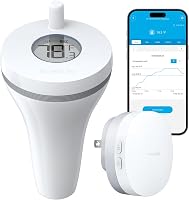 GoveeLife WiFi Pool Thermometer P1 Chill Score 9.6/10Check price on Amazon
A digital floating pool thermometer with a 328 foot Wi-Fi gateway, IPX7 waterproofing, and a stated temperature range from -4 to 158 F.
-
2
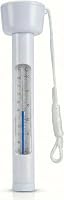 Pool Thermometer Floating Chill Score 9.3/10Check price on Amazon
A 7.5 inch analog floating plastic thermometer with a tether string that reads up to 120 F and 50 C on dual scales.

A digital floating pool thermometer with a 328 foot Wi-Fi gateway, IPX7 waterproofing, and a stated temperature range from -4 to 158 F.
Pros & ConsViewHide
Pros
- Stated accuracy of plus or minus 0.9 F
- Wide range from -4 to 158 F with 2 second refresh
- Includes Wi-Fi gateway with up to 328 ft range
- Rated IPX7 waterproof and includes fixed rope
Cons
- Requires 2.4 GHz Wi-Fi network only
- Gateway must stay clear of obstacles for stable signal
- Powered by 2 AAA batteries that need eventual replacement
- 1-year service support rather than a formal warranty
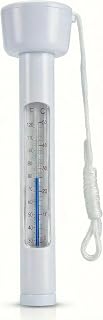
A 7.5 inch analog floating plastic thermometer with a tether string that reads up to 120 F and 50 C on dual scales.
Pros & ConsViewHide
Pros
- Simple floating analog gauge with tether string
- Dual scale display reads up to 120 F and 50 C
- Shatter-resistant plastic body 7.5 inches long
- Mechanical operation requires no batteries or app setup
Cons
- No warranty term is stated
- Spec table contains contradictory solar and battery entries
- Takes 1 to 2 minutes in water to settle before reading
- No stated accuracy tolerance or lower temperature limit
More to compare
 XY-WQ Flamingo Floating Pool Thermometer with StringCheck price on Amazon
 XY-WQ Puffer Floating Pool Thermometer with StringCheck price on Amazon
 XY-WQ 2 Pack Floating Pool ThermometersCheck price on Amazon
 XY-WQ Turtle Floating Pool Thermometer with StringCheck price on Amazon
 Floating Pool ThermometerCheck price on Amazon
 Pool Thermometer Floating Easy ReadCheck price on Amazon
Floating thermometer vs digital pool thermometer: key differences
| Feature | Analog floating pick (Inpool FPTF) | Digital wireless pick (GoveeLife P1) |
|---|---|---|
| Sensor mechanism | Internal liquid column or bimetal coil | Submerged digital thermistor sensor |
| Reading location | Directly on floating dial at water level | Remote app, indoor gateway, or on-body LCD |
| Stated response time | 1 to 2 minutes submerged to settle | 2 seconds rapid refresh |
| Stated temperature range | Up to 120 F (50 C) | -4 F to 158 F |
| Stated accuracy | Not stated in listing | Plus or minus 0.9 F |
| Power source | None (mechanical) | 2 AAA batteries (1 to 3 year life) |
| Connectivity | None (manual visual check) | 433 MHz RF and 2.4 GHz Wi-Fi |
| Data tracking | None | 20-day app graph and 2-year history export |
The operational gap between these two thermometer styles is significant. Analog floaters rely on physical liquid expansion or mechanical indicators that adjust slowly to water temperature changes. Digital monitors integrate electronic thermistors that take rapid readings, and connected models can transmit data through radio frequencies or home Wi-Fi to remote displays and apps. While an analog gauge requires walking to the water, wireless digital units allow you to check readiness before stepping outdoors.
Why digital and analog gauges read water differently
An analog floating thermometer needs sufficient contact time for its outer plastic body and internal column to reach thermal equilibrium with the surrounding liquid. The Inpool listing, for example, states a settlement time of 1 to 2 minutes before the reading stabilizes. If you pull the gauge out of the water to read the scale in dim light, ambient air immediately begins changing the reading, which can lead to false numbers.
Digital pool thermometers reduce that lag with electronic sensors that update rapidly, with the GoveeLife listing publishing a 2-second response time. When a floating sensor features a submerged probe, such as the 5.9-inch immersion depth listed for the GoveeLife P1, it captures water slightly below the surface film. Thermal stratification happens quickly when tubs sit covered between dips. See our guide on cold plunge water care for maintaining water quality and circulation.
Where you measure changes the water reading
Water temperature is not uniform across a tub or pool. Surface water exposed to direct sunshine or cool ambient air can differ by several degrees from the water near the floor. A floating thermometer that sits high on the surface often reads warmer on a sunny afternoon than what your legs feel once submerged. For the most consistent reading, choose a model whose sensor reaches below the surface layer.
Water currents also influence readings. If you anchor a floater right beside a chiller return or water filter outlet, it reflects localized flow rather than average tub conditions. Both models evaluated below include tether cords so you can secure them in a neutral zone away from direct jets.
Floating pool thermometers worth checking
These are scored on the Chill Score, which weighs performance 35, build 25, value 25, safety certifications 10 where it applies and warranty 5. Thermometers carry no safety listing, so both score 0 for safety.
| Product | Chill Score | Perf. /35 | Build /25 | Value /25 | Safety /10 | Warranty /5 |
|---|---|---|---|---|---|---|
| GoveeLife P1 Digital | 9.6 | 32 | 20 | 20 | n/a | 1 |
| Inpool FPTF Analog | 9.3 | 21 | 16 | 19 | n/a | 0 |
Scores run from 9.2 to 9.8: each product’s point total is placed on that range, so more points always means a higher score. Safety counts only for powered gear or where the listing states safety features; where it does not apply, the score is taken over the remaining 90 points.
For more choices, including submersible wired sensors, see our best cold plunge thermometers roundup.
Measuring water temperature in practice
- Allow settlement time for analog gauges. The Inpool listing recommends 1 to 2 minutes submerged in the water for the gauge to settle before taking a reading. Do not pull the gauge out into warm air and hesitate, as ambient air starts shifting the reading immediately.
- Check your Wi-Fi frequency before setup. Smart monitors like the GoveeLife P1 require a 2.4 GHz Wi-Fi network and a clear line of sight to the RF gateway within its 328-foot maximum range.
- Secure the tether string. Both analog and digital floaters come with a cord. Tie it to an edge handle away from direct chiller returns so the sensor stays in open, circulating water rather than drifting into stagnant corners.
- Verify immersion depth. Surface water fluctuates faster than deeper water. A design like the GoveeLife P1, with a listed 5.9-inch immersion depth, reaches deeper than shallow surface caps to measure closer to body depth.
- Inspect casing seals before each dip. Waterproof digital floaters rely on tight seals. Ensure the casing is securely fastened, as noted on the GoveeLife listing, to protect internal electronics and battery compartments from water intrusion.
Common mistakes
- Leaving a floating thermometer in direct sunlight and trusting the surface reading as the true plunge temperature.
- Lifting an analog gauge out of cold water and taking several seconds to read the dial while air warms it.
- Assuming a spec table listing for solar power or batteries is correct when the product is an unpowered analog gauge.
- Placing a wireless gateway behind thick concrete or metal walls that block the 433 MHz radio signal.
Common questions
Is a digital pool thermometer more accurate than a floating analog thermometer?
Digital pool thermometers generally state higher precision, such as the ±0.9°F accuracy tolerance published for the GoveeLife P1. Budget analog floaters rarely state an accuracy tolerance and rely on visual alignment with printed degree marks. However, a digital thermometer depends on fresh batteries and intact waterproof seals to maintain its accuracy.
How long does an analog floating thermometer take to read?
Analog floating gauges typically require 1 to 2 minutes submerged, as stated on the Inpool listing, allowing the internal fluid or mechanical coil to match the water temperature. Lifting the unit out into warm ambient air can cause the reading to shift rapidly. For the most reliable check, read the dial while the probe remains submerged in the tub.
Can a floating pool thermometer stay in a cold plunge tub all winter?
Floating thermometers can remain in cold water down to their published limits, such as the -4°F rating on the GoveeLife sensor. However, expanding solid ice can crack plastic casings or damage waterproof seals. If your plunge tub begins freezing solid at the surface, store the thermometer inside until the water is fully liquid.
Do digital pool thermometers work through insulated plunge covers?
Radio frequency gateways using 433 MHz can usually transmit through standard foam plunge covers, but dense metal shielding or thick concrete can attenuate the signal. The GoveeLife P1 gateway lists a line-of-sight range of up to 328 feet, which decreases around walls and metal enclosures. Keeping the gateway near a window facing your tub helps maintain a steady link.
Why does my floating thermometer read warmer than the chiller setting?
Water stratifies inside a tub when circulation is off, leaving warmer water at the surface where floaters rest. Ambient sunlight warming the floating casing can also elevate the dial reading above the deeper water. Stirring the water before measuring mixes the thermal layers, giving a representative reading of the bulk water without placing the gauge directly in a localized return stream.
Sources: Amazon product listings for the thermometers named above, collected 13 October 2026. Related: our cold plunge safety guide and best cold plunge covers.
Back to all cold plunge reviews.