Short answer
What is the main difference between sauna stones and ceramic stones?
Sauna stones are quarried natural rocks, such as Finnish olivine or volcanic lava stone, featuring irregular shapes and porous surfaces. Ceramic stones are manufactured synthetic pieces engineered into uniform shapes like cylinders or spheres. Natural stones provide traditional, soft steam when ladling water, while ceramic stones promote consistent convective airflow through the heater.
Side by side Choose sauna stones if Choose ceramic stones if
When you step into your home sauna at the end of the day, the heat radiating from the heater basket shapes the entire session. Choosing between sauna stones vs ceramic stones comes down to whether you prefer the traditional feel and heat retention of natural quarried rock or the uniform sizing and durability of engineered ceramic media. Choose natural sauna stones if you want authentic quarried minerals that hold heat for rich löyly; choose ceramic stones if you want manufactured shapes that provide predictable airflow and resist crumbling over time.
This comparison covers heat retention, steam generation, airflow, heater element safety and upkeep, using current retail listings as concrete examples. Listings were collected 13 October 2026.
This article is informational and is not medical advice. High heat creates risks of overheating and dehydration. Never use a sauna under the influence of alcohol, avoid sessions during pregnancy, and consult a physician if you have cardiovascular conditions. Ensure heaters and controls carry recognized UL or ETL electrical listings. See our Medical Disclaimer.
Chillveda earns a commission when you buy through links on this page, at no extra cost to you. As an Amazon Associate I earn from qualifying purchases. Affiliate disclosure.
Quick picks
-
1
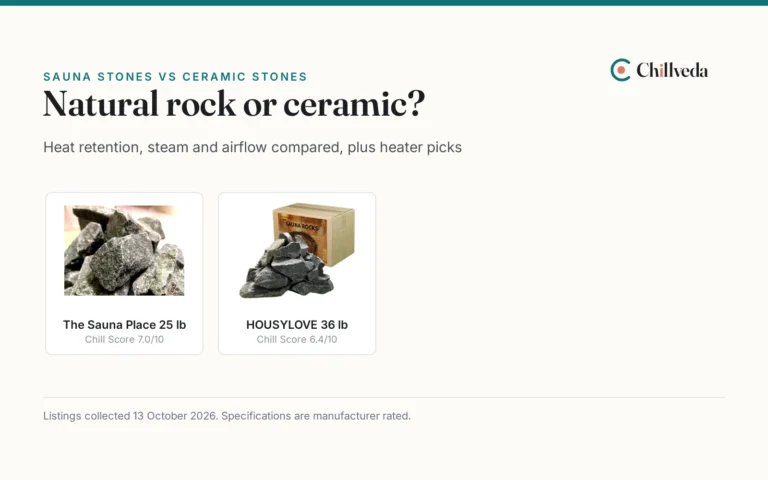
 The Sauna Place 25 LB Box of Replacement Sauna Chill Score 9.5/10Check price on Amazon
A 25-pound box of Finnish olivine stones listed for wet or dry home sauna heaters.
-
2
 Sauna Rocks Stones for Sauna Heater in Steam Room Chill Score 9.4/10Check price on Amazon
A 35.5 to 36-pound pack of volcanic lava stones in assorted sizes for indoor or outdoor sauna stoves.

A 25-pound box of Finnish olivine stones listed for wet or dry home sauna heaters.
Pros & ConsViewHide
Pros
- Sourced from Finland per the listing
- Olivine stone noted for density and heat retention
- Listed for both wet and dry saunas
- 25-pound package weight matches between title and spec table
Cons
- No individual stone dimensions stated
- No safety certifications listed
- No warranty term is stated
- Single weight option in this box

A 35.5 to 36-pound pack of volcanic lava stones in assorted sizes for indoor or outdoor sauna stoves.
Pros & ConsViewHide
Pros
- Assorted rock sizes from small to large stated
- Volcanic lava rock listed for high temperature resistance
- Listed for both indoor and outdoor saunas
- Large surface area for watering stated
Cons
- Weight contradiction between 36 lb in title and 35.5 pounds in spec table
- Requires washing stones before use per listing
- Must run steam room empty on initial cycle to avoid smell or crack
- No warranty term is stated
More to compare
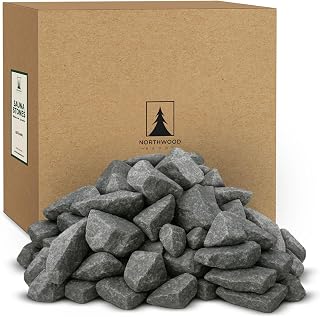 Northwood SaunaCheck price on Amazon
 Sauna Rocks Stones for Sauna Heater in Steam RoomCheck price on Amazon
Sauna stones vs ceramic stones at a glance
| Sauna stones | Ceramic stones | |
|---|---|---|
| Material source | Quarried natural rock (such as olivine or lava) | Manufactured refractory ceramic |
| Shape and uniformity | Irregular natural pieces | Uniform engineered shapes |
| Steam release | Retains water on mineral surfaces for soft steam | Vaporizes water across engineered surfaces |
| Airflow around elements | Depends on packing density and rock sizes | Open channels between uniform pieces |
| Durability over time | Subject to eventual weathering and crumbling | Engineered to resist thermal fracturing |
| Initial preparation | Varies by supplier (some specify washing) | Varies by manufacturer instructions |
| Heater compatibility | Standard for electric and wood sauna heaters | Compatible where heater makers permit alternative media |
| Appearance | Traditional rugged rock appearance | Uniform, modern geometric appearance |
Heat retention, steam and airflow
The primary role of any sauna heating medium is absorbing thermal energy from the heating elements and transferring it into the room, while providing a hot surface for water vaporization. Natural sauna stones, such as the Finnish olivine in The Sauna Place listing, are prized for high density and capacity to store heat. The rough, irregular surfaces of natural rocks capture water droplets and hold moisture until it vaporizes, creating the soft, humid burst of steam known as löyly.
Ceramic stones are manufactured from refractory ceramic materials molded into uniform shapes, such as cylinders or grooved spheres. Because ceramic pieces have consistent dimensions, they stack in an open matrix that leaves defined channels throughout the heater cavity. This geometric regularity allows air to circulate around electric heating elements, helping distribute convective heat through the sauna room. When water is ladled over ceramic media, vaporization occurs across the engineered surfaces, though the feel of the steam can differ from the traditional mineral heat of natural quarried rock.
Durability, maintenance and heater safety
The main practical distinction between these two media over time is how they respond to repeated heating and cooling. Natural quarried rock can develop internal stress from repeated expansion and contraction. Over extended periods of regular use, mineral stones can gradually weather, shed dust, or develop cracks. In the HOUSYLOVE listing, for example, the maker directs users to wash the stones before installation and run the steam room empty on the initial cycle to avoid odor or cracking. The Sauna Place listing does not specify washing or pre-burn steps for its Finnish olivine rock, showing that preparation guidelines vary between suppliers. When natural rock does degrade over time, settling debris can restrict airflow around electric heating elements.
Ceramic media is engineered specifically to withstand repeated thermal cycling without shedding mineral dust. Because ceramic pieces have uniform composition throughout, they do not contain the natural grain lines or hidden fissures found in quarried stone. As a result, ceramic media resists crumbling between heating elements, which helps maintain consistent airflow over extended periods.
Installation needs, volume and weight
Sauna stones and ceramic media do not draw electrical power on their own, so electrical specifications are not stated in these stone listings. Electric sauna heaters that hold these stones operate on dedicated circuits, where amperage equals wattage divided by voltage (amps = W / V). For complete electrical wiring considerations, see our sauna electrical requirements guide, and browse compatible heating units in our sauna heaters review.
Physical dimensions and weight determine how media fits into your heater tray. The HOUSYLOVE listing provides package dimensions of 13.78 by 9.06 by 7.48 inches, containing 35.5 pounds of rock according to its spec table, or 36 LB per its title, and notes an assortment of rock sizes. The Sauna Place example supplies 25 pounds in a single box, though its package dimensions and individual stone sizes are not stated. When loading natural stones of mixed sizes, larger pieces are placed loosely at the bottom to allow air passage, whereas uniform ceramic pieces stack without sorting.
Upkeep and replacement cycles
Upkeep routines reflect the physical characteristics of each material. Natural sauna stones benefit from periodic inspection. Over time, sauna owners check the rock compartment, remove cracked or weathered pieces, rinse off settled dust, and add replacement rocks as needed. See our sauna stones roundup for replacement options.
Ceramic media requires less frequent replacement because it resists crumbling into sediment. Periodic maintenance generally involves checking that the pieces remain properly seated in the basket and that airflow channels remain unobstructed.
Gear for each route
These are scored on the Chill Score: performance 35, build 25, value 25, safety certifications 10 where it applies and warranty 5. Neither listing states a UL or ETL certification, so both score 0 for safety.
| Product | Chill Score | Perf. /35 | Build /25 | Value /25 | Safety /10 | Warranty /5 |
|---|---|---|---|---|---|---|
| The Sauna Place 25 lb | 9.5 | 29 | 21 | 20 | 0 | 0 |
| HOUSYLOVE 36 lb | 9.4 | 27 | 19 | 19 | 0 | 0 |
Scores run from 9.2 to 9.8: each product’s point total is placed on that range, so more points always means a higher score.
Choose sauna stones if
- You value authentic natural minerals and traditional Finnish sauna character.
- You want quarried rock options such as Finnish olivine or volcanic lava stone.
- You are comfortable inspecting stones periodically and replacing weathered pieces over time.
- Your heater manufacturer recommends natural quarried rock for its warranty terms.
Choose ceramic stones if
- You want uniform piece shapes that create predictable, open airflow channels around heater elements.
- You want media engineered to resist thermal cracking and spalling over extended use.
- You want to minimize rock dust and small mineral fragments falling into your heater tray.
- Your heater manufacturer permits alternative manufactured media in the rock basket.
Check Your Space First
- Check that your storage shelf or sauna bench can support boxed rock weights; the Sauna Place example weighs 25 pounds in a single box, while the HOUSYLOVE box lists 35.5 pounds in its spec table.
- Verify floor and shelf clearance for storage; the HOUSYLOVE package lists dimensions of 13.78 by 9.06 by 7.48 inches before unpacking.
- Check the rock capacity of your heater basket; loading a 25-pound box like the Sauna Place listing or up to 36 LB like the HOUSYLOVE option requires confirming your heater manufacturer’s recommended load limits.
- Ensure your heater wiring and clearances conform to manufacturer requirements before loading stones around the heating elements; neither listing states cord or plug specifications for loose stone.
Common questions
What is the main difference between sauna stones and ceramic stones?
Sauna stones are quarried natural rocks, such as Finnish olivine or volcanic lava stone, featuring irregular shapes and porous surfaces. Ceramic stones are manufactured synthetic pieces engineered into uniform shapes like cylinders or spheres. Natural stones provide traditional, soft steam when ladling water, while ceramic stones promote consistent convective airflow through the heater.
Can you use ceramic stones in any sauna heater?
Most electric sauna heaters can accommodate ceramic stones if the heater manufacturer permits alternative media. However, some heater warranties require specific natural rocks, such as olivine or peridotite, to protect heating elements. Always check your heater manual before replacing natural rocks with ceramic media.
Do ceramic stones produce good steam?
Yes, ceramic stones absorb and radiate heat efficiently, generating steam when water is poured over them. However, because their surface texture and density differ from natural quarried rock, the steam release can feel faster than the gradual evaporation from porous natural minerals like olivine. Some sauna owners place ceramic pieces near the bottom for airflow and top them with natural stones for steam.
How often do sauna stones need to be replaced?
Natural stones gradually degrade, fissure and shed dust due to repeated heating and cooling cycles. Experienced sauna owners inspect their stones periodically and replace crumbled pieces to prevent element damage. Ceramic stones resist thermal degradation longer, reducing the frequency of total replacements.
Do you need to wash new sauna stones before using them?
It depends on the product guidelines. For example, the HOUSYLOVE listing explicitly directs users to wash the stones before loading to clear dust, while The Sauna Place listing states no washing directions. Rinsing natural rocks before initial use is generally recommended to remove loose quarry dust from heating elements.
Back to all sauna reviews.